


China Fiber Laser Metal Cutting Machine Buying Guide: Cost, Suppliers, Service & Shipping
 2026-09-29
WHAT ARE YOU LOOKING FOR?
Search Across Products, Blog Posts, Support Content, And Resources.

China Fiber Laser Metal Cutting Machine Buying Guide: Cost, Suppliers, Service & Shipping
2026-09-29

Buying a fiber laser cutting machine from China can give buyers access to a wide range of machine sizes, power levels, configurations, and price points. The challenge is that two machines advertised with the same laser power can differ significantly in components, cutting performance, automation, service, and total delivered cost.
This guide focuses on the full purchasing process—from choosing the right machine and supplier to comparing quotes, reviewing contracts, arranging shipping, and confirming installation and after-sales support.
Quick Answer: Before buying a fiber laser cutting machine from China, confirm the machine type, laser power, working area, supplier type, configuration, cutting performance, machine cost, warranty, spare parts, shipping terms, installation, training, and purchase-contract responsibilities.
| What to Check | What You Need to Confirm |
|---|---|
| Machine Type | Sheet, tube, sheet-and-tube, single table, exchange table, open or enclosed |
| Laser Power | Power required for your regular materials and thicknesses—not only occasional maximum jobs |
| Working Area | Sheet size, maximum part size, nesting requirements, and available floor space |
| Supplier Type | Manufacturer, trading company, or local distributor—and who is responsible for technical support |
| Machine Configuration | Laser source, cutting head, motion system, control software, safety features, and included accessories |
| Cutting Performance | Results on your own material, thickness, and part drawings |
| Machine Cost | Base price plus optional equipment and accessories |
| Warranty & Service | Warranty scope, technical support, local service, and response process |
| Spare Parts | Availability, stock location, lead time, and replacement cost |
| Shipping | EXW, FOB, CIF, DDP, packaging, freight, customs, and import responsibility |
| Installation & Training | Who installs the machine, who trains operators, and what costs are included |
| Purchase Contract | Final configuration, payment terms, delivery, acceptance, warranty, and service responsibilities |
Key points to confirm before buying a fiber laser cutting machine from China.
When comparing quotations, make sure each supplier is quoting against the same application requirements and a comparable machine configuration. Differences in components, included accessories, service, shipping terms, and installation responsibilities can significantly affect both the initial price and the final cost of putting the machine into production.
China is one of the most competitive markets for fiber laser cutting machines, offering a broad range of machine sizes, power levels, configurations, and automation options at different price points. This combination of choice and competitive pricing is why many businesses source laser cutting equipment from China.
However, buyers can easily focus too much on the quoted machine price. The real purchase extends well beyond delivery. Shipping, installation, training, spare parts, warranty, and technical support all affect how smoothly the machine can be put into production and kept running.
After-sales service is especially important when buying overseas. Buyers should confirm whether remote technical support is available, whether there are local technicians or service partners, and how quickly replacement parts can be supplied. A lower purchase price becomes less attractive if a relatively small problem results in extended downtime.
Buying from China can be a good option when you have clear production requirements and can properly evaluate both the machine and the supplier. It is particularly suitable when:
A local supplier may be more suitable when your team has limited experience with fiber laser equipment, fast on-site service is critical, or production cannot tolerate long downtime.
Although the initial price may be higher, local installation, training, technicians, and spare-parts availability can reduce the complexity of bringing the machine into production and supporting it over time.
Before asking suppliers for quotations, define what the machine will actually be used for. A supplier can only recommend an appropriate fiber laser cutting machine configuration if they understand your materials, typical thicknesses, part sizes, production volume, and workflow. Giving several suppliers the same requirements also makes their quotations much easier to compare.
Start with the form of material you process. If most of your work is flat sheet, a dedicated sheet laser is usually the simplest choice. Businesses that regularly cut round, square, or rectangular tubing may need a tube laser, while a sheet-and-tube machine can be useful when both processes are part of the normal workload.
Combination machines add flexibility, but that flexibility is only valuable if the tube function will actually be used. For occasional tube jobs, a dedicated sheet machine may still be the more practical investment.
Laser power should be selected around the materials and thicknesses you cut regularly, rather than the thickest material you might process once in a while.
When contacting a supplier, provide your main materials, typical thickness range, maximum required thickness, and expected production volume. This gives the supplier a much better basis for recommending power than simply asking for a 1.5 kW, 3 kW, or 6 kW machine.
Higher power can increase cutting capability and productivity, but it can also increase the machine price, auxiliary requirements, and operating costs. More power is not automatically the better configuration if most of your work is thin sheet. For a more detailed business-level comparison, see the Metal Laser Cutting Machine Power Guide.
The working area should match both your incoming sheet size and the dimensions of the parts you produce.
Compact machines can work well for smaller parts, prototypes, custom products, and businesses that do not need to load full-size industrial sheets. Standard-format machines are more appropriate when production is based around larger sheet stock or when maximizing nesting capacity is important.
Available floor space should also be checked early, especially once exchange tables, loading systems, and safety clearances are included.
A single-table machine keeps the system simpler and usually requires less floor space. It can be sufficient for lower-volume production or workflows where loading and unloading time is not a major constraint.
An exchange table allows one sheet to be prepared while another is being cut, which can reduce idle time in more continuous production. Whether that additional productivity justifies the extra cost and space depends largely on how often the machine will run and how quickly material needs to move through it.
Open machines provide easier access to the cutting area and are common in many fabrication environments. Enclosed systems provide greater separation between the cutting process and the surrounding workspace and may be preferable where safety, fumes, or production environment requirements are more demanding.
When comparing Chinese suppliers, ask exactly what safety features are included rather than relying only on the terms “open” or “enclosed.” Door interlocks, observation windows, fume extraction, emergency stops, and other safety measures can vary between machines.
Automatic loading, unloading, material storage, and other automation can improve throughput, but they also increase the investment and complexity of the system.
For high-volume or repetitive production, automation may reduce material-handling time and dependence on manual loading. For custom work, prototypes, or smaller batches, a simpler configuration can be easier to operate and may provide a better return on investment.
When sourcing a fiber laser cutting machine from China, the company sending the quotation is not always the company that actually builds the machine. You may be dealing directly with a manufacturer, with a trading company that sources equipment from one or more factories, or with a local distributor representing a Chinese manufacturer in your market.
None of these purchasing channels is automatically better. The more important question is who is responsible for the machine before and after delivery, and how clearly those responsibilities are defined.
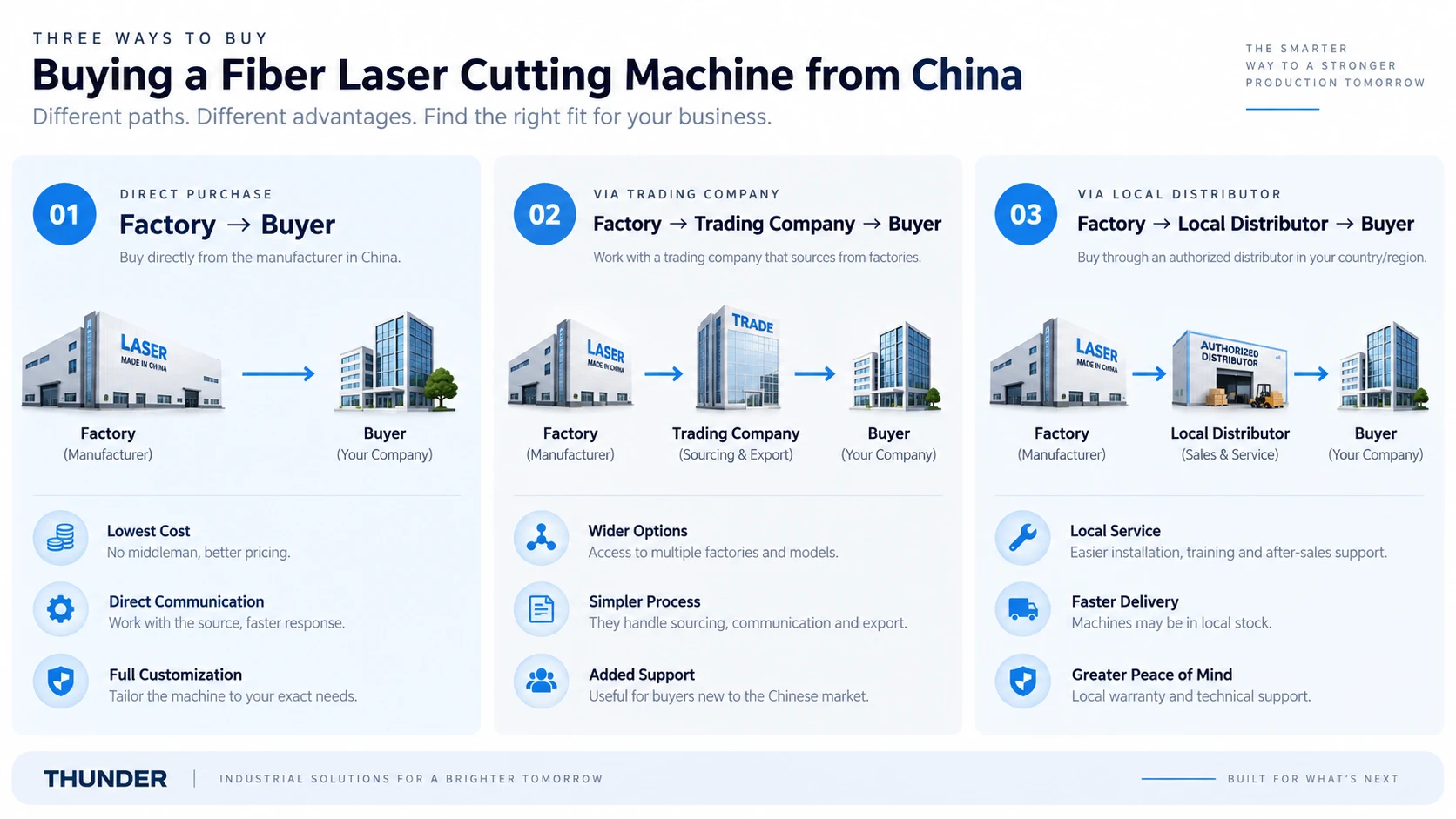
Compare the responsibilities of manufacturers, trading companies, and local distributors before choosing a supplier.
Buying directly from the manufacturer usually gives you closer access to the people who design, configure, and test the machine. This can be useful when you need a particular working area, laser source, cutting head, automation option, or other customization.
The point that needs more attention is overseas support. Before buying directly, confirm how installation and commissioning will be handled in your country, whether remote technical support is available, whether the manufacturer has local technicians or service partners, and where replacement parts will come from.
A trading company acts as an intermediary between the buyer and the factory. Some specialize in export sales and can simplify communication, documentation, shipping, or even sourcing several types of equipment from different manufacturers.
The trade-off is that the buyer may have less direct access to the company that actually manufactures and supports the machine. This becomes important when technical questions, warranty claims, or replacement parts are involved.
If you are working with a trading company, ask for the name of the actual manufacturer and clarify:
A local distributor may sell the same Chinese-built machine but handle more of the purchasing process in your own market. Depending on the distributor, this may include local quotations, installation, operator training, technical support, spare-parts inventory, and warranty handling.
The trade-off is usually a higher purchase price and, in some cases, fewer configuration choices than buying directly from the factory.
As a general reference, a fiber laser cutting machine purchased directly from a Chinese manufacturer can cost anywhere from around $10,000 for a basic entry-level system to $100,000 or more for a high-power, enclosed, exchange-table, or automated production machine.
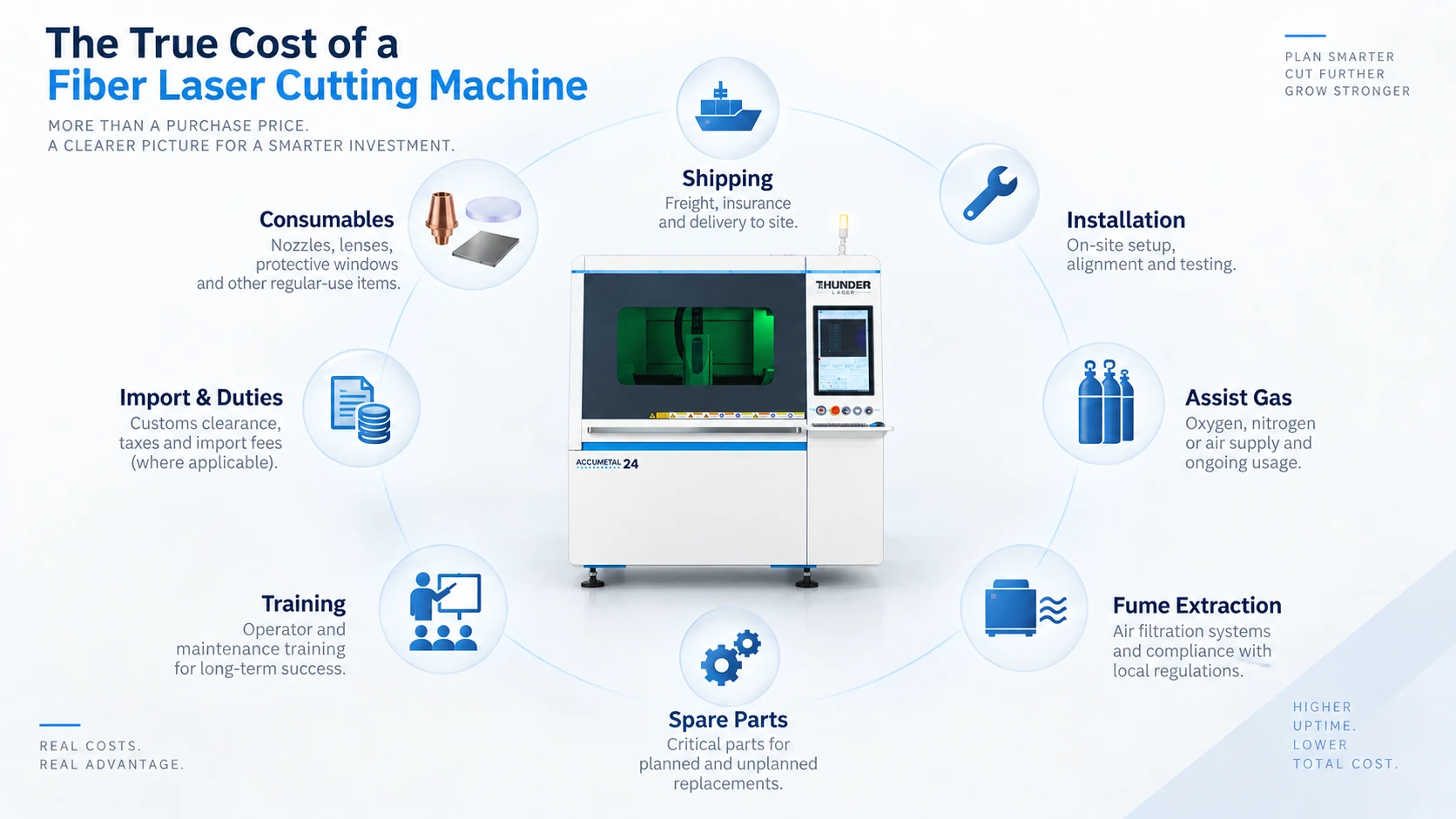
Fiber laser cutting machine prices in China vary significantly with power, configuration, automation, and included equipment.
For the power levels most commonly considered by small and mid-sized fabrication shops, a practical starting range is:
| Laser Power | Typical China Factory-Direct Price | Common Configuration |
|---|---|---|
| 1–1.5 kW | $10,000–$25,000 | Entry-level sheet metal cutting, usually open or basic single-table systems |
| 2–3 kW | $15,000–$40,000 | General fabrication, 3015-class machines, more component and enclosure options |
| 6 kW | $30,000–$80,000+ | Faster production, heavier-duty frame, enclosed or exchange-table configurations |
| 12 kW+ | $50,000–$150,000+ | High-power production, larger formats, advanced cutting heads, automation options |
Typical factory-direct price ranges for fiber laser cutting machines in China.
These figures should be treated as budget ranges rather than fixed market prices. Current Chinese listings show, for example, 1500W systems around $10,000–$15,000, 3000W systems around $18,000–$30,000, and 6000W systems beginning around $30,000, while higher-specification machines can cost substantially more.
The reason the ranges are so wide is simple: laser power alone does not define the machine. Two 3 kW machines can have the same nominal cutting power but very different frames, cutting heads, motion systems, safety enclosures, tables, components, and support packages.
A useful way to understand Chinese pricing is to compare the type of machine rather than power alone.
For example, current Chinese-market listings show basic 1500–6000W sheet-metal systems in roughly the $10,000–$45,000 range, while fully enclosed 5 × 10 ft systems are publicly listed around $22,500–$64,000. More complex sheet-and-tube or automated systems can extend far beyond these ranges.
Before comparing two quotations, check whether they include the same equipment.
A typical fiber laser cutting machine quotation may include:
However, suppliers do not all package machines in the same way. A lower quotation may use a different laser source, cutting head, servo system, controller, or machine structure, or may exclude equipment included by another manufacturer.
For this reason, a $15,000 machine and a $25,000 machine with the same advertised 1.5 kW power are not necessarily equivalent products.
The machine itself may only be the starting point.
Depending on your production setup, the quotation may also include or separately price:
These options can move a machine from the bottom of a power-based price range to the top very quickly.
Most published Chinese machine prices should be treated as factory-direct reference prices. Export quotations may be provided under EXW or FOB terms, so the number on the quotation may not represent the amount required to get the machine running in your workshop.
Additional costs can include:
These costs vary considerably by destination, machine size, and import regulations, so there is no useful universal percentage that can simply be added to every Chinese quotation.
Instead of budgeting only for the machine's advertised selling price, divide the investment into three parts:
1. Machine Price
2. Equipment and Delivery
3. Ready-to-Produce Cost
For example, if you are considering a 3 kW fiber laser cutting machine from China, seeing a machine quotation somewhere around $20,000–$40,000 would not be unusual. But the amount you ultimately need to budget may be higher once the exact configuration, shipping, installation, and supporting equipment are included.
The most useful comparison is therefore not “Which supplier has the lowest machine price?” but:
Once you know what type of machine you need and have a realistic budget, the next step is narrowing down suppliers. China has a large number of fiber laser cutting machine manufacturers and exporters, but a broad product catalog or an attractive quotation does not necessarily mean a supplier is a good fit for your application.
A useful supplier should be able to understand your production requirements, recommend an appropriate configuration, explain what is included in the machine, and support it after delivery.
Start by checking whether the supplier regularly produces the type of machine you need. A company focused mainly on large-format industrial systems may not be the best match for a small in-house cutting operation, just as a supplier specializing in compact machines may not be suitable for high-volume sheet processing.
A good supplier should ask about what you plan to cut before recommending a machine.
That normally includes your materials, regular thicknesses, maximum thickness, part dimensions, production volume, and whether you need sheet, tube, or both. If a salesperson recommends a power level immediately without understanding the application, it is difficult to know whether the recommendation is based on your workload or simply on the machine they want to sell.
The quotation should clearly identify the main components and machine specifications rather than relying on descriptions such as “high-quality laser source” or “premium cutting head.”
You should be able to see information such as:
This makes it easier to understand why prices differ and whether two suppliers are actually offering comparable machines.
Before shortlisting a supplier, check whether they are willing and able to perform a cutting test based on your actual application.
If the machine will be exported, the supplier should also understand the practical requirements of selling equipment into your market.
Local presence is also worth checking. Some Chinese manufacturers work through distributors or service partners, while others support customers directly from China. Either approach can work, but you should understand which model applies in your location.
After-sales support should be considered while choosing the supplier, not after the machine has already been purchased.
Find out whether remote technical support is available, during which hours it is provided, and whether local technicians or service partners can respond when a problem requires on-site work. You should also understand where commonly needed spare parts are stocked and how long replacements normally take to reach your facility.
A supplier that offers a competitive machine but cannot clearly explain how technical problems, warranty claims, and replacement parts are handled may introduce more operational risk than the initial price suggests.
Once you have shortlisted several suppliers, the next step is to verify that the company, factory, machine, and support capabilities are actually what they claim to be. This is especially important in China, where some sellers market themselves as “factory direct” or as the original manufacturer even though the machines may be produced by another company.
The goal is not simply to confirm that the business exists. You need to understand who actually builds the machine, who controls the manufacturing process, and who will be responsible if something goes wrong after delivery.
Start by confirming the legal company name, registered address, factory address, and the relationship between the seller and the manufacturing entity.
If the supplier says it is the manufacturer, ask where the machines are produced and whether that factory belongs to the same company. If sales, export, and manufacturing are handled by different entities, ask how those companies are related and which one will appear on the contract, invoice, and warranty documents.
A trading company is not automatically a problem, but the relationship should be transparent. You should know who actually manufactures the machine before placing an order.
A supplier's website may show factory photos, production equipment, and assembly lines, but these materials alone do not always prove that the company actually manufactures the machines it sells.
Look for additional evidence that shows real and ongoing manufacturing activity. This may include independent factory-tour videos, customer or distributor visits, industry media coverage, production footage, trade-show content, and videos showing machines being assembled, tested, or prepared for shipment.
When reviewing this material, pay attention to whether the same factory, production teams, machine models, and manufacturing processes appear consistently across different sources. It is also useful to check whether the supplier regularly shows real machines in production rather than relying mainly on rendered images or promotional footage.
For buyers making a larger investment, visiting the factory in person can provide additional confidence, but it does not need to be the only way to verify manufacturing capability.
Before paying a deposit, confirm that the specifications in the quotation correspond to real components and identifiable models.
Check the laser source, cutting head, controller, software, servo system, working area, table configuration, safety features, and major optional equipment. Brand names and model numbers should be stated clearly where relevant.
Instead of relying only on standard demonstration samples, send your own drawing and specify the material and thickness you normally process. Ask the supplier to record the cutting conditions and, where possible, provide video of the test itself.
The result should give you a better indication of cut quality, small-hole performance, detail, consistency, and processing time under conditions that are closer to your actual production.
Technical support should also be verified before the order, rather than accepted as a general promise of “after-sales service.”
Ask how support works in your location:
Once you have quotations from several suppliers, do not start by comparing the final price. First make sure the suppliers are actually quoting comparable machines and that you understand what each price includes.
Two quotations for a “1500W fiber laser cutting machine” may cover very different components, accessories, service, and shipping arrangements.
A useful quotation should clearly identify the machine and the main items included in the offer. At minimum, look for:
Important components should be identified by brand or model where appropriate. Descriptions such as “premium laser source” or “high-quality cutting head” make meaningful comparison difficult.
Check whether the suppliers are recommending machines for the same production requirements.
Differences in laser source, cutting head, machine structure, motion system, working area, exchange table, enclosure, and automation can explain why two apparently similar machines have different prices.
Published specifications also need context. Positioning accuracy, repeat positioning accuracy, maximum speed, and acceleration describe different aspects of machine performance and should not be treated as interchangeable numbers.
A lower quotation may simply exclude equipment that another supplier has included.
Pay particular attention to items such as the chiller, fume extraction, air compressor, voltage equipment, software licenses, initial consumables, spare parts, installation, and operator training.
If something is necessary to put the machine into production but does not appear in the quotation, ask whether it must be purchased separately.
Finally, bring the quotations to a similar delivery point.
One supplier may quote FOB China, another CIF to your port, and another include delivery much closer to your facility. Installation, technician travel, customs fees, local transport, and workshop preparation may also sit outside the quoted machine price.
The more consistent the scope of each quotation, the easier it becomes to understand whether a price difference comes from the machine itself, the equipment included, the service package, or the shipping arrangement.
Once you have selected a supplier, the final machine configuration and the important commitments made during the sales process should appear in the purchase contract or its attached technical documents.
The contract should clearly identify the machine being purchased, including the agreed laser power, working area, major components, table configuration, software, auxiliary equipment, options, and included accessories.
The contract should state the total price, currency, payment schedule, production lead time, and expected delivery or shipment date.
If a cutting test or factory acceptance test has been agreed, record the basic acceptance conditions as well. Buyers should also understand what must happen before the final balance becomes due.
The agreed Incoterm and delivery point should be stated clearly, together with any installation, commissioning, or training included in the order.
The warranty should state its duration, basic coverage, and how claims are handled. If major components have separate manufacturer warranties, these should also be understood.
The contract does not need to repeat every sales conversation, but important technical specifications, costs, responsibilities, and service commitments should not depend on informal communication alone.
Choosing the machine and supplier is only part of the purchase. The machine still has to reach your facility, be installed correctly, and remain supportable once production begins.
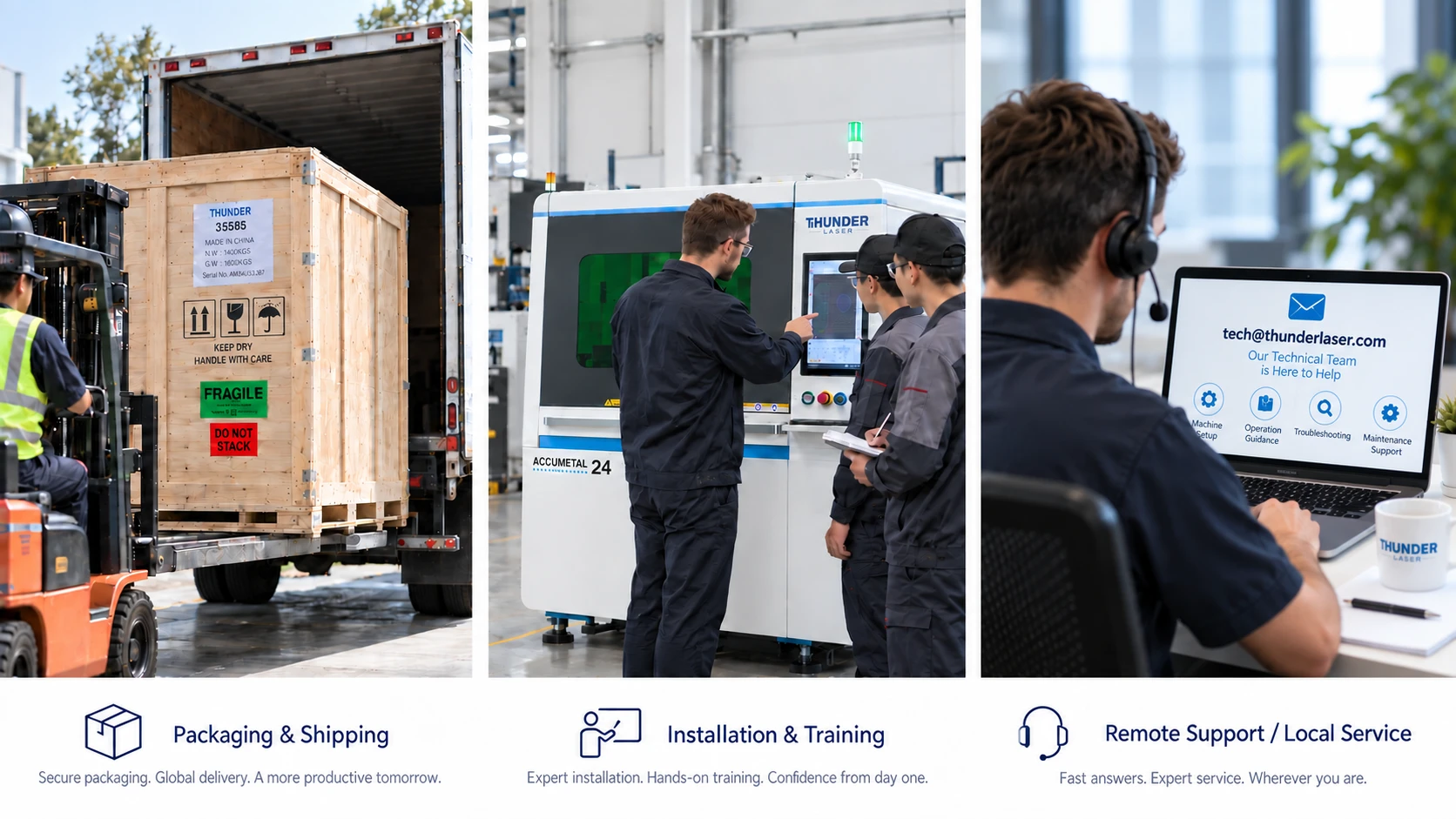
Shipping, installation, operator training, and after-sales support are critical parts of an overseas fiber laser machine purchase.
Chinese machinery suppliers commonly quote using EXW, FOB, CIF, or DDP terms. What matters is understanding exactly where the supplier's responsibility ends and what you will need to arrange yourself.
Also check how the machine will be packed and protected during international transport. Before shipment, obtain the packing list and confirm the number, size, and weight of the packages so your freight forwarder and receiving team can prepare accordingly.
Import documents and compliance requirements vary by country, so these should be confirmed with the supplier and your local customs or freight representative before the machine leaves China.
Before delivery, confirm what your facility needs in terms of:
Also confirm whether commissioning will be completed remotely, by a visiting engineer, or through a local service partner.
Operator training should cover normal machine operation, software workflow, basic parameter use, consumables, routine maintenance, and common troubleshooting rather than simply showing how to start the machine.
For an imported machine, the most important service question is often what happens when production stops.
Remote support can resolve many software, parameter, and diagnostic issues quickly, so check how it is provided and whether support is available during practical hours for your region.
You should also know what happens when remote assistance is not enough. Ask whether the manufacturer has local technicians, distributors, or service partners who can provide on-site support.
Spare-parts availability matters for the same reason. Common consumables may be easy to stock in advance, but buyers should also understand where replacement components are located and how quickly they can be supplied.
Make sure you can clearly describe:
Giving the same requirements to each supplier will also make later quotations easier to compare.
Check:
Make sure the final quotation and contract agree on:
Ask the supplier to confirm that the agreed machine has completed testing and that the shipment matches the order.
Check the final machine configuration, accessories, spare parts, packing list, shipping documents, and agreed acceptance requirements before releasing any payment tied to shipment.
Buying a fiber laser cutting machine from China can provide access to a broad range of machine configurations at competitive investment levels, but the purchasing decision should extend well beyond the initial quotation.
For buyers comparing Chinese manufacturers, the most useful question is not simply which machine has the lowest price. It is whether the machine fits the workload and whether the supplier can support it reliably once it is operating in your facility.
Talk To Our Experts Now!
Please leave your contact information so that we can serve you better.
FAQS
It can be, provided the supplier and machine are properly evaluated before purchase. Verify who actually manufactures the equipment, review the machine configuration, request a cutting test, and confirm warranty, service, and spare-parts arrangements. The level of support available in your country is particularly important for an imported machine.
Do not rely only on claims such as “factory direct.” Check the company's manufacturing address, production information, factory footage, third-party factory visits, customer or distributor content, and evidence of machines being assembled and tested. For larger investments, visiting the factory can provide additional verification.
Buying directly may provide more configuration flexibility and closer communication with the factory, while a local distributor may simplify installation, training, warranty handling, and on-site service. The better option depends on how much of the import and support process your business is prepared to manage.
Yes, particularly when cut quality, small features, dimensional accuracy, or productivity are important to your application. Use your own drawing and, where possible, the same material and thickness used in production rather than relying only on standard demonstration samples.
Common consumables such as nozzles, protective lenses, ceramic components, and other frequently replaced items are useful to keep on hand. The supplier should also advise which machine-specific parts may have longer replacement lead times in your region.
Some manufacturers work through local distributors, technicians, or service partners, while others provide most support directly from China. Ask specifically who will assist you if remote troubleshooting cannot solve the problem and how quickly on-site support can be arranged.
FIND THE RIGHT LASER FOR YOUR NEXT PROJECT
Explore Thunder Laser solutions designed for different materials, workflows, and production needs.


 Stable & Consistent MachinesUnlimited ApplicationsRobust After-sales SupportFactory Direct Supply


