


Fiber Laser Metal Cutting Machine Assist Gas O₂ vs. N₂ vs. Air
 2026-09-15
WHAT ARE YOU LOOKING FOR?
Search Across Products, Blog Posts, Support Content, And Resources.

Fiber Laser Metal Cutting Machine Assist Gas O₂ vs. N₂ vs. Air
2026-09-15

Assist gas plays a critical role in fiber laser metal cutting. It helps remove molten material from the kerf while also affecting cutting performance, edge quality, oxidation, and overall operating cost.
The three most common assist gases used with fiber laser metal cutting machines are oxygen (O₂), nitrogen (N₂), and compressed air. Each works differently and is better suited to different metals and production requirements. Oxygen is commonly used for carbon steel, nitrogen is preferred when clean, oxide-free edges are required, and compressed air can provide a more economical option for many thin- and medium-sheet applications.
Choosing the right assist gas therefore depends on more than the metal alone. Material type, thickness, required edge finish, downstream processing, and production cost should all be considered.
Quick Answer: There is no single best assist gas for every fiber laser cutting application.
| Assist Gas | Common Applications | Main Advantage | Main Trade-Off |
|---|---|---|---|
| Oxygen (O₂) | Carbon steel, mild steel | Supports the cutting reaction and thicker steel cutting | Oxidized cut edge |
| Nitrogen (N₂) | Stainless steel, aluminum, brass | Clean, bright, oxide-free edge | Higher gas consumption and cost |
| Compressed Air | Carbon steel, stainless steel, aluminum | Lower assist-gas cost for suitable applications | Some oxidation or discoloration may occur |
Comparison of oxygen, nitrogen, and compressed air for fiber laser metal cutting.
In simple terms: choose oxygen for carbon steel cutting, nitrogen when edge quality and oxidation control matter most, and compressed air when production cost is the priority and slight oxidation is acceptable.
Oxygen (O₂) is commonly used for cutting carbon steel and mild steel with fiber laser metal cutting machines. Unlike nitrogen, oxygen actively reacts with the heated steel and releases additional heat, helping support the cutting process.
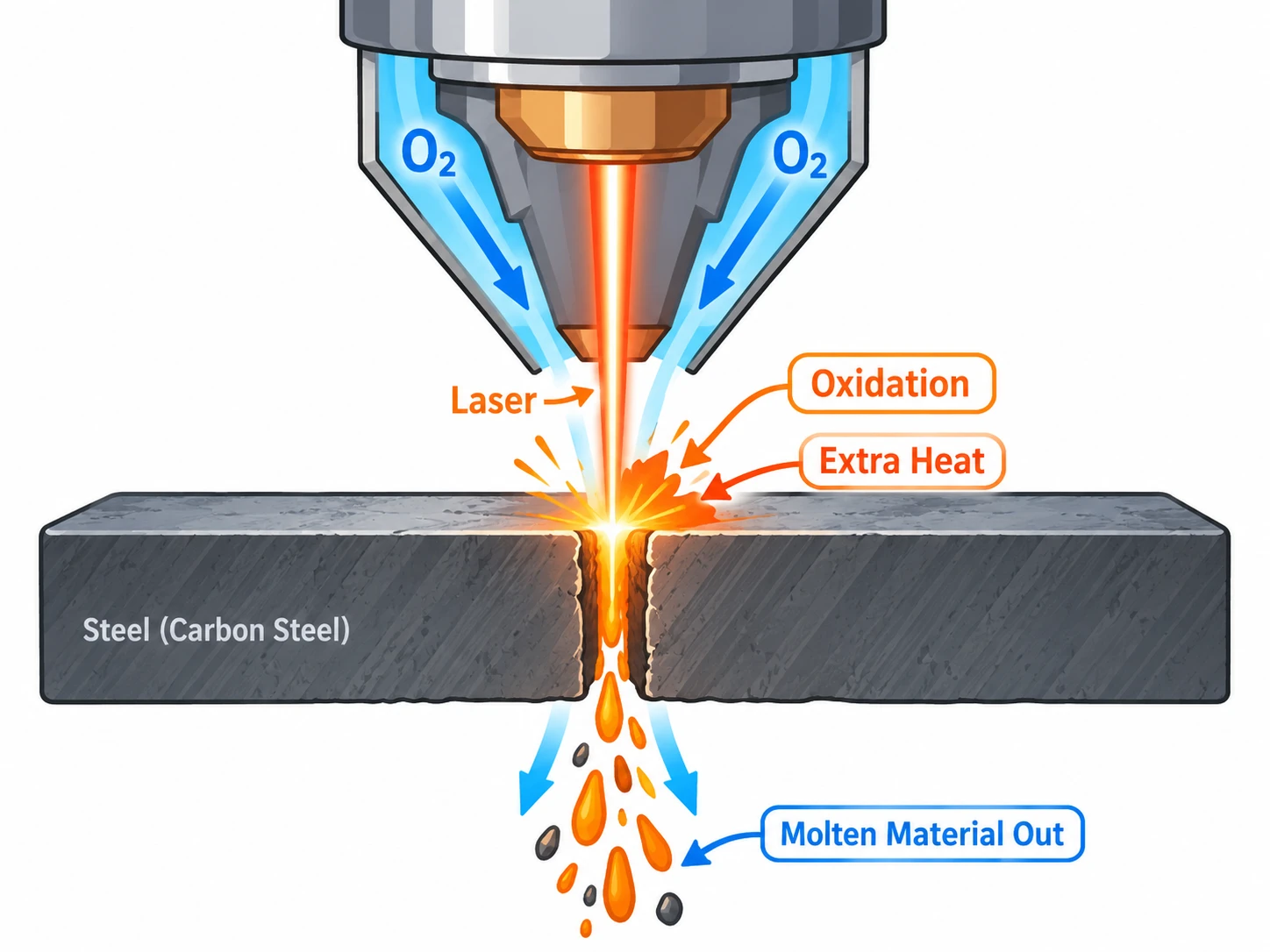
Oxygen assist gas supports fiber laser cutting of carbon and mild steel.
The process is straightforward:
This makes oxygen particularly useful for carbon-steel cutting, especially as material thickness increases.
The main trade-off is oxidation.
Oxygen cutting may produce:
For stainless steel or aluminum where a bright, oxide-free edge is important, nitrogen is usually a better choice.
| Cutting Requirement | Oxygen |
|---|---|
| Carbon steel / mild steel | Recommended |
| Thicker carbon steel | Strong choice |
| Oxide-free edge | Not ideal |
| Bright stainless-steel edge | Not recommended |
| Bright aluminum edge | Not recommended |
| Oxidized edge is acceptable | Suitable |
Oxygen is best suited to carbon and mild steel when an oxide-free edge is not required.
In short: choose oxygen when cutting carbon or mild steel and cutting capability is more important than maintaining a completely oxide-free edge.
Nitrogen (N₂) is commonly used when cutting stainless steel, aluminum, and other metals where a clean, oxide-free edge is important. Unlike oxygen, nitrogen does not intentionally add heat through an oxidation reaction. Its main role is to blow molten metal out of the kerf while limiting oxidation.
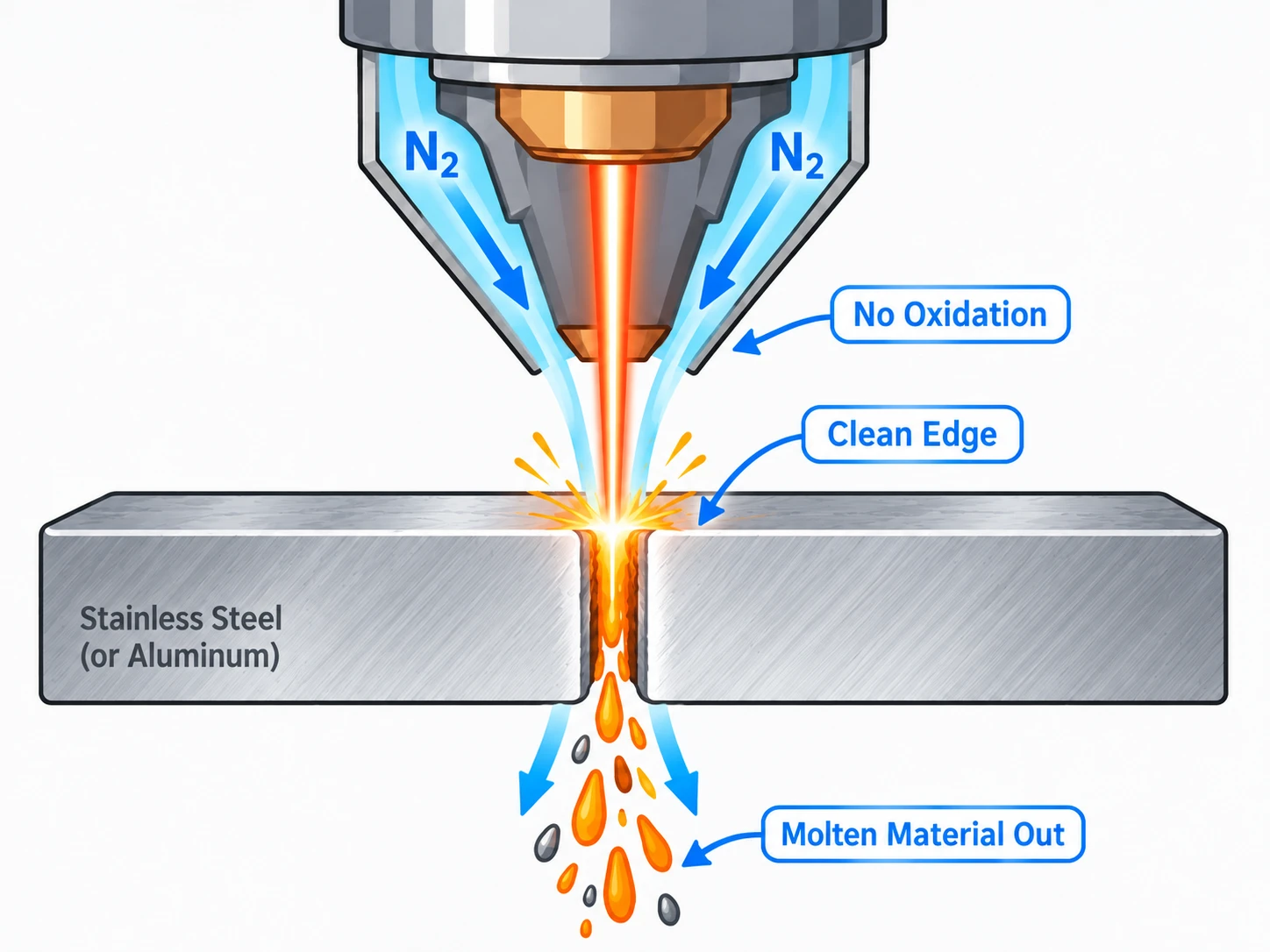
Nitrogen assist gas helps produce clean, bright, low-oxidation laser-cut edges.
Because the laser provides the cutting energy, sufficient laser power and gas pressure become increasingly important as material thickness increases.
The main disadvantage is gas consumption and cost.
For shops with high nitrogen consumption, bulk nitrogen or an on-site nitrogen generator may be worth considering.
| Cutting Requirement | Nitrogen |
|---|---|
| Stainless steel | Recommended |
| Aluminum | Recommended |
| Bright, clean edge | Strong choice |
| Oxide-free edge | Strong choice |
| Minimize post-processing | Strong choice |
| Lowest assist-gas cost | Usually not the best option |
Nitrogen is preferred when clean, bright, low-oxidation cut edges are the priority.
In short: choose nitrogen when edge quality and oxidation control are more important than minimizing assist-gas cost.
Compressed air can also be used as an assist gas for many fiber laser metal cutting applications. Because air is approximately 78% nitrogen and 21% oxygen, its cutting behavior falls between pure nitrogen and pure oxygen.
It is especially attractive when users want to reduce reliance on purchased cutting gases.
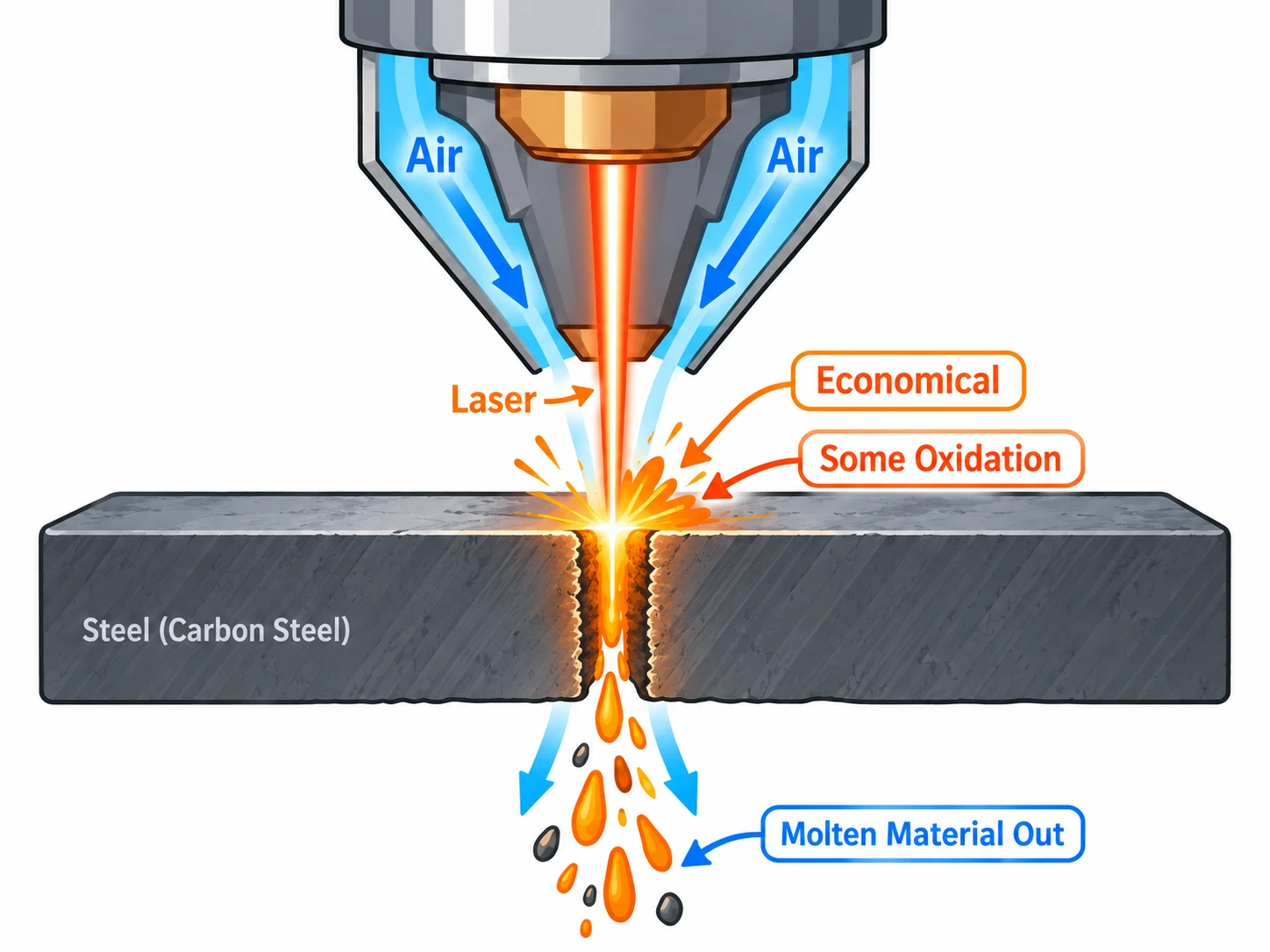
Compressed air provides a cost-efficient assist-gas option for suitable fiber laser metal cutting applications.
As a result, compressed air can provide good cutting results for suitable applications, but it generally does not produce the same oxide-free edge as high-purity nitrogen.
So while compressed air can reduce purchased-gas costs, it should not be considered a completely “free” cutting gas.
| Cutting Requirement | Compressed Air |
|---|---|
| Lower assist-gas cost | Strong choice |
| Thin / medium sheet production | Suitable |
| Stainless steel | Suitable when slight oxidation is acceptable |
| Aluminum | Suitable depending on edge requirements |
| Completely oxide-free edge | Not ideal |
| High cosmetic edge requirement | Nitrogen is usually better |
Compressed air is a practical option when assist-gas cost matters more than achieving a fully oxide-free edge.
In short: choose compressed air when reducing operating cost is a priority and the application can tolerate some oxidation or edge discoloration.
Assist gas directly affects the finished cut edge of a fiber laser metal cutting machine. The biggest differences between oxygen, nitrogen, and compressed air are oxidation, edge appearance, post-processing requirements, and cost.
| Factor | Oxygen (O₂) | Nitrogen (N₂) | Compressed Air |
|---|---|---|---|
| Edge oxidation | High | Very low | Low to moderate |
| Edge appearance | Darker, oxidized | Bright and clean | Generally clean, but some discoloration may occur |
| Carbon steel | Excellent fit | Possible when oxide-free edges are required | Suitable for selected applications |
| Stainless steel | Usually not preferred for clean edges | Excellent fit | Good when slight oxidation is acceptable |
| Aluminum | Usually not preferred | Excellent fit | Good for suitable applications |
| Post-processing | May require oxide removal | Usually minimal | Depends on required finish |
| Assist-gas cost | Moderate | Usually highest | Usually lowest for regular production |
| Best for | Carbon steel cutting | High-quality, oxide-free edges | Cost-efficient general cutting |
Cut quality, oxidation, post-processing, and cost differences between oxygen, nitrogen, and compressed air.
If edge quality is the main priority, nitrogen generally produces the best result because it minimizes oxidation.
If carbon-steel cutting capability is the priority, oxygen is often the better choice.
If lower operating cost matters more than achieving a completely oxide-free edge, compressed air can provide a practical alternative.
The best assist gas therefore depends on the required finished part—not simply on which gas produces the fastest or cheapest cut.
The best assist gas depends heavily on the metal being cut. For most fiber laser metal cutting applications, oxygen is commonly preferred for carbon steel, while nitrogen is preferred for stainless steel and aluminum when clean, oxide-free edges are required. Compressed air can be a lower-cost alternative when slight oxidation is acceptable.
| Metal | Preferred Assist Gas | Alternative | Main Reason |
|---|---|---|---|
| Carbon Steel / Mild Steel | Oxygen | Compressed Air / Nitrogen | Oxygen supports the cutting reaction and thicker steel cutting |
| Stainless Steel | Nitrogen | Compressed Air | Clean, bright, low-oxidation edge |
| Aluminum | Nitrogen | Compressed Air | Cleaner edge with less oxidation |
| Brass | Nitrogen | Process-dependent | Helps limit oxidation and maintain edge quality |
| Copper | Process-dependent | N₂ / O₂ depending on validated process | Cutting behavior depends strongly on machine and process setup |
Recommended starting points for assist-gas selection by metal type.
Oxygen is usually the first choice for carbon and mild steel.
Choose oxygen when:
Consider compressed air for suitable thinner-sheet applications when reducing operating cost is more important than maintaining an oxide-free edge.
Nitrogen can also be used when oxidation must be minimized, but the cutting economics and required laser power may differ.
Nitrogen is generally the preferred assist gas for stainless steel when edge quality matters.
Choose nitrogen when you need:
Compressed air is a practical alternative when:
Nitrogen is commonly preferred for aluminum when a clean edge and low oxidation are required.
Choose nitrogen for:
Choose compressed air when:
For brass, nitrogen is commonly used when clean cutting and oxidation control are priorities.
For copper, assist-gas selection is more process-dependent because cutting performance can vary significantly with material thickness, laser power, cutting head, and machine configuration.
For reflective metals:
In short: start with oxygen for carbon steel, nitrogen for clean stainless steel and aluminum, and compressed air when cost matters more than achieving a completely oxide-free edge.
Assist gas affects more than cut quality. The amount of oxidation left on the cut edge can also change how much cleaning, grinding, or surface preparation is needed before the next production step.
| Assist Gas | Typical Edge Condition | Post-Processing Impact |
|---|---|---|
| Oxygen (O₂) | Oxidized edge | May require oxide removal or cleaning |
| Nitrogen (N₂) | Clean, low-oxidation edge | Usually requires less edge preparation |
| Compressed Air | Some oxidation or discoloration possible | Depends on finish requirements |
Assist gas can directly affect downstream cleaning and finishing requirements.
Oxygen cutting can leave an oxide layer on carbon-steel edges.
Additional preparation may be needed before:
Depending on the required finish, this may involve brushing, grinding, blasting, or other cleaning methods.
Nitrogen minimizes oxidation, which can reduce secondary edge preparation.
This is useful when:
Compressed air usually falls between oxygen and nitrogen.
Post-processing depends on:
The key point: the cheapest assist gas is not always the lowest-cost option for the finished part. Gas cost should be considered together with any additional cleaning or post-processing it creates.
Assist gas can be a significant operating cost for a fiber laser metal cutting machine, especially in continuous production. The actual cost depends on gas consumption, local gas prices, material thickness, cutting time, and supply method.
Oxygen is commonly supplied through:
Oxygen consumption depends on cutting conditions, but oxygen cutting typically operates at lower pressure than high-pressure nitrogen cutting.
Main cost factors include:
For occasional or lower-volume cutting, cylinders may be sufficient. Higher-volume production may justify a bulk supply system.
Nitrogen can become one of the largest assist-gas expenses in fiber laser cutting because clean cutting often requires high pressure and high gas flow.
Common nitrogen supply options include:
Higher production volume generally makes nitrogen supply strategy more important.
| Nitrogen Supply | Best Suited For | Main Consideration |
|---|---|---|
| Cylinders | Occasional cutting | Simple, but limited capacity |
| Cylinder Bundles | Low-to-medium production | Higher capacity, frequent replacement still required |
| Bulk Liquid Nitrogen | High-volume production | Reliable supply, but requires tank and supplier infrastructure |
| Nitrogen Generator | Regular long-term use | Higher initial investment, lower dependence on delivered gas |
Common nitrogen supply options for different fiber laser production volumes.
A nitrogen generator can be worth considering when nitrogen consumption is consistently high, but the decision should be based on actual usage, required purity, pressure, equipment cost, and local gas pricing.
Compressed air can reduce purchased-gas costs because the air is generated on-site.
However, compressed-air cutting is not free. Costs include:
The air must also be clean and dry to protect the cutting system and maintain stable cutting performance.
For suitable applications, compressed air can offer lower ongoing assist-gas costs than purchased nitrogen or oxygen.
| Option | Initial Cost | Ongoing Cost | Best Fit |
|---|---|---|---|
| Oxygen cylinders | Low | Moderate | Occasional carbon-steel cutting |
| Nitrogen cylinders | Low | High at heavy usage | Low-volume clean cutting |
| Bulk nitrogen | Higher infrastructure | Lower per-unit cost at scale | High-volume production |
| Nitrogen generator | High | Lower long-term gas purchasing cost | Regular nitrogen-intensive production |
| Compressed air system | Medium–High | Electricity + maintenance | Cost-sensitive regular cutting |
Assist-gas supply options differ in initial investment, ongoing cost, and suitable production volume.
The lowest gas price does not always produce the lowest finished-part cost. Edge cleaning, post-processing, gas delivery, electricity, and equipment maintenance should also be included in the comparison.
Choosing between oxygen, nitrogen, and compressed air should start with the material and required finished edge, not gas price alone.
A practical starting point is:
These are starting points rather than universal rules. Thickness and required cut quality can change the best choice.
Ask whether the finished part needs:
If oxide-free edge quality is important, nitrogen is usually the strongest choice.
If some oxidation is acceptable, oxygen or compressed air may provide better cutting economics.
Assist-gas selection can change as material thickness increases.
For example:
Always match gas selection with the machine's tested cutting parameters.
Consider what happens after cutting:
An inexpensive cutting process can become more expensive if it creates additional cleaning or finishing work.
Do not compare only the purchase price of the gas.
Consider:
| Your Priority | Recommended Starting Point |
|---|---|
| Carbon steel cutting | Oxygen |
| Thicker carbon steel | Oxygen |
| Clean stainless-steel edge | Nitrogen |
| Clean aluminum edge | Nitrogen |
| Minimize oxidation | Nitrogen |
| Lower assist-gas cost | Compressed Air |
| Reduce nitrogen deliveries | Compressed Air or Nitrogen Generator |
| Minimize post-processing | Nitrogen |
| Balance cost and acceptable edge quality | Compressed Air |
Quick assist-gas selection guide based on cutting priorities.
In short: choose assist gas based on material → thickness → edge quality → downstream processing → total production cost. There is no single gas that is best for every fiber laser metal cutting application.
The Thunder AccuMetal fiber laser metal cutting machine supports multiple assist gases, allowing users to match the cutting process to the metal, required edge quality, and operating cost.
| Assist Gas | Typical Use on AccuMetal | Main Benefit |
|---|---|---|
| Oxygen (O₂) | Carbon steel / mild steel | Supports stronger carbon-steel cutting capability |
| Nitrogen (N₂) | Stainless steel, aluminum | Clean, low-oxidation cut edges |
| Compressed Air | Suitable general metal cutting | Helps reduce assist-gas operating cost |
Thunder AccuMetal supports oxygen, nitrogen, and compressed air for different cutting requirements.
This flexibility allows users to choose between:
Rather than relying on one gas for every job, AccuMetal users can select the assist gas according to material → edge quality → downstream process → operating cost.
Choosing the right assist gas for a fiber laser metal cutting machine depends on the material, thickness, required edge quality, downstream process, and total production cost.
There is no single best gas for every application. The most practical choice is the one that delivers the required cut quality while keeping both cutting and post-processing costs under control.
Talk To Our Experts Now!
Please leave your contact information so that we can serve you better.
FAQS
Fiber laser metal cutting machines commonly use oxygen, nitrogen, or compressed air as assist gases. The best choice depends on the metal, thickness, required edge quality, and production cost.
Neither is universally better. Oxygen is generally better suited to carbon and mild steel, while nitrogen is preferred when a clean, oxide-free edge is required, particularly on stainless steel and aluminum.
Nitrogen is usually the preferred choice for stainless steel because it minimizes oxidation and produces a cleaner, brighter cut edge. Compressed air can be a lower-cost alternative when slight oxidation is acceptable.
Oxygen is commonly used for carbon and mild steel. Its reaction with the heated steel releases additional energy that supports the cutting process, although it leaves an oxidized edge.
Yes. Compressed air can be used to cut stainless steel in suitable applications. It can reduce assist-gas costs, but the cut edge may show more oxidation or discoloration than nitrogen cutting.
Yes. Compressed air can be used for suitable aluminum-cutting applications, particularly when operating cost is more important than achieving a completely oxide-free edge. Nitrogen is generally preferred when edge quality is the priority.
Compressed air can reduce purchased-gas costs because it is generated on-site. However, the total cost still includes the compressor, electricity, dryer, filtration, and maintenance.
Nitrogen limits oxidation while blowing molten metal out of the kerf. This helps produce a cleaner, brighter, low-oxidation edge, especially on stainless steel and aluminum.
For carbon and mild steel, oxygen can support the cutting process by reacting with the heated metal and releasing additional thermal energy. This is particularly useful when cutting thicker steel, but it also creates an oxidized edge.
Not necessarily. Cylinders or bulk nitrogen may be sufficient for lower-volume production. An on-site nitrogen generator becomes more attractive when nitrogen consumption is consistently high and reducing dependence on delivered gas can justify the additional equipment investment.
NEED HELP FINDING THE RIGHT SOLUTION?
Talk to our team for machine recommendations, application advice, and support based on your needs.


 Stable & Consistent MachinesUnlimited ApplicationsRobust After-sales SupportFactory Direct Supply


