







Best Laser Engraver for Marble Businesses | Titan Pro
 2026-06-16
WHAT ARE YOU LOOKING FOR?
Search Across Products, Blog Posts, Support Content, And Resources.

Best Laser Engraver for Marble Businesses | Titan Pro
2026-06-16
Marble engraving can support a valuable range of personalized products, including portrait plaques, memorial pieces, awards, wedding keepsakes, interior signs, and premium home décor. Because marble has natural weight, texture, and permanence, customers often perceive it as more valuable than common engraving materials.
However, choosing the best laser engraver for a marble business is not simply a matter of purchasing the most powerful machine. A conventional CO₂ laser may already be sufficient for surface photos, text, logos, and decorative patterns. A more advanced dual-laser system becomes valuable only when its additional capabilities solve a real production problem or create profitable new products.
This guide compares conventional CO₂ laser machines with Titan Pro, explains when CO₂ or MOPA fiber processing is more appropriate, reviews a real marble engraving test, and provides a practical framework for evaluating production capacity and return on investment.
Quick Answer: Use a conventional CO₂ laser if your business mainly produces surface photos, text, and decorative marble pieces. Consider Titan Pro when you need CO₂ and MOPA fiber processing, mixed-material products, repeat production, or deeper text effects—and only when those capabilities can generate enough additional profit to justify the upgrade.

Titan pro 35 can laser mark & engrave marble with great deatls.
Upgrading should begin with a business problem, not a machine specification. A faster motion system, larger work area, or additional laser source has value only when it helps you accept more orders, reduce production costs, improve consistency, or sell higher-value products.
A production-focused upgrade may be appropriate when your current equipment is beginning to limit what your business can deliver.
You may be ready to upgrade when:
An upgrade is easier to justify when it addresses several of these problems at the same time. For example, a dual-laser system may support marble portraits, deeper lettering, metal accessories, wooden stands, and mixed-material awards within one production platform.
CO₂ lasers are widely used for stone and marble engraving. They are especially effective for photographs, grayscale artwork, logos, surface text, and decorative patterns. A well-configured CO₂ machine may therefore remain the most economical option for many small workshops.
Limitations become more noticeable when the business moves beyond standard surface engraving. Depending on the machine, these may include:
These limitations do not mean that a CO₂ laser is unsuitable for marble. They indicate the point at which a CO₂-only workflow may no longer cover the full product range a growing business wants to offer.
The correct laser source depends on the desired result. Photo engraving, deep lettering, relief patterns, and metal accessories should not automatically be treated as the same process.
| Comparison | Conventional CO₂ Laser | Titan Pro |
| Laser source | CO₂ only | RF CO₂ and MOPA fiber |
| Marble photo engraving | Suitable | Suitable with the RF CO₂ source |
| Deep text or relief testing | Limited by material response and heat buildup | Additional MOPA fiber option for suitable marble |
| Uncoated metal marking | Generally not supported | Supported with the MOPA fiber source |
| Mixed-material products | May require another machine | Wider stone, non-metal, and metal workflow |
| Positioning | Depends on machine configuration | Overhead and head-mounted camera workflow |
| Production scale | Small workshops and standard surface engraving | Growing businesses and diversified production |
| Initial investment | Lower | Higher |
A comparison table that summarizes the main workflow differences between a conventional CO₂ laser and Titan Pro for a marble engraving business.
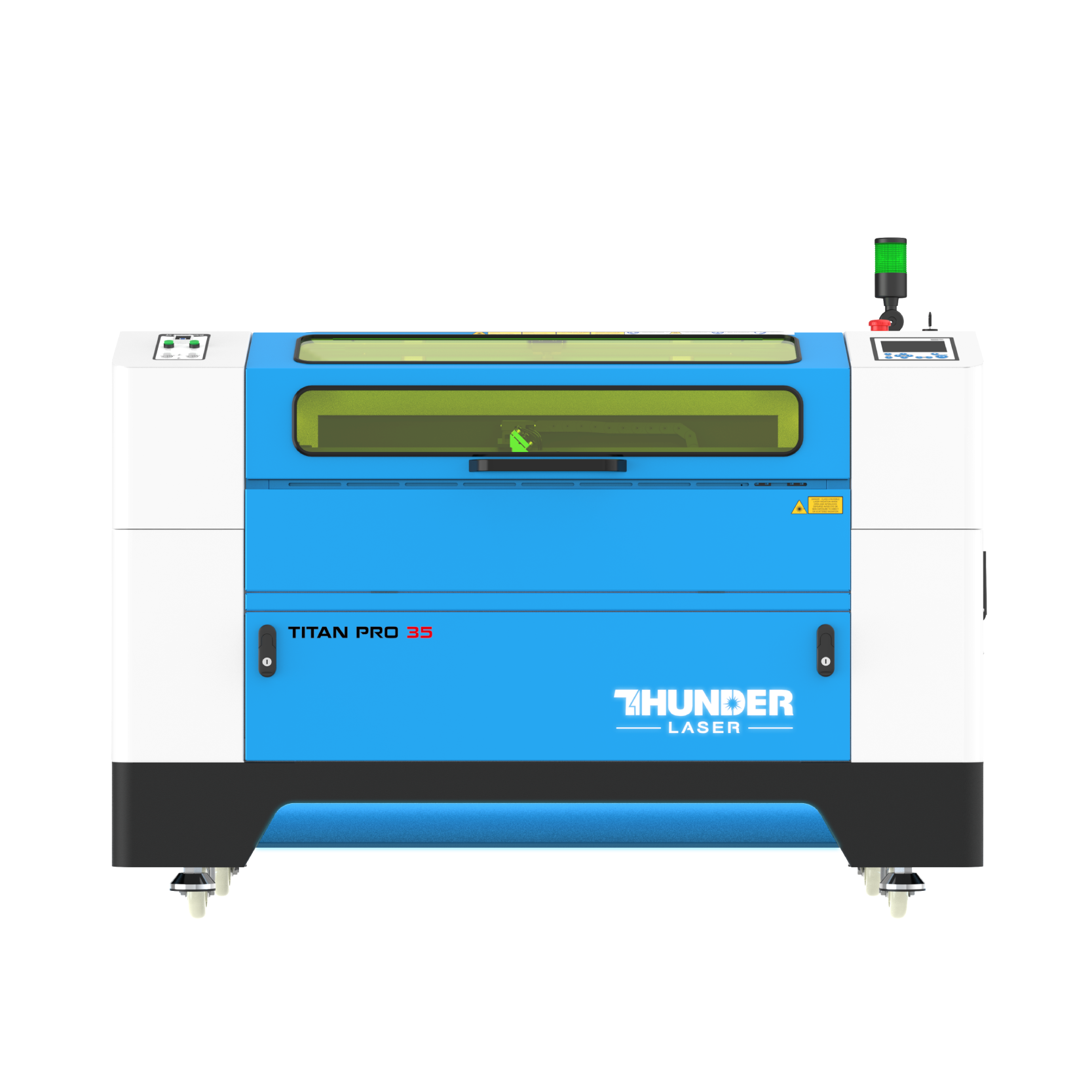
Titan Pro should not be positioned as automatically producing a better result for every marble project. Its main advantage is production flexibility. It combines an RF CO₂ source for common non-metal applications with a MOPA fiber source for metal marking and selected deeper or more defined effects on suitable marble.
Titan Pro models provide working areas of 700 × 500 mm, 900 × 600 mm, and 1300 × 900 mm. The system also uses AC servo motion, with engraving speeds of up to 3000 mm/s and acceleration up to 8G. These specifications can support larger layouts and faster movement, but actual job time still depends on engraving area, resolution, passes, depth, and material response.
CO₂ and fiber laser processing create different effects on marble. Material color, mineral composition, veining, coating, and surface finish can all change the result, so every production material should be tested before customer orders are accepted.
| Marble Job | Recommended Starting Point | Reason |
| Photo or portrait engraving | CO₂ | Better suited to shallow engraving, grayscale, and visible image contrast |
| Surface text and logos | CO₂ | Efficient for common surface marking applications |
| Deep text or relief effect | Fiber test recommended | May create greater physical definition on suitable marble |
| Fine decorative borders | Test CO₂ and fiber | The best source depends on required contrast and depth |
| Marble plaque with metal nameplate | CO₂ and fiber | CO₂ processes the marble while fiber marks the metal component |
| Award with marble, wood, acrylic, and metal | Dual-laser workflow | Supports more of the finished product on one platform |
A practical table that explains when to begin testing CO₂, fiber, or a combined dual-laser workflow for different marble products.
For a more detailed technical explanation of material response, see the complete marble laser engraving and marking guide.
Titan Pro may be the right choice when its dual-source capability supports actual customer demand. This could include a memorial company adding metal QR code plates, an award manufacturer combining marble bases with marked stainless steel, or a personalization business expanding into larger stone products and mixed-material gift sets.
Titan Pro is more likely to be a practical investment when:
It may not be necessary when:
In these cases, improving artwork preparation, material selection, product photography, sales channels, or production templates may create a better return than replacing the machine.
To evaluate a combined CO₂ and fiber workflow, two portrait samples were produced on marble using a Titan Pro 35. One sample featured Albert Einstein and the other featured Marilyn Monroe.
Each design contained two processing areas:
The portrait files were cropped, converted to grayscale, adjusted for contrast, cleaned of unnecessary background detail, and resized to fit the marble layout. Preparing the image before engraving is essential because poor contrast, low resolution, or excessive shadow can reduce facial recognition in the finished result.

The following CO₂ settings were used after testing:
| Setting | Test Parameter |
| Speed | 1500 mm/s |
| Maximum power | 15% |
| Minimum power | 0% |
| Resolution | 350 DPI |
| Engraving direction | Bi-directional |
| Image output | Negative |
| Image mode | Jarvis |
A parameter table that shows the RF CO₂ settings used for the two Titan Pro marble portrait tests.

These settings are reference values from a specific test, not universal marble settings. Power, speed, DPI, image mode, focus, and passes should be retested whenever the marble type, color, surface finish, artwork, lens, or machine configuration changes.
The RF CO₂ laser was used to create the two 127 × 180 mm portrait areas. The Einstein portrait required 7 minutes and 18 seconds, while the Marilyn Monroe portrait required 7 minutes and 24 seconds.
This stage demonstrates why CO₂ remains the practical starting point for marble photo engraving. It can reproduce a broad image area relatively quickly while preserving recognizable facial features, shadows, and grayscale detail.

Final image quality still depends heavily on the stone itself. Strong natural veining can pass through faces or text, while different mineral compositions may create different levels of contrast. A successful sample on one marble blank should not be treated as proof that every marble product will produce the same result.
The MOPA fiber source was used to process the text beneath each portrait. The approximate text area was 87 × 31 mm, and each sample used 15 passes.
The Einstein text required 34 minutes, while the Marilyn Monroe text required 35 minutes. The longer processing time came from the repeated passes used to create a more pronounced and physically defined text effect.
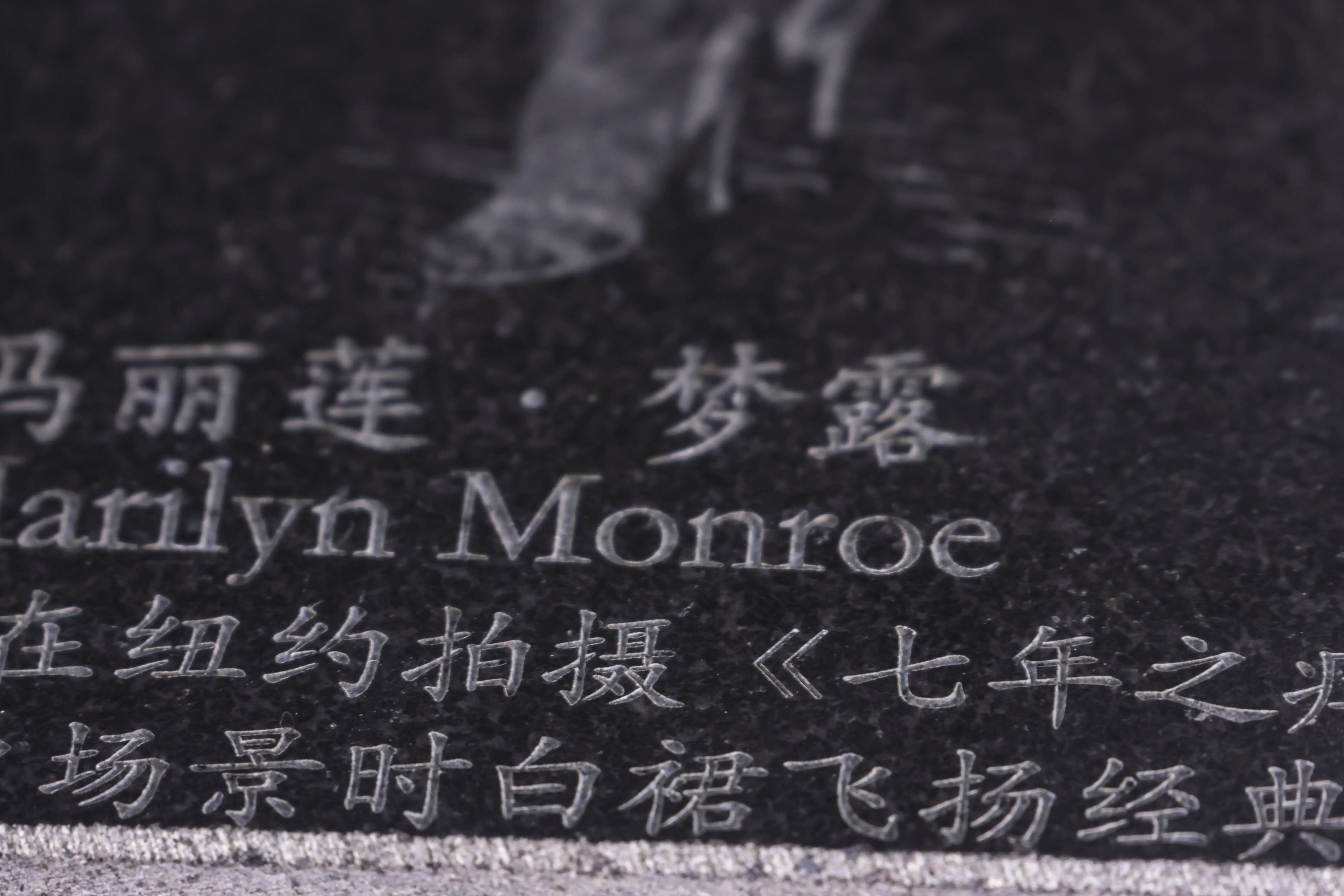
This result also shows why fiber should not automatically replace CO₂ for all marble processing. The fiber stage created a different effect, but it required considerably more processing time than the large CO₂ portrait area. It is most valuable when customers will pay for the deeper result or when the fiber source also supports profitable metal accessories and other products.
| Sample | CO₂ Portrait Time | Fiber Text Time | Total Laser Time |
| Einstein marble sample | 7 minutes 18 seconds | 34 minutes | 41 minutes 18 seconds |
| Marilyn Monroe marble sample | 7 minutes 24 seconds | 35 minutes | 42 minutes 24 seconds |
A processing-time comparison showing the CO₂ portrait stage, fiber text stage, and total laser time for the two marble samples.
After processing, each marble piece should be cleaned and inspected for portrait clarity, text readability, alignment, surface residue, edge definition, and overall presentation. Cleaning, handling, setup, and inspection time should also be included when calculating production capacity.

2 marble examples made with titan pro 35.
The strongest reason to upgrade is not that Titan Pro can process marble. A conventional CO₂ laser can already produce many marble products. The stronger business case is that a dual-laser platform can expand the complete range of products a workshop can manufacture and personalize.
Potential marble product categories include:
Additional revenue may come from the options added to the basic product rather than the marble blank itself. Possible upsells include:
A marble plaque with a marked metal nameplate and fitted display stand can support a higher selling price than a single engraved tile. Titan Pro becomes more valuable when the business regularly sells these complete products.
Machine speed alone does not determine production capacity. In the real test, the CO₂ portrait stage took slightly more than seven minutes, but the fiber text stage required 34 to 35 minutes. Therefore, deep fiber processing—not the advertised maximum motion speed—was the main production bottleneck.
A realistic capacity calculation should include:
For example, a sample requiring approximately 42 minutes of laser time cannot automatically be scheduled as eleven completed products in an eight-hour shift. Setup, cleaning, artwork, inspection, operator availability, and job changes reduce the actual output.
Workflow improvements may still come from camera-assisted positioning, saved templates, larger batch layouts, fewer transfers between machines, and the ability to process stone and metal components on one platform. These benefits should be measured through real production records rather than assumed from machine specifications.
Return on investment should be calculated from the additional profit created by the upgrade—not from total sales that the business was already generating.
| ROI Input | Costs or Values to Include |
| Total upgrade investment | Machine, shipping, installation, training, extraction, accessories, and workspace preparation |
| Cost per product | Marble blank, labor, machine time, electricity, cleaning, finishing, packaging, and rework |
| Revenue per product | Base price, personalization, design service, deeper engraving, accessories, and rush fees |
| Additional monthly orders | Orders that could not be accepted or produced efficiently with the current equipment |
| Avoided outsourcing | Metal marking, larger jobs, mixed-material work, transport, and supplier margins |
A business planning table that identifies the main costs and revenue inputs needed to estimate the ROI of a Titan Pro upgrade.
Monthly Additional Gross Profit
Additional monthly orders × average additional gross profit per order + avoided outsourcing costs
Estimated Payback Period
Total upgrade investment ÷ monthly additional gross profit
Suppose the current CO₂ machine can already produce the same basic plaque. Revenue from that plaque should not be counted as a benefit of upgrading. The calculation should include only the additional margin created by new product effects, metal accessories, larger orders, lower outsourcing costs, shorter setup, or higher capacity.
If the result depends on a large increase in orders that has not yet been validated, the business may be better served by testing the market first. Product samples, pre-orders, advertising campaigns, and existing customer interviews can provide evidence before a major equipment purchase.
Titan Pro is a strong option for established or growing businesses that need more than basic marble surface engraving. Its value comes from combining RF CO₂ and MOPA fiber processing, supporting mixed-material products, offering larger work areas, and reducing dependence on separate equipment for stone and metal components.
However, a conventional CO₂ laser may remain the better investment for a workshop focused on occasional portraits, surface text, decorative patterns, or small personalized plaques. In that situation, the additional fiber capability and production platform may not generate enough new profit to recover the higher investment.
The best laser engraver for a marble business is therefore the machine that matches its real order mix. Before upgrading, determine which jobs are currently being rejected or outsourced, how much additional gross profit those jobs could generate, how often the new capabilities would be used, and how long the investment would take to recover.
Titan Pro is most compelling when the answer is measurable: more profitable products, less outsourcing, more consistent production, or greater capacity for confirmed demand.
Test Your Marble Before Choosing a Machine
Send your marble sample, artwork, and target effect to Thunder Laser to evaluate CO₂, fiber, or combined processing before making an upgrade decision.
Contact UsTalk To Our Experts Now!
Please leave your contact information so that we can serve you better.
FAQS
Yes. Titan Pro can be used for marble surface engraving, including text, decorative graphics, photo engraving, memorial plaques, awards, and custom stone products. For best results, users should test parameters based on marble color, surface finish, artwork type, and desired contrast.
CO2 laser is commonly used for marble surface engraving, especially for photos, text, and decorative artwork. The best choice also depends on the marble type, engraving goal, and whether the business needs to process other materials such as metal, wood, or acrylic in the same workflow.
Marble laser engraving can be profitable because marble products often have higher perceived value than common gift materials. Memorial plaques, pet memorials, awards, wedding gifts, and luxury décor pieces can support premium pricing when the engraving quality, design, and presentation are professional.
Popular marble engraving products include memorial plaques, pet memorial stones, wedding keepsakes, corporate awards, marble coasters, home décor tiles, hotel signs, restaurant signs, executive desk pieces, and premium gift sets with metal or wood accessories.
Businesses may consider upgrading to Titan Pro when their current laser workflow limits engraving quality, production speed, working area, positioning accuracy, or mixed-material product options. Titan Pro is designed to support more professional production needs for shops that want to scale marble engraving into a repeatable business line.
Titan Pro is designed as a dual-laser system, which makes it suitable for businesses that want to combine marble engraving with metal marking or mixed-material product packages. This is useful for marble plaques with nameplates, awards with logo tags, memorial products with QR code plates, and premium gift sets.
The best Titan Pro size depends on your typical product dimensions, daily order volume, batch production needs, workshop space, and future product plans. Smaller formats may suit gifts and compact plaques, while larger formats are better for memorial boards, décor panels, signage, and batch layouts.
Start with clean marble surfaces and test different speed, power, interval, and image settings before production. Dark marble often provides stronger visual contrast for photo engraving. High-quality artwork preparation is also important, especially for portraits, memorial images, and detailed graphics.
FIND THE RIGHT LASER FOR YOUR NEXT PROJECT
Explore Thunder Laser solutions designed for different materials, workflows, and production needs.


 Stable & Consistent MachinesUnlimited ApplicationsRobust After-sales SupportFactory Direct Supply


