


Laser Cutter Venting Outside vs Fume Extractor: Best Ventilation Setup
 2026-07-08
WHAT ARE YOU LOOKING FOR?
Search Across Products, Blog Posts, Support Content, And Resources.

Laser Cutter Venting Outside vs Fume Extractor: Best Ventilation Setup
2026-07-08
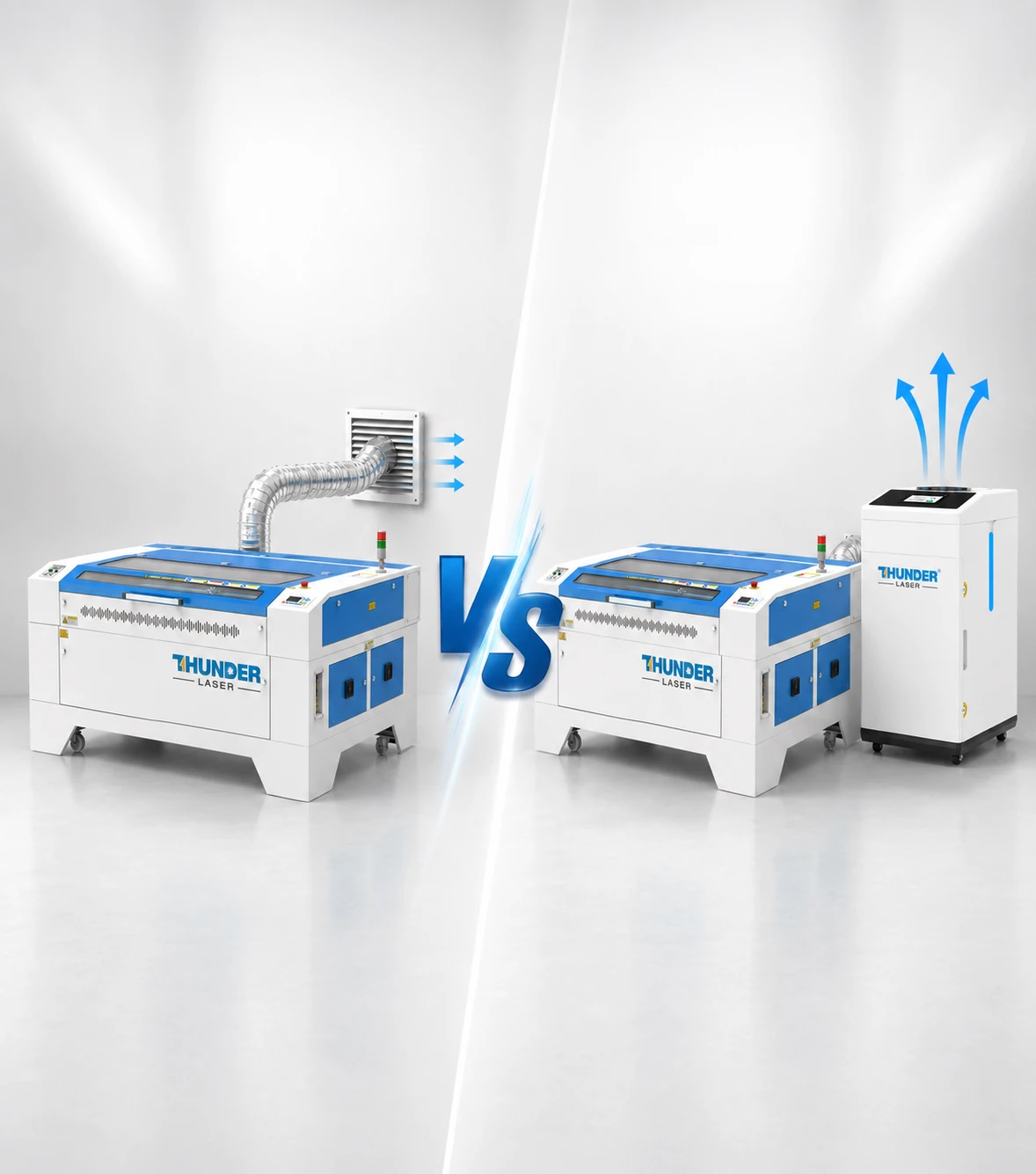
When setting up a laser cutter, one of the first questions is whether you should vent the fumes outside or use a fume extractor. Both options can work, but they solve different problems and fit different workspaces.
Venting outside is often simple when you have a short, direct exhaust path and only use the laser occasionally. A fume extractor becomes more valuable when you use the laser indoors, work in a shared or air-conditioned space, process smoky or odorous materials, or need more control over particles, odor, and VOCs.
For simple garage setups with a short, safe exhaust route, venting outside may be enough. For indoor laser cutter ventilation, acrylic smoke, MDF smoke, shared spaces, air-conditioned rooms, or daily production, a fume extractor or hybrid setup is usually better. The best choice depends on local venting rules, ducting conditions, materials, usage frequency, and odor or VOC control needs.
| Your Situation | Better Choice |
| Short duct path, garage, occasional use | Vent outside |
| Indoor room, no easy outdoor exhaust route | Fume extractor |
| Apartment, office, classroom, or shared workspace | Fume extractor |
| Laser cutting acrylic smoke, MDF smoke, leather odor, rubber odor, or coated materials | Fume extractor or hybrid setup |
| Air-conditioned or heated room | Fume extractor or hybrid setup |
| Neighbor-sensitive exhaust location | Fume extractor + outdoor exhaust |
| Need both filtration and outdoor discharge | Fume extractor + outdoor exhaust |
A quick comparison table that shows when to vent a laser cutter outside and when to use a fume extractor or hybrid ventilation setup.
Laser cutter ventilation matters because laser cutting and engraving can create smoke, fumes, fine particles, odors, VOCs, and gas-phase contaminants. These pollutants should be removed from the laser machine and workspace before they affect operators, nearby workers, indoor air quality, machine safety, or workspace comfort.
During laser cutting or engraving, the material is heated, burned, melted, or vaporized. Wood and plywood can create smoke and resin odor. Acrylic often creates a strong smell. MDF can produce dense smoke and adhesive-related odor. Leather, rubber, plastics, and coated boards may create stronger fumes that are harder to manage with basic outdoor venting alone.
Poor ventilation can also affect the laser cutter itself. Smoke, residue, and heat can build up on lenses, mirrors, cutting beds, cabinet surfaces, and exhaust paths. Over time, this may reduce cutting quality, increase cleaning work, and raise the risk of flare-ups when processing combustible materials.
That is why the real question is not only “Can I vent my laser cutter outside?” The better question is: “Can my setup remove laser cutting fumes effectively, control odor and VOCs, protect the workspace, and support stable long-term use?”
Venting a laser cutter outside means connecting the laser cutter to an exhaust hose, duct, laser cutter exhaust fan, or inline fan, then sending smoke and fumes outdoors through a window, wall vent, roof outlet, or dedicated exhaust path.
This is one of the most common laser cutter ventilation setups, especially for garages, detached workshops, and fixed workspaces with easy outdoor access. The goal is to move laser cutting fumes, smoke, heat, and odor out of the room before they spread through the workspace.
A basic laser cutter vent outside setup pulls contaminated air from the machine’s exhaust port and pushes it outdoors through ducting. The airflow may come from the laser cutter’s built-in exhaust fan, an external inline fan, or a dedicated laser cutter exhaust fan installed along the duct path.
A typical vent-out setup includes:
The cleaner and shorter the exhaust route is, the easier it is for the fan to move smoke outside. Long duct runs, tight bends, narrow hoses, loose connections, or poorly placed outdoor outlets can reduce exhaust performance and allow odor to remain near the laser cutter or return into the building.
Venting outside is often the first option many laser cutter owners consider because it is simple, familiar, and usually cheaper than buying a dedicated fume extractor.
Main advantages:
Main limitations:
These limitations are why many users start comparing a laser exhaust fan vs fume extractor after they move the laser indoors, increase production, cut stronger-smell materials, or receive odor complaints around the exhaust outlet.
Venting outside works best when the exhaust route is short, direct, and easy to control.
It is usually a good fit when:
Key point: Venting outside can be practical and cost-effective when the setup is simple, safe, and low-risk.
A simple vent-out setup may not be enough when your laser work creates more smoke, odor, or installation pressure than the exhaust path can handle.
Consider a fume extractor or hybrid setup if:
Key point: Venting outside mainly moves fumes from one place to another. If you need filtration, odor reduction, VOC control, or better indoor air management, a fume extractor becomes more valuable.
A fume extractor for laser cutter use captures smoke and fumes from the laser machine, passes the contaminated air through filters, and then discharges the treated air back into the room or sends it outdoors, depending on the setup.
Compared with a simple vent-out setup, a laser fume extractor helps control smoke, fine particles, odor, VOCs, and airborne residue before the air is released. This makes it especially useful for indoor laser cutter ventilation, shared workspaces, air-conditioned rooms, schools, offices, makerspaces, and small laser businesses.
A basic laser fume extraction setup connects the laser cutter exhaust port to the fume extractor through an exhaust hose or duct. When the laser starts cutting or engraving, the extractor pulls laser cutting fumes from the laser bed and guides the contaminated air into the filtration system.
A typical laser fume extraction system may include:
Some fume extractors are used as indoor recirculation systems. Others are connected to an outdoor exhaust path after filtration. A common hybrid setup is:
Hybrid setup
Laser cutter → Fume extractor → Outdoor exhaust
This setup filters laser cutting fumes before the air leaves the building, helping reduce odor, particles, and pollutant load around the outdoor discharge point.
A laser fume extractor gives you more control over smoke, odor, particles, and VOCs, but it also comes with cost and maintenance requirements.
Main advantages:
Main limitations:
For users who process strong-smell materials or run laser jobs every day, a professional laser fume extractor can be a more practical long-term solution than relying only on a simple exhaust fan.
A laser fume extractor is usually a better fit when your setup has more demanding air-control needs.
It is more suitable when:
Key point: A fume extractor is usually the better choice when your laser setup involves indoor use, strong-smell materials, shared spaces, long working hours, difficult outdoor venting, or higher expectations for air control.
For most laser cutter owners, the better choice depends on where the laser is installed, what materials are processed, how often the machine runs, whether odor control is needed, and whether the workspace allows a proper outdoor exhaust route.
| Factor | Vent Outside | Fume Extractor |
| Best use case | Garages, workshops, fixed spaces | Indoor setups, offices, classrooms, apartments, makerspaces |
| Installation requirement | Requires easy outdoor access | More flexible, works when direct outdoor venting is difficult |
| Key advantage | Simple if a short, safe exhaust path is available | Easier when wall drilling, window venting, or fixed ductwork is limited |
An installation comparison table that shows when outdoor venting or a fume extractor is easier to install.
| Aspect | Vent Outside | Fume Extractor |
| Upfront cost | Lower | Higher |
| Ongoing cost | No filter replacement | Requires filter replacement |
| Air quality control | Basic removal only | Controls smoke, odor, particles, and VOCs |
| Long-term value | Better for simple, low-risk setups | Better for indoor air quality and stable use |
A cost comparison table that explains upfront cost, ongoing cost, air control, and long-term value differences.
| Aspect | Vent Outside | Fume Extractor |
| Odor handling | Moves odor outdoors without treatment | Reduces odor through filtration before discharge or recirculation |
| Impact area | May affect nearby outdoor spaces | Helps reduce odor impact around the workspace or outlet |
| Best use case | Low-odor materials, isolated outlets | Odor-sensitive environments or shared spaces |
An odor-control table that compares how outdoor venting and fume extraction handle laser cutting smells.
Key point: If odor may affect neighbors, customers, students, employees, or nearby work areas, a laser fume extractor or hybrid setup is usually a better choice.
| Aspect | Vent Outside | Fume Extractor |
| VOC handling | Removes VOCs from the room but releases them outdoors without treatment | Uses carbon or gas-phase filtration to help reduce VOCs |
| Treatment before discharge | No | Yes, depending on filter type and quality |
| Control level | Basic removal only | Controlled filtration and reduction |
A VOC-control table that compares untreated outdoor discharge with carbon or gas-phase filtration.
Key point: For VOC control, focus on filtration capability, carbon capacity, and filter condition, not just airflow power.
| Factor | Vent Outside | Fume Extractor |
| HVAC impact | Removes conditioned indoor air during operation | Reduces dependence on constant outdoor exhaust |
| Energy effect | May increase heating or cooling load | Helps maintain indoor temperature stability |
| Best use case | Non-conditioned or simple workshop spaces | Air-conditioned or heated indoor spaces |
An HVAC impact table that shows how outdoor venting and fume extraction affect conditioned indoor air.
| Aspect | Vent Outside | Fume Extractor |
| Maintenance type | Duct, fan, outlet, and sealing inspection | Filter checks, replacement, suction monitoring |
| Consumables | Minimal | Requires filter replacement |
| Maintenance effort | Low to moderate | Moderate |
| Control stability | Depends on ducting and fan condition | More stable when filters are maintained properly |
A maintenance table that compares duct and fan inspection with filter-based fume extractor maintenance.
| Aspect | Vent Outside | Fume Extractor |
| Layout type | More fixed | More flexible |
| Mobility | Harder to move after installation | Easier to reposition |
| Workspace fit | Stable, permanent environments | Changing or growing workspaces |
A mobility comparison table that explains why fume extractors can be more flexible than fixed outdoor venting routes.
Key point: If your laser cutter may move later, or if your workshop layout is still changing, a fume extractor offers greater flexibility than a fixed vent-out setup.
| Scenario / Condition | Vent Outside | Fume Extractor |
| Workspace type | Garages, detached workshops | Home studios, offices, classrooms |
| Layout | Fixed production spaces | Flexible or shared workspaces |
| Ducting | Short, direct duct paths | No fixed duct required |
| Material odor | Low-odor materials | Strong-smell materials |
| Air quality sensitivity | Low concern | Odor-sensitive environments |
| Temperature control | Not critical | Air-conditioned or heated rooms |
| Typical environments | Simple workshops | Labs, makerspaces, schools |
A workspace comparison table that shows where outdoor venting or fume extraction is usually a better fit.
Quick takeaway: Vent Outside or Use a Fume Extractor?
Choose venting outside if your laser cutter has a short, safe, and approved outdoor exhaust path, and your work does not create major odor or air quality concerns.
Choose a fume extractor if your laser cutter is used indoors, in a shared or air-conditioned space, with strong-smell materials, or in a location where smoke and odor need better control.
Choosing between venting outside and using a laser fume extractor is not only about cost. The better choice depends on whether outdoor exhaust is allowed, whether the duct path can move fumes effectively, what materials you process, how often you use the laser cutter, and how much air control your workspace requires.
Direct outdoor venting is only a good option when it is allowed, safely routed, and unlikely to affect nearby people.
Before choosing a vent-out setup, check:
A vent-out setup does not treat the fumes. It moves smoke, odor, fine particles, VOCs, and gas-phase contaminants from the laser room to the outdoor environment. If untreated laser fumes may create odor, VOC, air quality, or neighbor-related concerns, a laser fume extractor or hybrid setup is usually the safer long-term choice.
Even if outdoor venting is allowed, the exhaust path still needs to work in real conditions. A poor duct route can make a vent-out setup weak, noisy, or unreliable.
Check these points:
A long duct path, narrow hose, weak exhaust fan, or poorly placed outlet can leave smoke inside the laser cabinet or odor in the room.
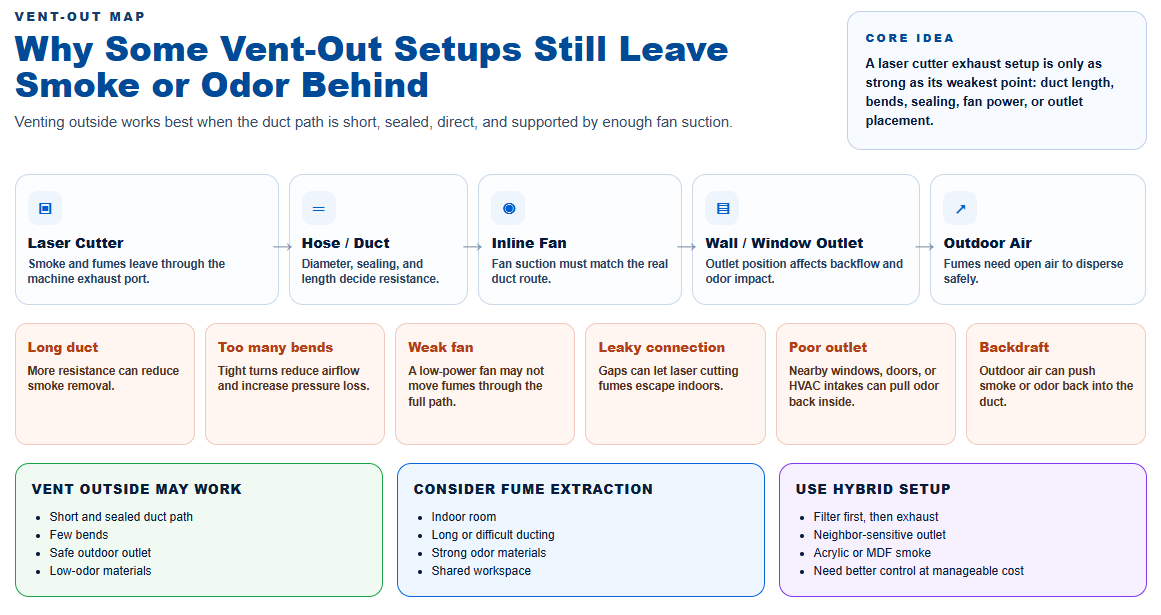
Key point: Venting outside works best when the exhaust path is short, sealed, direct, and supported by enough fan power. If your exhaust path is difficult, a fume extractor or hybrid setup may provide more stable smoke control.
Material choice directly decides how much smoke, odor, residue, and VOC control your laser cutter ventilation setup needs.
| Material | Smoke | Odor | VOC Concern | Better Setup |
| Wood | Medium | Medium | Low-Medium | Vent or Extractor |
| Acrylic | Medium | High | High | Extractor / Hybrid |
| MDF | High | High | Medium-High | Extractor / Hybrid |
| Rubber | High | High | High | Extractor / Hybrid |
| Paper | Low-Medium | Low | Low | Vent may work |
A material ventilation table that summarizes common fume concerns for laser cutting and engraving materials.
If you mainly process low-odor materials for occasional projects, a safe and well-designed vent-out setup may be enough. If you often cut acrylic, MDF, leather, rubber, plastics, coated boards, or other odor-heavy materials, a fume extractor or hybrid setup is usually a better choice.
Material safety note: Do not laser cut PVC, vinyl, or unknown plastics unless the material is confirmed safe for laser processing.
The more often your laser cutter runs, the more stable your ventilation setup needs to be.
| Usage Frequency | Better Direction |
| Occasional hobby use | Vent outside may be enough if the outlet is safe |
| Weekly craft projects | Vent outside or fume extractor, depending on material and workspace |
| Daily laser cutting or engraving | Fume extractor or hybrid setup |
| Long production runs | High-performance fume extraction setup |
| Multiple jobs in the same room | Fume extractor or hybrid setup |
| Multiple laser machines | Larger extractor or central fume extraction system |
A usage-frequency table that explains how laser workload affects the best ventilation setup choice.
Repeated laser cutting can cause odor to build up in the room, residue to collect inside the machine, and filters or ducts to load faster. If the laser supports customer orders or daily production, the ventilation system should maintain consistent airflow and suction over time.
Key point: The more often the laser cutter runs, the less you should judge ventilation by upfront cost alone. Airflow, static pressure, filter capacity, odor control, and maintenance planning become part of the real operating cost.
The more shared, enclosed, or professional the workspace is, the more valuable a fume extractor becomes.
| Workspace | Typical Need |
| Garage | Vent outside may work if the outlet is safe and isolated |
| Detached workshop | Vent outside often works well with short ducting |
| Home studio | Fume extractor helps manage indoor air and odor |
| Apartment | Fume extractor is usually more practical |
| Office / studio | Fume extractor helps control odor, comfort, and workspace appearance |
| School / STEAM classroom | Controlled fume extraction is usually preferred |
| Lab / makerspace | Fume extractor or hybrid setup for shared use |
| Small business workshop | Depends on material, production volume, and odor sensitivity |
| Commercial building | Fume extractor or approved exhaust setup may be required |
A workspace planning table that explains typical laser ventilation needs for garages, home studios, offices, schools, makerspaces, and commercial buildings.
If your laser cutter is used near students, employees, customers, family members, neighbors, or nearby workers, the ventilation setup should do more than remove visible smoke. It should help control odor, fine particles, VOCs, and long-term workspace comfort.
Air conditioning and heating also matter. Venting outside continuously pulls indoor air out of the workspace while the laser cutter is running. In summer, this can remove cooled air from an air-conditioned room. In winter, it can remove heated air. For temperature-controlled offices, classrooms, studios, labs, and production spaces, this can affect comfort and energy cost over time.
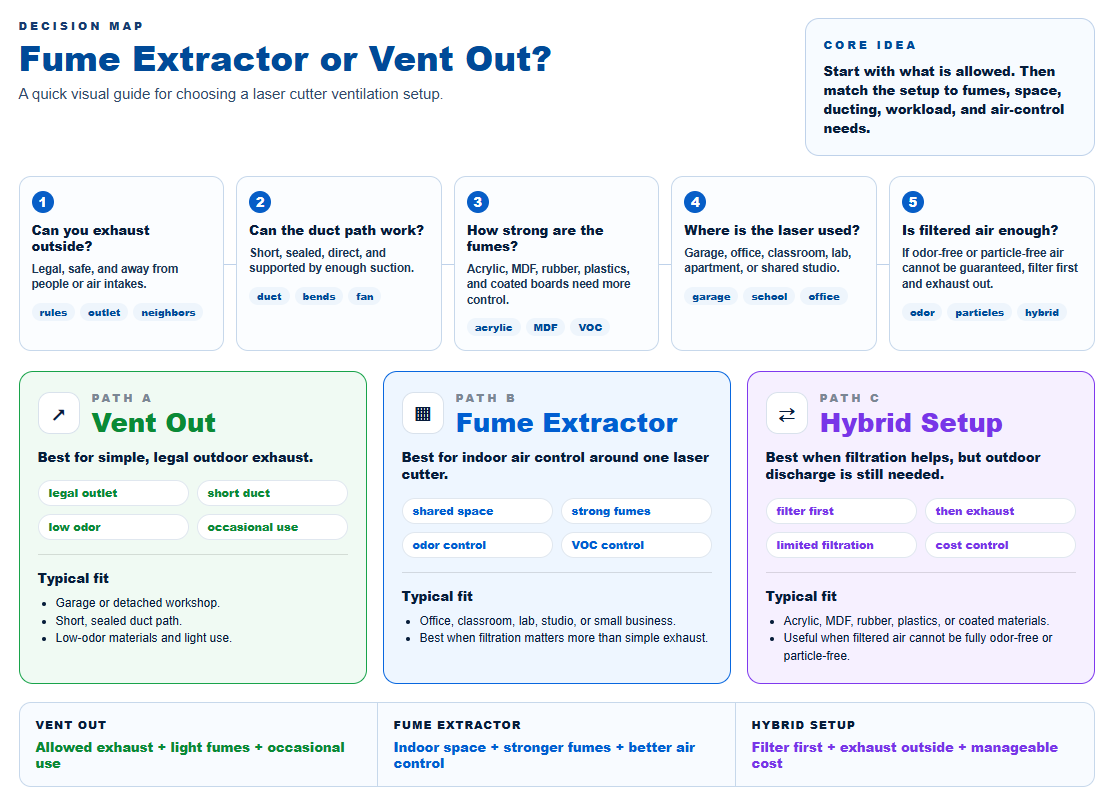
Key point: If you need indoor air quality, odor control, VOC control, shared-space comfort, or stable temperature, a fume extractor or hybrid setup is usually more practical than direct venting alone.
Most laser cutter ventilation setups fall into three practical options: vent outside only, fume extractor only, or fume extractor + outdoor exhaust.
A vent-out-only setup works when your laser cutter exhaust can be safely routed outdoors without filtration.
Typical setup
Laser cutter → Exhaust hose / duct → Exhaust fan or inline fan → Outdoor outlet
Best for:
| Situation | Recommendation |
| Simple garage setup | Vent outside |
| Short duct path | Vent outside |
| Low-odor materials | Vent outside |
| Occasional hobby use | Vent outside |
| Acrylic, MDF, rubber, or coated materials | Consider fume extractor or hybrid setup |
| Neighbor-sensitive outlet | Consider fume extractor or hybrid setup |
A vent-out setup table that shows when direct outdoor laser exhaust is practical and when filtration should be considered.
Key point: Venting outside is practical when the setup is simple, safe, and low-risk. It is less suitable when laser cutting fumes, odor, VOCs, or outdoor discharge concerns need better control.
A fume extractor for laser cutter use is better when direct outdoor venting is difficult, restricted, or not ideal for indoor air quality.
Typical setup
Laser cutter → Fume extractor → Filtered air discharge
Best for:
| Situation | Recommendation |
| No easy outdoor exhaust route | Fume extractor |
| Indoor laser cutter setup | Fume extractor |
| Air-conditioned or heated room | Fume extractor |
| Shared workspace | Fume extractor |
| Strong-smell materials | Fume extractor |
| Daily laser cutting or engraving | Fume extractor or hybrid setup |
A fume-extractor setup table that shows when indoor filtration is the better laser ventilation option.
Key point: A fume extractor for laser cutter use is valuable when you need more than basic smoke removal. It helps manage smoke, odor, particles, VOCs, and indoor workspace comfort.
A hybrid setup combines laser fume extraction with outdoor discharge. This is often the most balanced option for professional, shared, or odor-sensitive spaces.
Typical setup
Laser cutter → Fume extractor → Outdoor exhaust
A hybrid setup is also useful when the fume extractor’s filtration capacity is limited. Not every fume extractor can make the air completely odor-free or particle-free, especially during laser cutting acrylic smoke, MDF smoke, rubber odor, plastics, or coated materials. If you want better control without relying on a very large or expensive filtration system, adding outdoor exhaust after the fume extractor can be a more practical solution.
In this setup, the fume extractor reduces smoke, particles, odor, and VOC load first. Then the remaining treated air is discharged outdoors. This helps keep indoor air cleaner while keeping the total setup cost more manageable.
Best for:
| Situation | Recommendation |
| You need filtration and outdoor exhaust | Hybrid setup |
| Your fume extractor cannot guarantee odor-free or particle-free air | Hybrid setup |
| Outdoor odor may affect nearby people | Hybrid setup |
| School, lab, office, or makerspace | Hybrid setup |
| Daily cutting of acrylic or MDF | Hybrid setup |
| Strong VOC or odor concern | Hybrid setup |
| Professional workspace | Hybrid setup |
A hybrid setup table that explains when to combine a fume extractor with outdoor exhaust.
Key point: A hybrid setup is a practical middle ground. It reduces laser cutting fumes through filtration first, then sends the remaining treated air outdoors instead of relying on indoor recirculation alone.
If you choose a fume extractor for laser cutter use, do not judge it only by price or fan size. A good laser smoke extractor should match your machine size, materials, smoke load, ducting conditions, and maintenance expectations.
For a deeper explanation of airflow, static pressure, capture velocity, filtration stages, filter life, total cost of ownership, and the full selection process, read the complete guide: Best Fume Extractor Buying Guide.
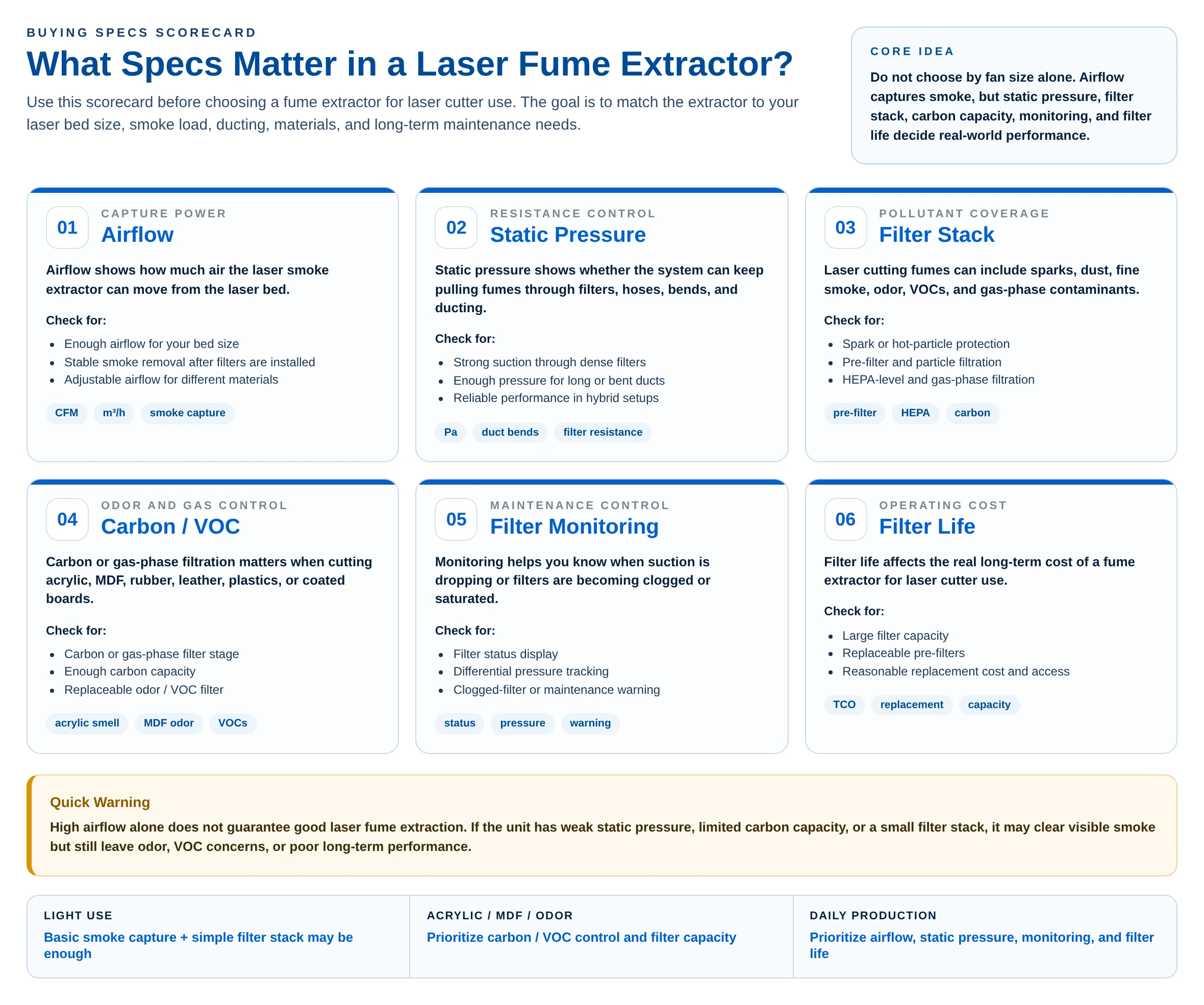
| Spec | Why It Matters |
| Airflow | Helps clear smoke from the laser bed |
| Static pressure | Maintains suction through filters, hoses, duct bends, and exhaust resistance |
| Filter stack | Handles smoke, dust, particles, odor, and VOCs |
| Carbon / VOC control | Helps reduce acrylic smell, MDF odor, and gas-phase contaminants |
| Filter monitoring | Helps maintain performance before suction drops or odor returns |
| Filter life | Affects long-term operating cost |
A fume extractor buying-check table that explains why airflow, static pressure, filter stack, carbon media, monitoring, and filter life matter.
Simple checklist:
Key point: Airflow captures visible smoke, but static pressure, filter design, carbon capacity, monitoring, and filter life decide whether the fume extractor performs well in daily use.
After comparing venting outside and using a fume extractor, the next question is usually simple: which fume extractor for laser cutter use should you choose?
The models below are examples by setup level. Final selection should be based on your laser bed size, material load, ducting conditions, filter configuration, and the latest manufacturer specifications.
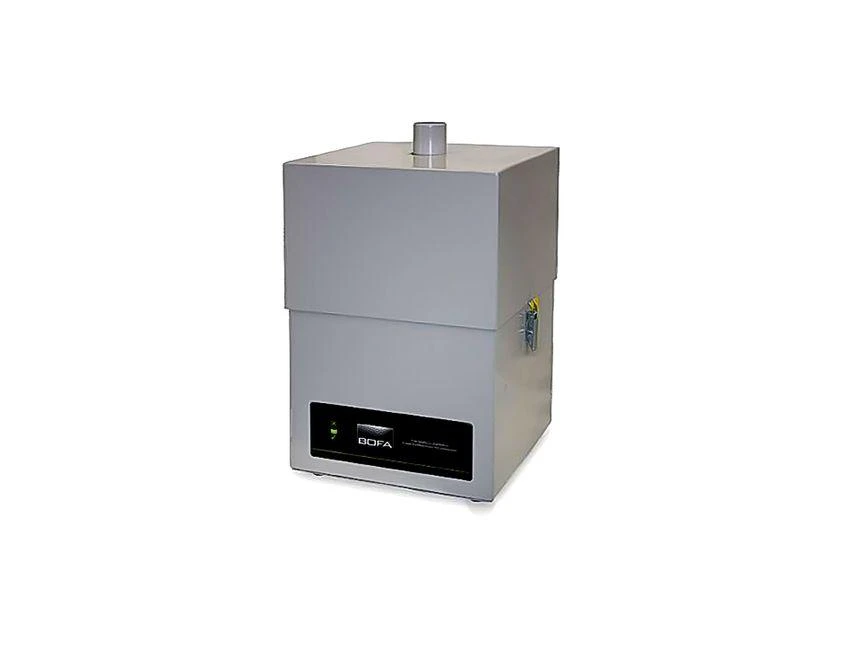
Best for:
BOFA AD Access is a compact fume extractor option for lighter laser engraving and small-format laser applications. It is suitable when the main need is basic smoke capture, particle filtration, and odor reduction in a small workspace.
Typical filtration focus:
Suitable for:
Not ideal for:
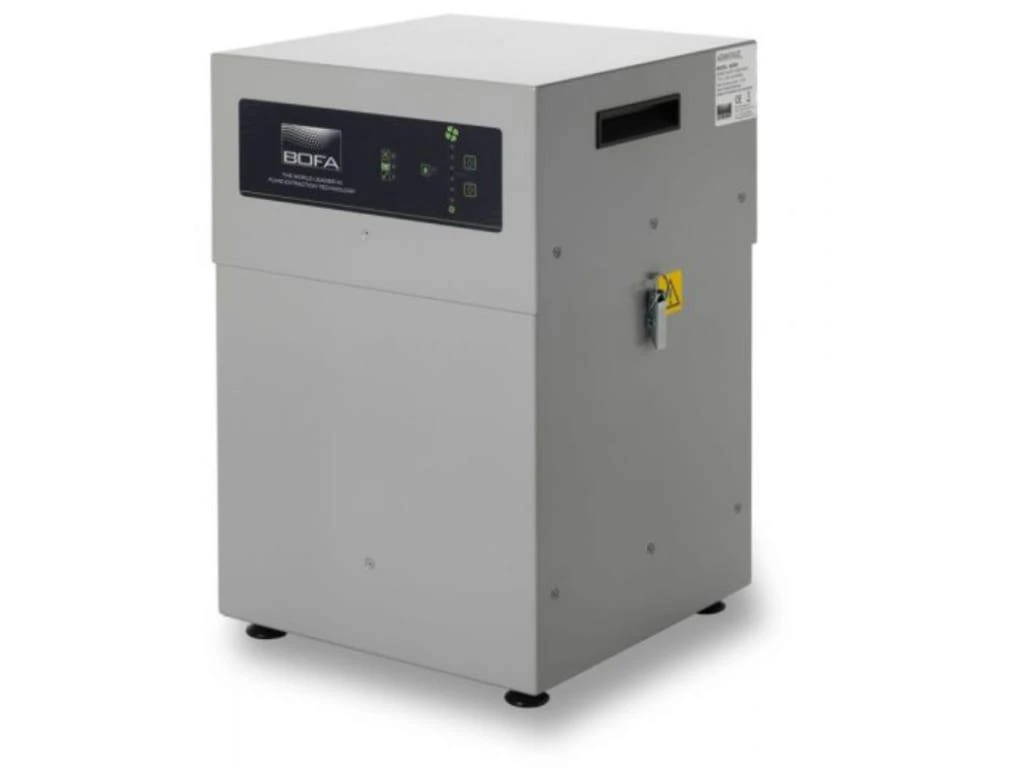
Best for:
BOFA AD 350 is a more capable fume extractor for laser cutter users who need better smoke and odor control than a small desktop extractor can provide. It is suitable for users who cut or engrave more often but still work with a compact laser setup.
Typical filtration focus:
Suitable for:
Not ideal for:
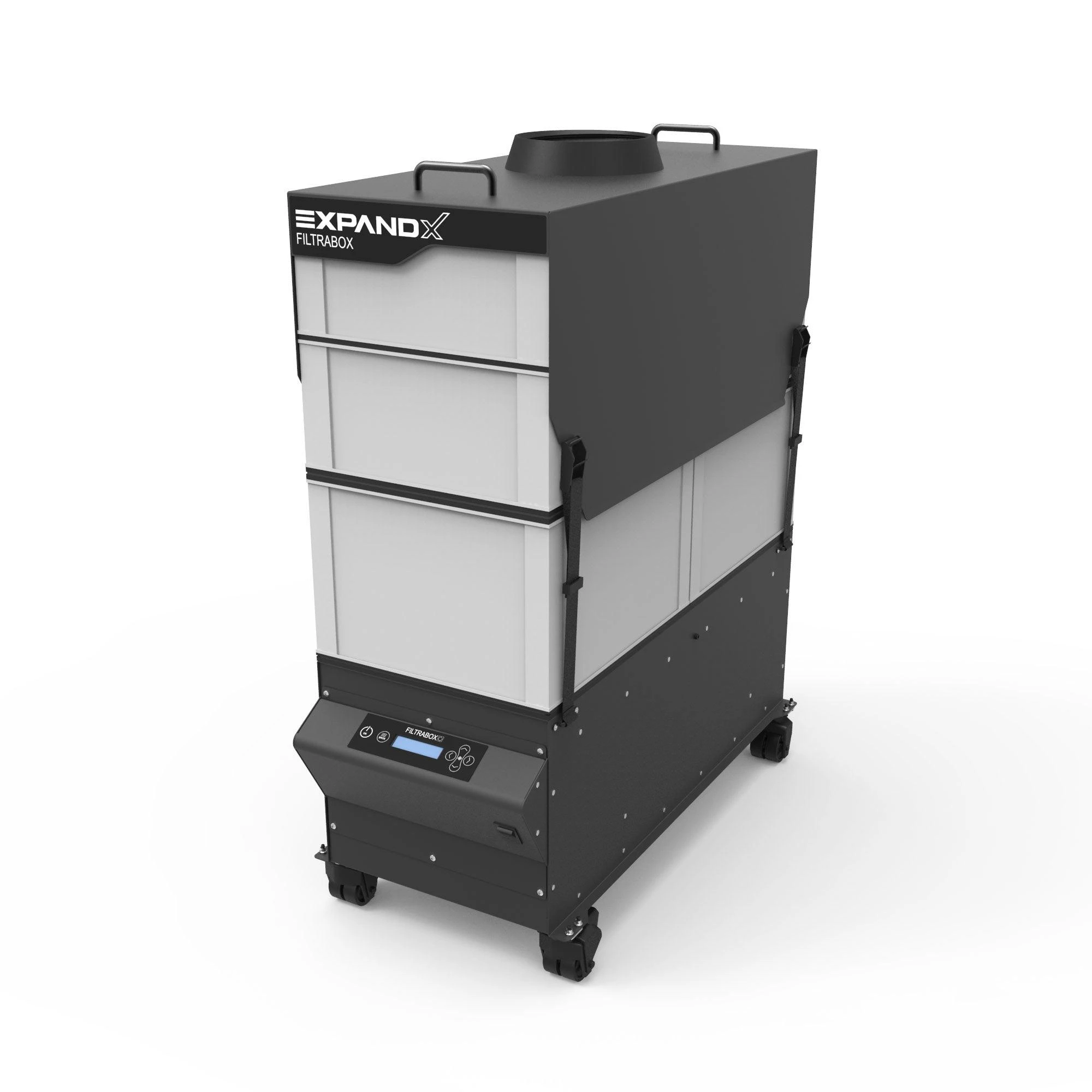
Best for:
Filtrabox systems are often considered by users who want a compact or expandable fume extraction setup for small laser cutter workspaces. They are suitable when the user wants better indoor smoke and odor control than direct outdoor venting, but still needs a relatively compact footprint.
Typical filtration focus:
Suitable for:
Not ideal for:

Best for:
Thunder Air 700 is a professional fume extractor for laser cutter setups that need stronger airflow, higher static pressure, and more complete filtration than compact desktop units. It is especially useful for CO₂ laser cutters, shared spaces, and users who process smoky or odor-heavy materials regularly.
Typical filtration focus:
Suitable for:
Not ideal for:
Key point: Thunder Air 700 is best positioned as a professional fume extractor for CO₂ laser cutter users who need stronger smoke capture, odor control, VOC filtration, and more stable long-term performance.
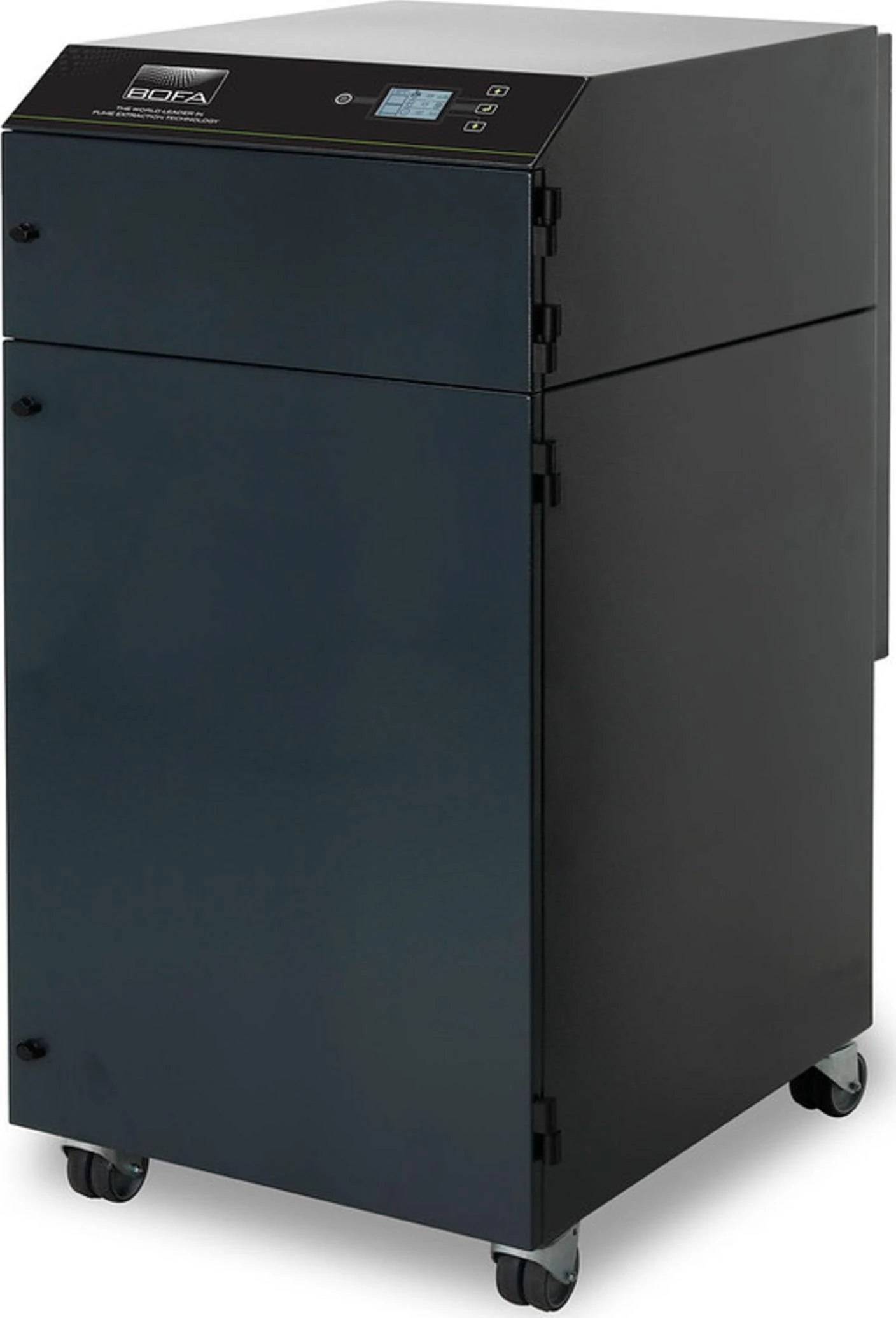
Best for:
For users running larger laser systems, frequent production, or multiple machines, a higher-capacity fume extraction system may be required. BOFA AD 500 iQ, AD Oracle iQ, or a central fume extraction system may be considered when a compact unit cannot provide enough airflow, static pressure, filter capacity, or long-term filter life.
Typical needs:
Suitable for:
Not ideal for:
| Level | Recommended Option | Best For | Main Value |
| Entry-level | BOFA AD Access | Small desktop lasers, light engraving | Compact smoke and odor control |
| Compact professional | BOFA AD 350 | Small to medium laser users | Stronger filtration for regular use |
| Flexible small-business | Filtrabox Compact / Expand Series | Makerspaces, studios, small workshops | Modular indoor filtration |
| Professional CO₂ laser setup | Thunder Air 700 | CO₂ laser cutters, schools, labs, makerspaces, businesses | Strong airflow, static pressure, multi-stage filtration, odor and VOC control |
| Large production | BOFA AD 500 iQ / AD Oracle iQ or central system | Large lasers, multiple machines, heavy production | Higher capacity and advanced monitoring |
A fume extractor recommendation table that compares entry-level, compact professional, small-business, professional CO₂ laser, and large-production extraction options.
Final recommendation: How to Choose a Fume Extractor
Choose BOFA AD Access if you need a compact fume extractor for light desktop laser engraving.
Choose BOFA AD 350 if you need a stronger compact fume extractor for small to medium laser cutter use.
Choose Filtrabox if you want a flexible filtration option for smaller workshops, makerspaces, or moderate laser cutting fumes.
Choose Thunder Air 700 if you need a professional fume extractor for CO₂ laser cutter setups involving acrylic smoke, MDF smoke, VOCs, odor control, shared workspaces, or daily production.
Choose BOFA AD 500 iQ, AD Oracle iQ, or a central fume extraction system if you run larger machines, multiple laser cutters, or high-volume production.
Key point: The best fume extractor for laser cutter use is not simply the smallest, cheapest, or strongest unit. It should match your laser bed size, materials, smoke load, odor control needs, ducting conditions, workspace type, and long-term maintenance expectations.
The right laser cutter ventilation setup depends on your space, materials, usage frequency, and air quality expectations. Venting outside can work well for simple garage or workshop setups with a short, safe exhaust path and low-odor materials.
If you use your laser cutter indoors, cut acrylic, MDF, rubber, plastics, or coated materials, or work in a school, office, makerspace, or shared space, a fume extractor or hybrid setup gives you better control over laser cutting fumes, odor, particles, VOCs, and workspace comfort.
Need Help Choosing the Right Laser Ventilation Setup?
Tell us your laser model, workspace type, materials, ducting conditions, and how often you run the machine. Our team can help you decide whether venting outside, using a fume extractor, or building a hybrid setup is the better fit.
Contact UsTalk To Our Experts Now!
Please leave your contact information so that we can serve you better.
LASER CUTTER VENTING
& FUME EXTRACTOR FAQS
Not always. Some laser cutter setups can use a fume extractor instead of direct outdoor venting. However, the setup must be able to capture and control laser cutting fumes, smoke, odor, particles, and VOCs. For simple garages, venting outside may work. For indoor or shared spaces, a fume extractor or hybrid setup is usually better.
Yes, but indoor laser cutter ventilation must be planned carefully. You need a way to capture smoke and fumes at the source, control odor and particles, and prevent fumes from spreading through the room. For home studios, offices, schools, labs, apartments, and makerspaces, a fume extractor is usually more practical than relying only on an exhaust fan.
A fume extractor is better when you need filtration, odor reduction, VOC control, indoor air quality control, or more installation flexibility. Venting outside can be better for simple garage or detached workshop setups with a short, safe exhaust path and low-odor materials.
A regular room air purifier is not a proper replacement for a fume extractor for laser cutter use. Laser cutting fumes should be captured at the machine exhaust source, not after they spread through the room. A laser fume extractor is designed to connect to the laser cutter and handle smoke, particles, odor, and VOCs more directly.
The smell may come from poor sealing, weak airflow, long ducting, too many bends, backdraft, outdoor fumes returning indoors, or strong-smell materials such as acrylic, MDF, rubber, leather, plastics, or coated boards. If the room still smells after cutting, a fume extractor or hybrid setup may provide better odor control.
For laser cutting acrylic smoke, a fume extractor or hybrid setup is usually recommended because acrylic can create a strong odor and VOC concern. A setup such as Laser cutter → Fume extractor → Outdoor exhaust can help reduce smoke, odor, particles, and VOC load before discharge.
Carbon or gas-phase filtration is important when odor and VOC control matter. Particle filters handle smoke and dust, while carbon or gas-phase filters help reduce odor and gas-phase contaminants. If you cut acrylic, MDF, rubber, leather, plastics, or coated boards, carbon / VOC filtration becomes more important.
Yes. A fume extractor and outdoor exhaust can be used together in a hybrid setup: Laser cutter → Fume extractor → Outdoor exhaust. This setup filters laser cutting fumes before they leave the building. It is useful for schools, offices, makerspaces, labs, professional workshops, and neighbor-sensitive exhaust locations.
FIND THE RIGHT LASER FOR YOUR NEXT PROJECT
Explore Thunder Laser solutions designed for different materials, workflows, and production needs.


 Stable & Consistent MachinesUnlimited ApplicationsRobust After-sales SupportFactory Direct Supply


