


Best Laser Fume Extractor for Engraving & Cutting: 2026 Buying Guide
 2026-03-13
WHAT ARE YOU LOOKING FOR?
Search Across Products, Blog Posts, Support Content, And Resources.

Best Laser Fume Extractor for Engraving & Cutting: 2026 Buying Guide
2026-03-13

Laser engraving and cutting can generate smoke, fine particles, odors, and gaseous contaminants as materials are heated, melted, vaporized, or ablated. A suitable fume extraction system helps capture these emissions close to the source and keep them from spreading throughout the workspace.
But choosing the best laser fume extractor is not as simple as comparing airflow numbers. Two extractors with similar maximum airflow can perform very differently once they are connected to a laser machine, ducting, and multiple filter stages. Static pressure, filtration design, activated carbon capacity, filter loading, machine size, processed materials, and daily workload can all affect real-world extraction performance.
In this guide, we explain the specifications that actually matter when choosing a fume extractor for laser engraving and cutting, show how extraction requirements change with different materials and production workloads, and compare five representative systems: Thunder Air 700, xTool SafetyPro AP2 Max, FumeClear XL-500, Donaldson BOFA AD Oracle iQ, and PURE-AIR PA-FS500. Rather than declaring one universal winner, the goal is to help you understand which type of system best fits your laser setup and working environment.
Quick Answer: The best laser fume extractor is not necessarily the model with the highest airflow or the most filter stages. A good system should maintain sufficient airflow through your actual laser enclosure and ducting, provide appropriate particle and gas-phase filtration for the materials you process, and have enough filter capacity for your expected workload.
When comparing laser fume extractors, look at airflow together with static pressure, particle filtration, activated carbon or other gas-phase media, filter capacity, monitoring, noise, maintenance requirements, and machine compatibility. The right choice depends on your laser, materials, ducting, production volume, and whether the air will be recirculated or exhausted outdoors.
A good laser fume extractor is not defined by one headline specification. Maximum airflow is important, but it tells only part of the story. Once an extractor is connected to a laser enclosure, hose, bends, and multiple filter stages, the fan has to overcome resistance while continuing to remove smoke from the working area.
Filtration also has to match what the laser process actually produces. Fine particles, visible smoke, odors, and gaseous contaminants behave differently and are not controlled by the same type of filter. At the same time, a system that performs well during occasional engraving may not have enough filter capacity for several hours of daily cutting.
When comparing laser fume extractors, the most useful approach is therefore to evaluate the complete system: airflow, static pressure, particle filtration, gas-phase filtration, filter capacity, monitoring, noise, maintenance, and the expected workload.
If you want to understand the basic working principle of fume extraction, filter stages, and the different types of systems before comparing products, see our guide to what a fume extractor is and how it works.
Airflow describes how much air an extractor can move over a given period and is commonly expressed in cubic meters per hour (m³/h) or cubic feet per minute (CFM). In a laser system, sufficient airflow helps pull smoke away from the cutting or engraving area and move it toward the exhaust connection before it spreads through the enclosure or escapes into the room.
However, the maximum airflow published on a specification sheet is usually not the same as the airflow that will be available in your real installation.
A complete laser extraction path may include:
Each part creates resistance. As a result, two extractors that both advertise 700 m³/h, for example, may not deliver the same airflow once they are connected to a machine and operating through loaded filters.
This is why a higher maximum airflow number should not automatically be treated as better performance. The more useful question is whether the extractor can maintain enough airflow through your actual laser, ducting, and filtration system.
The answer depends partly on airflow and partly on the extractor's ability to work against resistance, which brings us to static pressure.
Static pressure describes the resistance that the fan has to overcome as it moves air through the extraction system. It is commonly expressed in pascals (Pa), millibars, or similar pressure units.
In a laser workspace, resistance can build up quickly:
Laser enclosure + exhaust port + hose + bends + filter media + filter loading = total system resistance.
A machine positioned directly beside an extractor with a short, large-diameter hose presents a very different airflow challenge from the same machine connected through several meters of ducting with multiple bends.
Filters create resistance as well. Dense fine-particle filters and gas-phase filtration media naturally restrict airflow, and particle filters normally become more restrictive as they collect smoke and debris. An extractor therefore needs sufficient pressure capability to continue pulling air through the system as operating conditions change.
This explains why airflow and static pressure should be considered together:
Neither specification should be evaluated in isolation.
This is particularly important when comparing professional laser fume extractors. One unit may publish a very high maximum airflow, while another may use a lower nominal airflow but substantially higher pressure capability. The better option depends on the airflow requirements and resistance of the actual installation rather than which specification is numerically larger.
Laser engraving and cutting can generate a mixture of visible smoke, fine particulate, dust, fibers, and process residue. A well-designed extraction system typically uses several filtration layers so that larger contaminants are removed before the air reaches finer and more expensive filters.
A typical particle-filtration path may include:
When comparing extractors, however, the number of filtration stages should not be used as a simple quality score.
A seven-stage system is not automatically better than a five-stage system. Manufacturers may count layers differently, and two products may divide similar filtration functions into a different number of physical filters.
Instead of asking only, “How many filters does it have?”, look at:
For frequent laser cutting, filter capacity can be just as important as nominal filtration efficiency. A highly efficient filter that loads very quickly may create frequent maintenance and operating costs in a smoke-heavy workflow.
Particle filtration and gas-phase filtration solve different problems.
HEPA and other particle filters are designed primarily to capture airborne particulate. They should not be assumed to remove odors, vapors, or gaseous contaminants simply because they provide high particle-filtration efficiency.
Gas-phase filtration is commonly handled with activated carbon or other adsorbent media. This becomes particularly relevant when processing materials that generate noticeable odor or gaseous emissions.
But seeing “activated carbon filter” on a specification sheet still does not tell you everything about gas-filtration capability.
Useful factors include:
This distinction matters when comparing systems for acrylic, leather, adhesive-containing boards, and other odor-heavy laser applications. Two extractors can both contain activated carbon while providing very different amounts of gas-phase media and different filter service lives.
Activated carbon should also not be treated as a universal solution for every gas. The correct filtration media depends on the contaminants produced by the material and process.
How often you use the laser can change the extraction requirement dramatically.
Consider two workshops using similar laser machines:
Even if both machines require similar enclosure airflow, Workshop B will normally load its filters much faster because significantly more particulate and process residue passes through the extraction system.
That means the “best” extractor should be evaluated not only by whether it can remove smoke today, but by whether the filter system is practical for the expected production volume.
When comparing filter capacity, consider:
A lower-priced extractor can become expensive to operate if high-cost filters need frequent replacement. Conversely, a larger professional system may have a higher initial purchase price but make more sense for regular production if its filter capacity reduces maintenance frequency and downtime.
Extraction performance changes as filters become loaded. This makes monitoring especially useful in professional or frequently used laser systems.
Depending on the extractor, monitoring features may include:
Differential-pressure monitoring is particularly useful because the pressure drop across a particle filter generally changes as contamination accumulates. This can give operators a more practical indication of filter loading than relying only on a fixed replacement schedule.
Adjustable airflow is useful for a different reason. Not every material or process creates the same smoke load, and maximum fan speed is not always necessary for every job. Being able to adjust extraction can help balance smoke removal, noise, power consumption, and filter loading.
More advanced systems may also attempt to maintain airflow automatically as filter resistance changes. These features can be valuable in production environments where consistent extraction is more important than simply achieving maximum airflow when the filter is new.
Performance specifications are important, but a fume extractor also has to fit into the way the workspace operates every day.
Noise matters particularly in classrooms, makerspaces, offices, shared studios, and small businesses where people spend long periods close to the equipment. Published sound levels can help with comparison, although actual perceived noise will depend on fan speed, installation, ducting, room acoustics, and operating load.
Physical size matters as well. A larger filtration system may offer greater filter capacity but require more floor space. A compact unit may fit easily beside a desktop machine but may involve smaller filters and more frequent servicing when used for heavy production.
Maintenance access is often overlooked during purchasing. Before choosing an extractor, consider:
These details may not attract as much attention as airflow or filtration efficiency, but they can have a major effect on the long-term usability and operating cost of the system.
Ultimately, a good laser fume extractor is one that balances extraction performance, filtration, capacity, and day-to-day practicality for the actual laser workflow. There is no single specification that can determine the best system on its own.
Before comparing individual fume extractor models, it is worth deciding what type of extraction setup your workspace actually needs. Not every laser requires the same solution, and a dedicated filtered extractor is not automatically the best answer in every situation.
In practice, most laser workspaces fall into one of four broad categories: direct outdoor exhaust, compact filtered extraction, professional multi-stage extraction, or industrial extraction. There is also a hybrid approach that combines filtration with outdoor discharge.
| Extraction Setup | Typical Strength | Main Consideration | Best Fit |
|---|---|---|---|
| Direct outdoor exhaust | Simple airflow path and no routine filter replacement | Requires a suitable and compliant outdoor discharge location | Garages, detached workshops, and occasional use with a short exhaust route |
| Compact filtered extractor | Small footprint and relatively simple installation | Filter and airflow capacity may be limited for heavy smoke loads | Desktop lasers and lighter engraving workloads |
| Professional multi-stage extractor | Balances airflow, pressure, particle filtration, and gas-phase filtration | Higher initial cost and ongoing filter maintenance | Enclosed laser machines, workshops, small businesses, schools, and regular production |
| Industrial extraction system | Higher capacity, pressure capability, monitoring, and continuous-duty performance | Larger footprint, infrastructure requirements, and higher investment | Heavy production and demanding industrial processes |
| Filtered hybrid exhaust | Filters contaminants before discharging air outdoors | Requires both filter maintenance and an outdoor exhaust route | Workspaces that want filtration plus external discharge |
A comparison of common laser fume extraction setups, their main strengths, limitations, and typical applications.
Direct outdoor exhaust is the simplest laser ventilation approach. Instead of filtering the contaminated air and returning it to the room, the system pulls smoke from the laser enclosure and transports it outdoors through a hose or duct.
A typical setup may include:
This approach can work well when the laser is positioned close to a suitable outdoor outlet and the duct path is short, direct, and well sealed.
Its main advantage is simplicity. There are no particle or carbon filters to replace, which can reduce initial investment and ongoing filter costs. For an occasional-use laser in a detached workshop or garage, a properly designed outdoor exhaust path may therefore be entirely practical.
However, direct exhaust does not remove contaminants from the air before they leave the building. Smoke, odors, particles, and gaseous emissions are transferred to the outdoor discharge point rather than filtered.
This means the outlet location matters. Discharge close to windows, doors, HVAC intakes, neighboring properties, walkways, or frequently occupied areas can create problems even if the indoor workspace itself remains clear.
Outdoor exhaust performance also depends heavily on the duct design. Long hose runs, undersized ducts, sharp bends, leaks, and restrictive outlets all increase resistance and reduce effective airflow.
Direct outdoor exhaust is generally most practical when:
If you are deciding specifically between direct venting and filtered extraction, see our detailed comparison of laser cutter venting outside vs using a fume extractor.
Compact filtered extractors are designed for situations where users want filtration but do not need the capacity of a larger professional system. They are common around desktop engraving machines, compact laser systems, and relatively light-duty applications.
Their biggest advantages are usually:
The limitation is capacity.
A compact extractor may work very well when engraving small products for a few hours per week but become less economical if it is connected to a large enclosed CO₂ laser cutting smoke-heavy materials every day.
Smaller housings generally leave less space for large particle filters and substantial quantities of gas-phase media. As workload increases, this can mean more frequent filter replacement, faster pressure increase as filters load, or reduced suitability for sustained high-smoke processing.
Compact systems are therefore best judged by the application rather than their physical size alone.
They are most suitable when:
If your business grows from occasional engraving into regular production, filter consumption and sustained airflow can eventually become more important than compact size.
A professional multi-stage fume extractor is the category most relevant to many enclosed CO₂ laser workshops, small businesses, schools, makerspaces, and regular-production environments.
Instead of optimizing primarily for minimum size, these systems are generally designed to balance several requirements:
This category becomes particularly useful when a laser is operated indoors or when the workflow includes materials that create substantial smoke or odor.
It can also make more sense in air-conditioned or heated workspaces. A direct exhaust system continually removes conditioned indoor air and requires replacement air to enter the building. A recirculating filtered system can avoid some of that air exchange, provided the filtration configuration is suitable for the contaminants being generated.
Professional systems are commonly a good fit for:
The trade-off is that professional filtration introduces ongoing maintenance. Particle filters gradually load with contamination, while gas-phase media eventually becomes saturated. Replacement filters therefore need to be treated as part of the operating cost rather than an occasional unexpected expense.
This is also where differences between fume extractor designs become more meaningful. Two professional systems may have similar maximum airflow but substantially different static-pressure capability, filter architecture, monitoring, carbon capacity, or maintenance design.
Those differences are why the product comparison later in this guide evaluates more than headline airflow alone.
Industrial extraction systems are designed for workflows where production load, operating hours, airflow resistance, or contaminant volume exceed what is practical for smaller workshop-oriented equipment.
The key difference is not simply that an industrial extractor is “more powerful.” Industrial systems may be engineered around a different operating priority: maintaining stable extraction under high resistance, supporting larger filters, handling longer production cycles, monitoring filter condition more closely, or integrating with a broader production process.
Features may include:
An industrial extractor may therefore publish a lower maximum airflow than another product while still being better suited to a high-resistance production process. This is another reason that comparing extractors by airflow alone can be misleading.
Industrial extraction becomes more relevant when:
For a small workshop, buying an oversized industrial system can add unnecessary cost and complexity. For a demanding production line, however, choosing a light-duty extractor simply because it has a high advertised airflow can create the opposite problem.
The decision does not always have to be “filter the air and return it indoors” or “send everything directly outside.”
A hybrid arrangement can combine filtration with outdoor exhaust:
In this configuration, contaminated air is passed through the filtration system before it leaves the building.
This can be useful when users want to reduce particle and odor load before outdoor discharge while still avoiding recirculation of the treated air into the workspace.
A hybrid setup may make sense when:
The trade-off is that a hybrid setup keeps both sets of requirements: filters still require replacement, and the outdoor duct still needs to be designed correctly.
Before looking at individual products, start with the constraints of your workspace and workflow.
| Your Situation | Usually Worth Considering |
|---|---|
| Occasional laser use in a garage with a short, safe outdoor exhaust route | Direct outdoor exhaust |
| Small desktop laser used mainly for light engraving | Compact filtered extractor |
| Enclosed laser used regularly in a workshop or small business | Professional multi-stage fume extractor |
| School, office, makerspace, or shared indoor environment | Professional filtered extraction |
| Strong odor, significant smoke, or frequent cutting | Professional extraction with appropriate particle and gas-phase filtration |
| Daily high-load production or demanding industrial process | Industrial extraction system |
| Need filtration but still prefer to discharge air outdoors | Filtered hybrid exhaust |
A quick guide to matching common laser workloads and workspace conditions with suitable extraction setups.
These categories are starting points rather than rigid rules. Machine size, materials, exhaust-port design, duct resistance, operating hours, filter capacity, local requirements, and the contaminants generated by the process all need to be considered before choosing a final system.
Once you know which category fits your workflow, the next step is to evaluate your machine, materials, smoke load, airflow path, filtration requirements, and operating cost in more detail.
Once you understand the main extraction technologies and the specifications that matter, the next step is to match the system to your actual laser workflow. A fume extractor that works well for occasional engraving may be poorly suited to daily MDF cutting, while an oversized industrial unit may add unnecessary cost and complexity to a small desktop setup.
A practical selection process should start with the laser machine and materials, then work outward through smoke load, ducting, filtration, and long-term operating cost.
The laser machine determines the basic airflow path that the extractor must support. Before comparing extractor specifications, identify how air moves through your machine and how the exhaust system connects to it.
Check the following:
Avoid choosing an extractor only because its advertised airflow appears high enough for the machine's work area. The complete airflow path matters more than enclosure size alone.
If the laser manufacturer provides recommended airflow, duct size, or extraction requirements, use those values as the starting point rather than relying on a universal CFM rule.
Material choice has a major effect on extraction requirements because different laser processes produce different amounts and types of contamination.
| Material / Workload | Typical Extraction Challenge | What to Prioritize |
|---|---|---|
| Wood | Smoke, fine particulate, and residue | Stable airflow and sufficient particle-filter capacity |
| Plywood | Smoke, particulate, and emissions influenced by adhesives and construction | Particle filtration plus appropriate gas-phase filtration |
| MDF | High particulate and smoke load during frequent cutting | Pre-filter capacity, main-filter capacity, static pressure, and maintenance access |
| Acrylic | Odor and gaseous process emissions | Stable extraction and meaningful gas-phase / activated-carbon capacity |
| Leather | Odor, smoke, and particulate | Combined particle and gas-phase filtration |
| Paper / Cardboard | Light smoke and airborne particulate | Reliable airflow and particle filtration |
Common laser materials can create very different particle, smoke, and gas-phase filtration requirements.
The table above is a selection guide rather than a statement that every material in a category is automatically safe to laser. Material composition can vary significantly, especially with coated, laminated, adhesive-backed, composite, or unknown materials.
Always confirm that the specific material is suitable for laser processing before use. A fume extractor reduces exposure to process emissions; it does not make an unsuitable material safe to laser. You can also review Thunder Laser's CO₂ laser material compatibility guidance when evaluating common laser materials.
The same laser machine can require very different extraction capacity depending on how it is used.
Consider the difference between:
The enclosure may be identical, but the amount of contamination entering the filters can be dramatically different.
A useful way to classify workload is:
| Workload | Typical Use Pattern | Extraction Priority |
|---|---|---|
| Occasional | Short jobs a few times per week | Basic extraction performance and reasonable filter cost |
| Regular | Daily engraving and light cutting | Stable airflow, multi-stage filtration, and manageable filter replacement |
| Production | Several hours of processing most days | Larger filter capacity, pressure capability, monitoring, and easy servicing |
| Heavy / Continuous | Long cutting cycles or production-line use | High-capacity filtration, continuous-duty design, process monitoring, and low maintenance downtime |
Laser workload and operating hours directly affect filter capacity, pressure, monitoring, and maintenance requirements.
This step is important because filter capacity is often overlooked during initial purchasing. An extractor may remove smoke effectively when the filters are new but become expensive or inconvenient if a high-smoke workload requires frequent filter changes.
The extractor should be selected as part of the complete laser exhaust system rather than as an isolated appliance.
Trace the airflow from the laser bed all the way to the extractor or outdoor discharge:
Then look for potential sources of resistance.
If your installation uses a short, large-diameter hose with few bends, a system with moderate pressure capability may perform well. A longer or more restrictive installation may place greater importance on static pressure.
This is also why comparing only the maximum airflow values of two extractors can be misleading. The unit that performs better in your installation is the one that can deliver the required airflow against the resistance of the actual system.
Once you understand what the laser is producing, check whether the filtration architecture is designed to control those contaminants.
A useful selection logic is:
| Primary Challenge | Filtration Priority |
|---|---|
| Large amounts of dust or debris | Effective pre-filtration and high dust-holding capacity |
| Fine smoke and particulate | High-efficiency particle filtration |
| Strong odor or gaseous emissions | Adequate activated carbon or other appropriate gas-phase media |
| Mixed engraving and cutting workload | Balanced multi-stage particle and gas-phase filtration |
| Specialized chemical contaminants | Application-specific filtration media verified for the contaminant |
Match the filtration architecture to the type of particles, smoke, odors, and gaseous contaminants generated by the process.
Do not assume that a high HEPA rating automatically means the extractor provides strong odor or VOC control. Particle filtration and gas-phase filtration perform different functions.
Likewise, do not judge filtration quality purely by the number of stages. A five-stage system and an eight-layer system may use different ways of counting filters. The important questions are what each stage removes, how much filtration media is available, and how the filters perform under your expected workload.
Filter efficiency tells you how effectively a filter captures specified particles under its rated conditions. It does not tell you how long that filter will remain practical in your workshop.
For regular laser production, also look at:
This distinction becomes especially important when comparing compact purifiers with larger professional extractors. A small unit may provide excellent filtration efficiency while still requiring much more frequent servicing in a heavy cutting environment.
Monitoring becomes more valuable as production volume increases.
For occasional use, a simple manual fan-speed control and routine visual filter inspection may be sufficient. In daily production, additional monitoring can reduce uncertainty and help operators maintain more consistent extraction.
Useful features may include:
These features should not replace routine maintenance, but they can make it easier to identify when filter loading begins to affect extraction performance.
An extractor can meet the technical requirements and still be inconvenient to use if it does not fit the workspace.
Before purchasing, check:
Noise deserves particular attention in schools, makerspaces, shared workshops, retail production spaces, and home-based businesses. A few decibels can matter when an extractor runs for several hours close to the operator.
Keep in mind that published noise values are useful for comparison but do not perfectly predict perceived sound in every installation. Fan speed, ducting, machine noise, room acoustics, and measurement method can all affect the result.
The lowest purchase price does not necessarily produce the lowest operating cost.
A more useful comparison is:
Replacement filters are often the largest ongoing expense in a filtered extraction system. Before purchasing, check:
For a lightly used desktop laser, filter cost may remain relatively small. In daily production, however, even modest differences in filter life can have a meaningful effect on annual operating cost.
This is one reason that a professional extractor with a higher initial price can sometimes offer better long-term value for a production environment, while a smaller, lower-cost system may still make more sense for occasional use.
Finally, confirm that the extractor can be integrated properly with the machine and that the supplier can support the system after purchase.
Check:
Ecosystem integration can also matter. Some extractors can automatically start and stop with a compatible laser machine or communicate filter status through the manufacturer's control system. Other professional units are designed as standalone systems that can work with many different machines.
Neither approach is automatically better. Deep ecosystem integration can simplify daily operation, while a more universal extractor may provide greater flexibility if the workshop uses machines from multiple manufacturers.
| Question | Why It Matters |
|---|---|
| What laser machine am I connecting? | Determines enclosure size, exhaust connection, and airflow path |
| What materials do I process? | Determines particle and gas-phase filtration needs |
| How many hours do I run the laser? | Determines filter capacity and maintenance requirements |
| How long and restrictive is the duct path? | Influences static-pressure requirements |
| Does the process create heavy particles or strong odor? | Helps determine filtration architecture and media capacity |
| How often will filters need replacement? | Affects long-term operating cost |
| Do I need monitoring or automatic airflow control? | Becomes more valuable in regular and production use |
| Does the extractor fit my workspace? | Noise, size, hose layout, and service access affect daily usability |
| Are replacement filters and support readily available? | Reduces future downtime and maintenance uncertainty |
A practical checklist for evaluating laser fume extractor compatibility, filtration, maintenance, and operating requirements.
If you can answer these questions before comparing individual products, it becomes much easier to distinguish between a compact purifier, a professional laser fume extractor, and an industrial extraction system.
The next step is to apply these criteria to specific use cases and then compare representative laser fume extractors using the same framework rather than judging them by one headline specification.
There is no single laser fume extractor that is best for every user. A compact engraver used occasionally in a home workshop has very different extraction needs from a CO₂ laser cutting MDF for several hours every day. The most useful way to compare systems is therefore to start with the workload and working environment, then prioritize the specifications that matter most for that situation.
The recommendations below focus on the type of extraction performance to look for rather than assigning one universal product winner. In the next section, we will apply the same criteria to five representative laser fume extractors and compare how their designs fit different workflows.
Small laser workshops often need a balance between professional extraction performance and practical day-to-day operation. Floor space may be limited, the extractor may sit close to the operator, and the same laser may be used for engraving, cutting, personalization, and short production runs.
For this type of environment, the best laser fume extractor should generally prioritize:
Filter capacity is particularly important for a small business because the machine may run much more frequently than a hobby laser. A compact purifier can appear attractive because of its lower purchase price and smaller footprint, but frequent filter replacement can quickly become inconvenient if production volume increases.
For regular engraving and mixed light-to-medium cutting, a professional multi-stage extractor is often a better long-term fit than a light-duty desktop purifier.
Indoor workshops without a practical outdoor exhaust route place greater importance on filtration because the treated air may be returned to the same room.
In this situation, airflow alone is not enough. The extractor needs to manage both particulate contamination and the gaseous or odor-producing components generated by the materials being processed.
Prioritize:
This is particularly relevant in offices, classrooms, shared studios, retail production spaces, and other locations where smoke or odor escaping into the room would quickly become noticeable.
It is also important not to assume that any filtered extractor can safely recirculate air from every laser process. The filtration media must be appropriate for the contaminants being generated, and some applications may still require external exhaust or specialized filtration.
Acrylic cutting is a good example of why laser fume extraction should not be evaluated by particle filtration alone. Compared with some wood-based workloads, the visible particulate load may not always be the main concern. Odor and gaseous process emissions can become the dominant extraction challenge.
For acrylic and other odor-heavy applications, prioritize:
One of the biggest mistakes in this category is comparing products only by whether they “include activated carbon.” Two systems may both use carbon filtration while containing very different amounts of media or using different filter constructions.
For odor-heavy processing, carbon capacity, media design, airflow through the media, and replacement frequency can be more meaningful than the simple presence of a carbon layer.
Frequent cutting of MDF, plywood, and other wood-based sheet materials can create a much heavier smoke and particulate load than occasional engraving. In these workflows, filter loading often becomes one of the most important practical limitations.
The best extractor for frequent cutting should prioritize:
This is where a small purifier can become expensive even if its initial extraction performance is acceptable. Heavy smoke loads can fill compact filters quickly, increasing pressure loss and maintenance frequency.
For users cutting MDF or plywood for several hours each day, filter capacity and maintenance cost should usually be treated as core purchasing criteria rather than secondary considerations.
Schools, makerspaces, and shared workshops have a different set of priorities from a private production environment. Multiple users may operate the laser, jobs change frequently, and the extraction system needs to remain easy to understand and maintain.
Useful priorities include:
Monitoring becomes especially valuable in shared environments because filter condition cannot always depend on one experienced operator noticing that airflow has gradually declined.
An extractor that provides clear status information can make maintenance more predictable and reduce the risk that heavily loaded filters continue to be used simply because no one knows when they were last replaced.
Noise should also be considered carefully. An extractor that is acceptable in an industrial shop may be disruptive in a classroom where students and instructors need to communicate while the laser is operating.
Daily production changes the buying decision because extraction becomes part of the manufacturing workflow rather than an occasional accessory.
For production use, the extractor should be evaluated on how consistently it performs over long operating periods and how much maintenance interrupts production.
Prioritize:
In production environments, a few minutes of maintenance may matter less than frequent unexpected downtime. The lowest-priced extractor is therefore not always the least expensive system to own.
A larger professional or industrial extractor can make better economic sense if it extends filter life, maintains extraction more consistently, and reduces interruptions during high-volume production.
Compact desktop lasers generally produce lower total airflow demand than larger enclosed production machines, but that does not mean filtration quality is unimportant.
For lighter desktop workflows, prioritize:
Deep ecosystem integration can also be valuable in this segment. Some systems can automatically start with the laser, adjust settings through software, or provide filter status through the machine ecosystem.
However, users planning to move from light engraving into frequent cutting should also consider whether a compact purifier has enough filter capacity to support future production growth.
| Your Main Use Case | What to Prioritize Most |
|---|---|
| Small workshop / small business | Balanced airflow, static pressure, filtration, noise, and maintenance |
| Indoor workspace without outdoor venting | Particle filtration, gas-phase filtration, sealing, and monitoring |
| Acrylic / odor-heavy processing | Activated-carbon capacity and gas-phase filtration |
| MDF / plywood / frequent cutting | Pre-filter capacity, particle capacity, static pressure, and filter cost |
| School / makerspace | Filtration, noise, monitoring, and simple maintenance |
| Daily production | Stable extraction, filter capacity, monitoring, serviceability, and TCO |
| Compact desktop laser | Compact size, suitable airflow, filtration, noise, and machine integration |
A use-case guide showing which fume extractor characteristics matter most for different laser workspaces and workloads.
These use cases help narrow the field, but they still do not identify one universal winner. The next step is to compare actual products using the same criteria: airflow, static pressure, filtration architecture, gas-phase media, filter monitoring, noise, maintenance, and application fit.
Once you know what your laser, materials, airflow path, and workload require, product specifications become much easier to interpret. To show how different designs approach laser fume extraction, we compared five representative systems currently positioned for laser-related applications.
To see how these selection criteria translate into real products, we compared five representative laser fume extraction systems: Thunder Air 700, xTool SafetyPro AP2 Max, FumeClear XL-500, Donaldson BOFA AD Oracle iQ, and PURE-AIR PA-FS500.
These five systems do not follow exactly the same design philosophy. Thunder Air, xTool, and FumeClear all offer relatively high airflow for workshop-scale laser applications, while BOFA and PURE-AIR place greater emphasis on pressure capability and professional filtration. xTool also focuses heavily on machine integration, while Thunder Air combines progressive filtration, VOC adsorption, filter-life management, and professional laser-workshop performance.
For that reason, this is not a simple ranking based on which machine has the highest number. The comparison looks at the complete extraction system, including airflow, pressure, filtration, filter life, monitoring, noise, power, and physical size.
The specifications below are based on publicly available manufacturer information reviewed in September 2026. Where a manufacturer does not clearly publish a specification, it is listed as “Not publicly specified” rather than estimated.
Keep in mind that manufacturer test methods may differ. Maximum airflow and maximum pressure are also not necessarily achieved at the same operating point, so the figures should be used to understand each system's design rather than treated as directly normalized laboratory test results.
Filter-life figures require similar caution. Actual service life can vary significantly depending on material, smoke load, cutting frequency, airflow setting, filter loading, and maintenance. The table therefore uses manufacturer-published replacement guidance rather than treating filter life as a guaranteed fixed value.
| Specification | Thunder Air 700 | xTool SafetyPro AP2 Max | FumeClear XL-500 | Donaldson BOFA AD Oracle iQ | PURE-AIR PA-FS500 |
|---|---|---|---|---|---|
| Max Airflow | 700 m³/h 412 CFM | 700 m³/h 412 CFM | 700 m³/h 412 CFM | 380 m³/h 224 CFM | 500 m³/h |
| Max Pressure | 4,000 Pa | Not publicly specified | 3,000 Pa | 96 mbar ≈ 9,600 Pa | 10,000 Pa |
| Filtration System | 5-stage bottom-to-top filtration Washable SS Protection → G4 → F8 → MOF Carbon + H11 → H13 HEPA | 72-cyclone separation + up to 7-stage filtration Cyclone particle separation followed by pre-, medium-, activated-carbon, ultra-dense carbon, formaldehyde-removal, and high-efficiency filtration | 8-layer filtration Flame-resistant protection + thick pre-filter + two thick fiberglass filter layers + four activated-carbon layers | Professional multi-stage filtration DeepPleat DUO pre-filtration + HEPA filtration + advanced carbon filtration, with reverse-flow air technology | Professional filtration system F9 deep-pleat filtration + H14 final filtration rated 99.99% at 0.3 μm + treated activated carbon |
| Published Filter Life / Replacement Guidance | Manufacturer states up to 18-month filter lifetime for the longest-life stage. | xTool states AP2 Max provides more than 4× the service life of AP2 under the same working conditions. | No directly comparable fixed replacement interval is clearly published in the current product specifications. | Manufacturer recommends replacing filters approximately every 12 months unless the iQ monitoring system indicates that earlier replacement is required. | No directly comparable fixed replacement interval is clearly published in the current product specifications. |
| Control & Monitoring | 7-inch touchscreen 5 airflow levels PLC-controlled speed regulation Differential-pressure filter monitoring and alarms | 1–100% airflow adjustment Automatic mode with compatible xTool machines Material-based airflow adjustment Software-based filter-life monitoring | Adjustable airflow Digital control panel Timer, operating status, and alarm functions | Intelligent Operating System (iQ) Automatic flow control Real-time airflow reading Independent filter-condition monitoring Optional VOC sensor | Standard public specifications focus primarily on extraction and filtration performance; advanced monitoring functions are not clearly specified for the standard PA-FS500. |
| Noise | ≤65 dB | 65 dB | <60 dB | <70 dBA at typical operating speed | <60 dBA at typical operating speed |
| Power / Electrical | 600 W | 900 W | 450 W | 115–230 V 12.5 A full-load current | 1.1 kW |
| Size / Weight | 475 × 605 × 972 mm 95 kg | 662 × 452 × 845 mm Weight not publicly specified | 21.65 × 17.32 × 34.84 in ≈60 kg | 975 × 455 × 505 mm 65 kg | 500 × 562 × 1040 mm 83 kg |
A side-by-side comparison of five laser fume extractors by airflow, pressure, filtration, monitoring, noise, electrical requirements, and physical size.
These five systems are designed around different priorities rather than the same performance target. Some emphasize higher airflow, some focus more on static pressure, while others place greater emphasis on filtration architecture, automation, or filter monitoring.
Thunder Air 700 combines 700 m³/h airflow and 4,000 Pa static pressure with a five-stage bottom-to-top filtration system, washable stainless-steel front-end protection, MOF-based gas filtration, and differential-pressure filter monitoring.
xTool SafetyPro AP2 Max also provides 700 m³/h airflow, but differentiates itself through 72-cyclone particle separation, multi-stage filtration, wide airflow adjustment, and deeper integration with compatible xTool machines.
FumeClear XL-500 offers approximately 700 m³/h airflow and 3,000 Pa negative pressure, with an eight-layer filtration structure that includes multiple activated-carbon layers.
Donaldson BOFA AD Oracle iQ publishes lower maximum airflow than the three systems above but significantly higher pressure capability, together with automatic flow control, real-time airflow monitoring, and independent filter-condition monitoring.
PURE-AIR PA-FS500 similarly emphasizes high pressure capability and combines 500 m³/h airflow with 10,000 Pa pressure, H14 particle filtration, and treated activated carbon.
None of these design approaches is inherently better in every application. Higher airflow may be more useful for larger enclosures, while higher pressure can be more valuable in restrictive ducting or dense filtration systems. Likewise, a greater number of filter stages does not automatically indicate better filtration, because manufacturers use different filter structures and counting methods. The more meaningful comparison is how well each system's airflow, pressure, filtration, filter capacity, monitoring, and maintenance requirements match the actual laser machine, materials, ducting, and workload.
Thunder Air 700 is designed to balance strong filtration performance with longer filter service life for regular laser production.
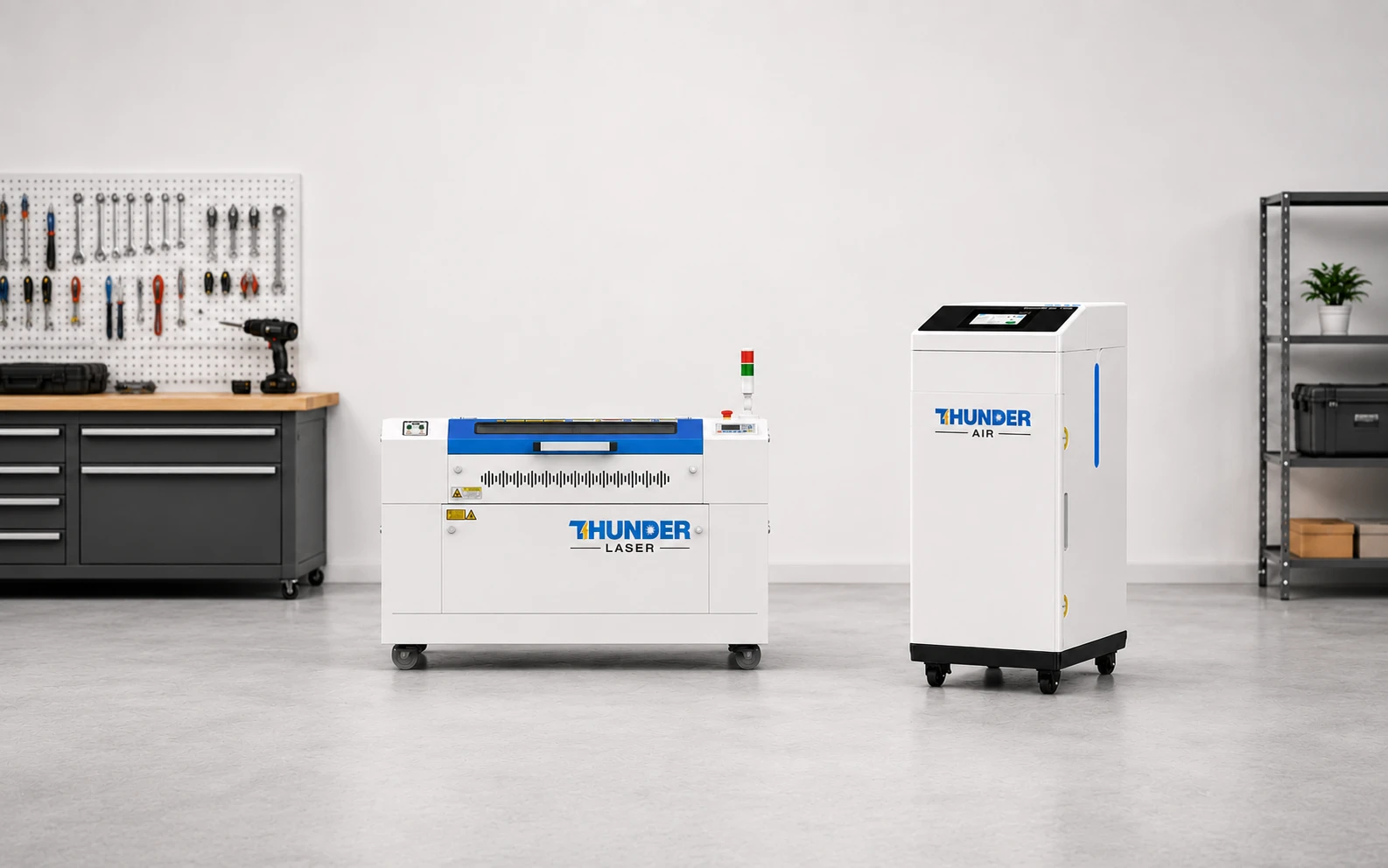
Thunder Air 700 fume extractor
Best for: Professional laser workshops and regular production users who want strong particle and VOC filtration while reducing downstream filter loading and long-term filter replacement frequency.
xTool SafetyPro AP2 Max combines high airflow with strong integration into the xTool laser ecosystem.
Best for: xTool users who value automatic machine integration, software-based control, and cyclone pre-separation.
FumeClear XL-500 focuses on high airflow and a filtration structure with substantial activated-carbon content.
Best for: Users who want high airflow and place particular importance on carbon-based odor and gas filtration.
BOFA AD Oracle iQ takes a more pressure- and process-control-focused approach than the high-airflow workshop systems above.
Best for: Professional and industrial users who prioritize pressure capability, controlled airflow, and detailed system monitoring.
PURE-AIR PA-FS500 stands out primarily for its high published pressure capability and H14 particle filtration.
Best for: Users who prioritize very high static pressure, H14 filtration, and a professional standalone filtration system.
The five systems are better suited to different priorities rather than forming a simple best-to-worst ranking.
The best laser fume extractor is ultimately the one that matches your laser enclosure, duct resistance, materials, smoke and VOC load, production volume, and acceptable filter-maintenance cost.
Many fume extractor comparisons focus too heavily on one specification. In practice, the most common buying mistakes come from looking at individual numbers without considering the complete laser setup.
The best laser fume extractor is not simply the system with the highest airflow, highest pressure, highest HEPA rating, or the greatest number of filter stages. The right choice depends on how well the extractor matches your laser machine, materials, ducting resistance, filtration requirements, workload, and acceptable maintenance cost.
Start with the actual process: identify how much smoke and particulate your work generates, whether VOC and odor control are important, how restrictive the airflow path is, and how frequently the laser will operate. Then compare airflow, static pressure, filtration architecture, filter capacity, monitoring, filter life, and long-term operating cost as a complete system.
For lighter or occasional laser use, a compact extractor or well-designed outdoor exhaust may be sufficient. For regular indoor production, schools, makerspaces, and professional workshops, a multi-stage fume extractor with adequate particle and gas-phase filtration, stable airflow, and practical filter management is generally more suitable.
Ultimately, the best system is the one that maintains effective extraction throughout your real workflow—not just when the filters are new or when the fan is operating under ideal test conditions.
Talk To Our Experts Now!
Please leave your contact information so that we can serve you better.
FAQS
FIND THE RIGHT LASER FOR YOUR NEXT PROJECT
Explore Thunder Laser solutions designed for different materials, workflows, and production needs.


 Stable & Consistent MachinesUnlimited ApplicationsRobust After-sales SupportFactory Direct Supply


