


Metal 3D Printing vs. CNC Machining: When Does Additive Manufacturing Make Sense?
 2026-10-01
WHAT ARE YOU LOOKING FOR?
Search Across Products, Blog Posts, Support Content, And Resources.

Metal 3D Printing vs. CNC Machining: When Does Additive Manufacturing Make Sense?
2026-10-01

Metal 3D printing or CNC machining—which is better for your next metal component? The answer depends on what the finished part needs to do, how complex it is, how many units you need, and what it takes to manufacture and inspect them.
CNC machining is often the practical choice for accessible geometries and precision surfaces. But when a component involves complex internal geometries, multiple assembled parts, or repeated design revisions, metal additive manufacturing deserves a closer look.
Selective laser melting (SLM), a laser powder bed fusion process, creates metal parts layer by layer rather than removing material from stock. That difference can open new design possibilities, but it does not automatically make printing faster or cheaper.
This guide compares metal 3D printing and CNC machining across geometry, prototyping flexibility, precision, material performance, lead time, production volume, and total cost. It also provides a practical way to decide when to machine, when to print, and when to combine both processes.
The fundamental distinction is how each method manufactures a part. CNC machining removes material from metal stock using cutting tools, while SLM builds a component by selectively melting layers of metal powder.
This difference influences design freedom, finishing requirements, production planning, and cost.
| Decision Factor | CNC Machining | Metal 3D Printing (SLM) |
|---|---|---|
| Best fit | Accessible geometries, precision features, repeatable machining | Complex internal features, integrated parts, customized designs |
| Design changes | Often fast for simple revisions; complex setups may need rework | Flexible for complex geometry changes, with new build preparation |
| Accuracy and finish | Strong for tight tolerances and smooth surfaces | Critical features may need secondary machining |
| Material selection | Broad range of established machinable alloys | Alloys must match a qualified printing process |
| Small-batch production | Effective for simple components | Attractive when complex parts can share a build |
| Production economics | Setup and machining time matter | Build utilization, height, supports, and post-processing matter |
| Inspection | Established dimensional and material verification methods | May require additional attention to internal quality and build-dependent properties |
The first question should not be whether a part can be 3D printed. It should be whether printing creates enough functional or manufacturing value to justify the complete process.
CNC machining remains a strong choice when part geometry is accessible, material requirements are established, and precision can be achieved through a straightforward machining sequence.
A mounting plate, simple housing, shaft, or bracket may be efficiently machined from stock. Replacing that process with SLM can introduce build preparation, support removal, and finishing without improving the component.
CNC also has an important advantage when parts require precise mating faces, threads, bores, or bearing seats. These features are routinely produced by milling, turning, drilling, and other conventional processes.
For simple repeat parts, programming and setup costs can be distributed across larger production quantities. Where the manufacturing process is already stable and economical, additive manufacturing needs a clear reason to be considered.
Choose CNC first when your design is easy to machine and the existing workflow already meets your quality, volume, delivery, and cost targets.
SLM becomes more attractive when the manufacturing challenge is connected to the component's design. SLM metal 3D printing systems offer manufacturers new ways to develop complex functional parts, consolidate assemblies, and produce selected low-volume components.
Internal passages, curved channels, and inaccessible features may require a conventional design to be divided into multiple machined components.
With SLM, some of these features can be built directly into a metal part. The resulting design may reduce the need for separate operations or joints.
However, printability still depends on build orientation, support strategy, powder evacuation, and inspection access.
An assembly made from several machined components may be redesigned into fewer parts when additive manufacturing removes some tool-access constraints.
The opportunity is not simply a lower component count. It may also include fewer assembly interfaces, reduced handling, and improved functional integration.
A successful redesign must still account for finishing, repairability, inspection, and total manufacturing cost.
SLM can be valuable for functional metal prototypes that contain complex features or require significant geometry changes.
Engineers can update the CAD model and prepare a new build without necessarily preserving the same machining fixtures, toolpaths, or component divisions as the previous design.
This is particularly useful during design exploration. It does not mean every printed prototype is faster: simple CNC revisions may be quicker, while SLM modifications can require revised supports, orientation, or process validation.
Multiple suitable components can be arranged within one SLM build.
This makes additive manufacturing worth considering for custom parts, low-volume components, and selected small-batch production.
Productivity depends on how efficiently parts can be nested, their build height, the selected material, and the work required after printing.
A full build plate is useful only if the parts can be finished, inspected, and delivered at a competitive total cost.
Price per machine hour is not enough to compare CNC machining with SLM.
A fair comparison should use the same functional requirements and include all the activities required to deliver an accepted part.
For CNC, costs may include stock material, programming, setup, machining, tooling, multiple fixtures, assembly, finishing, and inspection.
For SLM, costs may include build preparation, metal powder, machine operation, gas and consumables, support removal, heat treatment where needed, precision finishing, and inspection.
If additive manufacturing consolidates an original three-part assembly into two components, the comparison should cover the complete assembly—not one machined part against one printed part.
For an initial estimate, use the following simplified models:
CNC cost per accepted part:
(CNC setup and programming cost ÷ accepted quantity) + material, machining, finishing, assembly, and inspection cost per accepted part.
SLM cost per accepted part:
(Total build-level cost ÷ accepted parts from the build) + finishing, machining, and inspection cost per accepted part.
The second model assumes the build-level cost includes build preparation, equipment operation, powder consumption, and associated handling. Rejected parts must not be counted as accepted output.
Consider a hypothetical component with the following illustrative—not Thunder production—costs:
| Order Quantity | CNC Total Cost per Part | SLM Total Cost per Part |
|---|---|---|
| 5 | $250 | $235 |
| 10 | $170 | $135 |
| 20 | $130 | $135 |
In this example, SLM offers a lower calculated unit cost at 5 and 10 parts, while CNC becomes slightly more economical at 20 parts.
These numbers are not market prices or a general production-volume threshold. They demonstrate how CNC setup amortization and SLM build utilization can change the comparison.
Change the part geometry, printing height, finishing requirements, accepted yield, or machine availability, and the answer may change.
The correct economic question is: What does each complete manufacturing route cost per accepted functional component at the required quantity?
A short machining cycle does not necessarily mean a short delivery time. Likewise, a fast print is not necessarily a finished component.
For CNC, the complete schedule can include stock procurement, CAM programming, setups, machining, assembly, finishing, and inspection.
For SLM, it can include build preparation, queue time, printing, cooling, powder removal, stress relief where needed, part separation, finishing, and inspection.
Design changes matter as well.
A minor change to an accessible drilled hole might be handled quickly through an updated CNC program. A redesigned internal manifold could be more practical to prototype through SLM if CNC would otherwise require new component divisions and joining operations.
Before deciding, compare four dates: when the design is released, when manufacturing can start, when the part is physically finished, and when it can pass acceptance inspection.
The relevant lead time is the time to an acceptable, usable part—not merely machine operating time.
A component's geometry is only one part of its engineering requirements.
An SLM-printed part must meet the same functional expectations as any alternative manufacturing method, including critical dimensions, surface condition, material performance, and repeatability.
Machined surfaces are often preferred where precise fits and controlled finishes are essential.
SLM can manufacture the near-net geometry, but printed surfaces and critical dimensions may require secondary operations.
This is why it is important to identify precision features before designing the build, rather than treating finishing as an afterthought.
Metal additive manufacturing can introduce direction-dependent material behavior and residual stresses. The effect depends on the alloy, printing parameters, part geometry, build orientation, and subsequent treatment.
For load-bearing or fatigue-sensitive parts, material testing and design validation may be necessary.
An alloy name alone does not establish that a printed part has the same properties as a machined part made from conventional stock.
Complex internal channels are an advantage of SLM, but they create verification challenges.
Manufacturers may need to consider trapped powder, internal porosity, inaccessible surfaces, dimensional inspection, and non-destructive testing where appropriate.
The level of qualification should match the application. A fit-check prototype does not need the same evidence as a safety-critical aerospace or medical component.
A component is not production-ready simply because its CAD geometry can be printed. It must also be cleanable, finishable, inspectable, and capable of meeting its intended requirements.
Many metal components do not need to be made entirely by one process.
A hybrid approach uses SLM for features that benefit from additive manufacturing, then CNC for dimensions and surfaces where machining is more suitable.
For example, SLM may build a compact component with integrated internal passages, while CNC finishes:
This can preserve design flexibility without asking the additive process to deliver every surface in its final condition.
Hybrid manufacturing works best when it is planned during design. Engineers should consider machining allowances, fixture access, datums, support placement, and which surfaces will be accessible after printing.
The practical choice is sometimes not SLM versus CNC, but SLM plus CNC.
A real example comes from Thunder Laser's own manufacturing work, documented in the Thunder Bolt cutting cone case study.
The original cutting cone consisted of three independently CNC-machined components requiring precise assembly. Instead of printing those original components unchanged, Thunder's engineering team redesigned the structure for SLM.
Using the Thunder SLM-175 metal 3D printer, the team developed a two-component configuration and manufactured cutting cones using stainless steel powder.
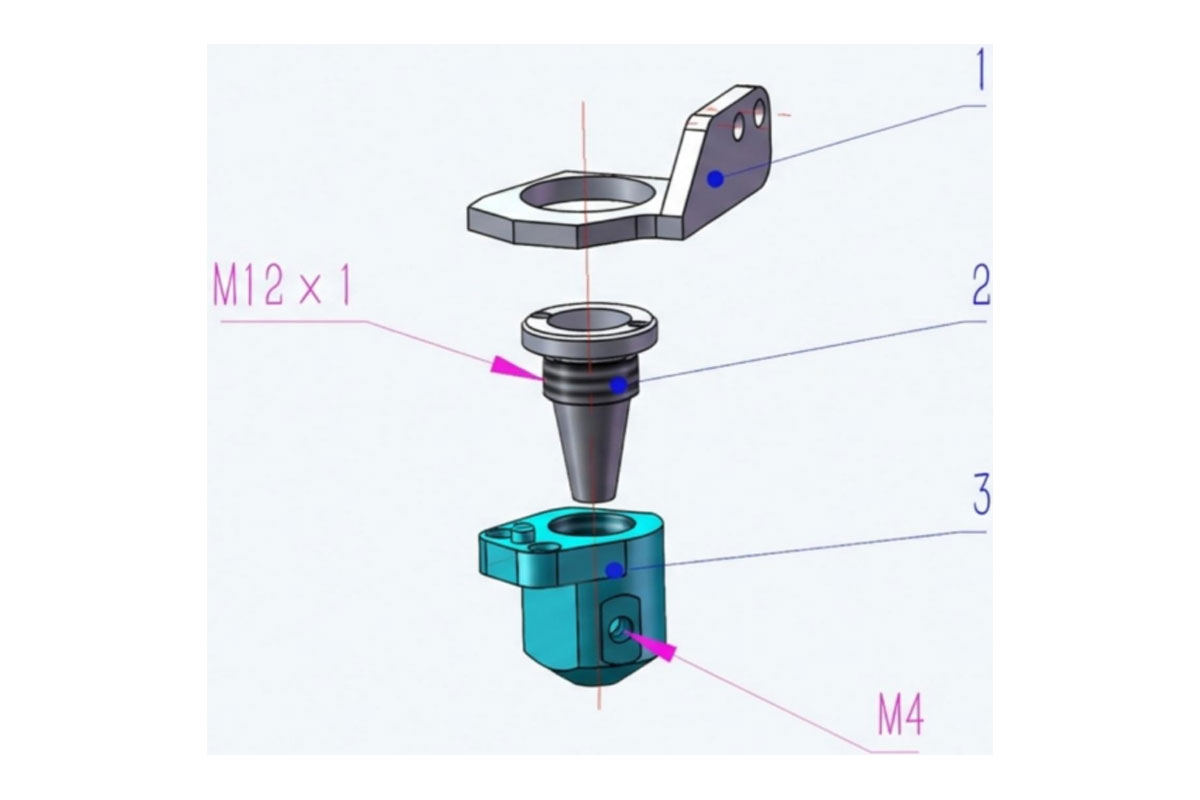
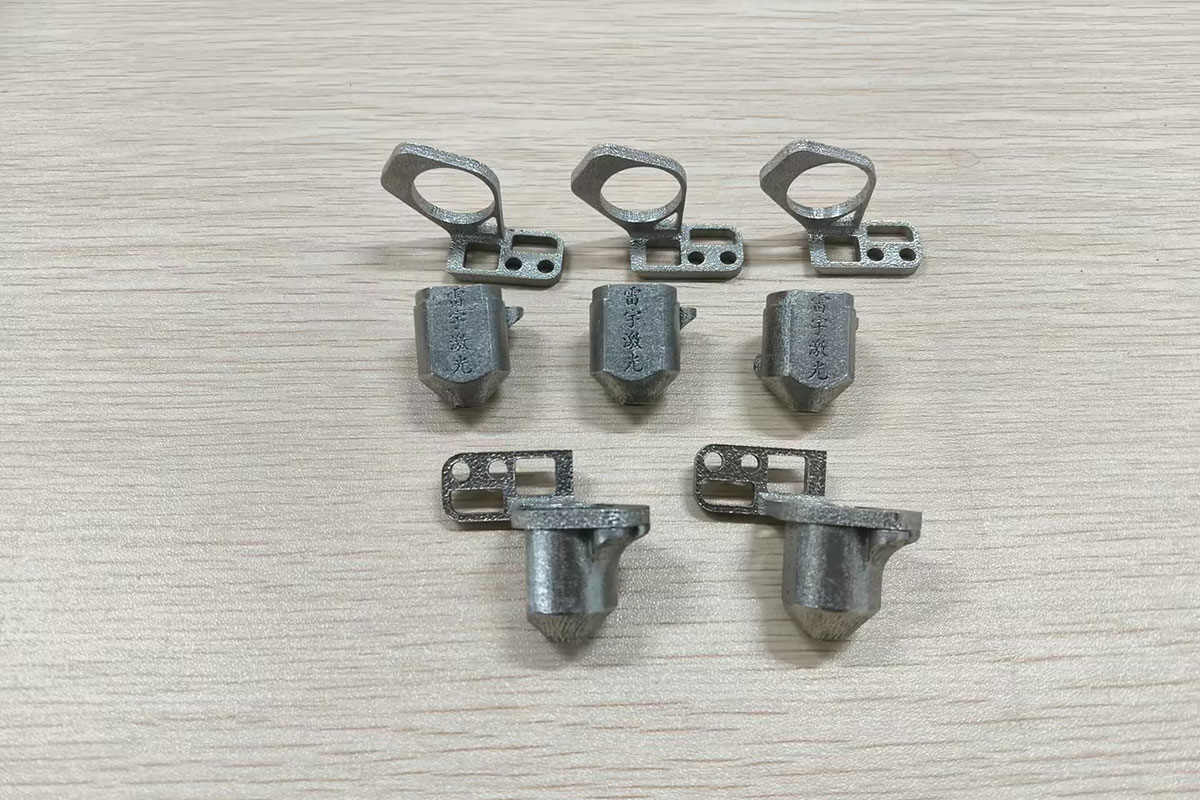
Internal process records documented a 22-unit printing batch completed in approximately 8.5 hours, equivalent to about 23 minutes of average printing time per cone.
The original CNC process was recorded at approximately 60 minutes of machining time per cone.
The batch-averaged SLM printing time was approximately 62% lower than that recorded CNC machining time. This compares the reported machine-process time metrics, not complete finished-part production cycles.
More importantly, the project combined three decisions: redesigning the geometry, consolidating components, and planning a batch build.
The redesigned cutting cone has since been commercially launched.
The broader lesson is that additive manufacturing can be most useful when it creates an opportunity to change the part and its manufacturing workflow—not merely substitute one machine for another.
Before choosing a manufacturing method, evaluate the component against its most important design, production, and quality requirements.
| Your Main Requirement | Starting Recommendation | What to Check |
|---|---|---|
| Simple shape, accessible features | CNC | Machining cost, setups, and quantity |
| Tight-tolerance surfaces on a straightforward part | CNC | Finishing specifications and production volume |
| Complex enclosed or curved internal passages | Evaluate SLM | Powder removal, supports, and inspection |
| Multi-component assembly with consolidation potential | Evaluate SLM | Function, joining requirements, and total assembly cost |
| Complex functional prototypes with substantial design revisions | Evaluate SLM | Build preparation and full prototype lead time |
| Additive geometry plus precision mounting surfaces | SLM + CNC | Machining allowances, datums, and fixture access |
| Repeated large-volume production of simple parts | CNC often preferred | Cost per accepted part and capacity |
| Safety-critical or heavily regulated applications | Qualification-led decision | Material data, process controls, testing, and certification requirements |
This matrix is a starting point, not an automatic approval to manufacture.
For a more defensible decision, prepare a short engineering brief containing the CAD model, target alloy, critical tolerances, annual and batch quantities, required delivery date, functional loads, inspection requirements, and acceptable cost.
These inputs allow both CNC and SLM options to be assessed against the same specification.
If your evaluation points toward additive manufacturing, the next step is to determine which machine and process configuration can meet your actual requirements. Our SLM metal 3D printer buying guide explains how to assess build volume, material compatibility, productivity, and total cost of ownership.
CNC machining remains highly effective for accessible geometry, precision requirements, and many established production tasks.
SLM metal 3D printing creates different opportunities: complex internal structures, part consolidation, flexible functional prototyping, and selected small-batch manufacturing.
Neither method is automatically faster, cheaper, or better.
The most useful decision begins with the completed part and works backward through design, production, finishing, inspection, lead time, and cost.
For some components, conventional machining is the clear answer. Others justify redesigning for SLM. And many benefit from combining the two.
Choose the process that delivers the required function and quality through the most effective complete manufacturing workflow.
Have a complex metal component that could benefit from additive manufacturing? Contact Thunder Laser to discuss your CAD design, material requirements, production quantity, and manufacturing goals.
Talk To Our Experts Now!
Please leave your contact information so that we can serve you better.
FIND THE RIGHT LASER FOR YOUR NEXT PROJECT
Explore Thunder Laser solutions designed for different materials, workflows, and production needs.


 Stable & Consistent MachinesUnlimited ApplicationsRobust After-sales SupportFactory Direct Supply


