


Titan vs. Nova Plus: Which Thunder Laser Machine Should You Choose?
 25-09-30
WHAT ARE YOU LOOKING FOR?
Search Across Products, Blog Posts, Support Content, And Resources.

Titan vs. Nova Plus: Which Thunder Laser Machine Should You Choose?
25-09-30

Choosing the right laser machine is not only about comparing power, speed, or working area. For most buyers, the real question is: Which machine fits my production needs, materials, budget, safety requirements, and long-term workflow?
Thunder Laser Nova Plus and Titan are both RF CO₂ laser machines, but they are designed for different types of users.
Nova Plus is a high-performance RF CO₂ laser machine designed for small businesses, schools, studios, makers, and growing workshops. It offers strong engraving quality, reliable cutting performance, large working area options, and better cost-performance for daily laser engraving and cutting.
Titan is an industrial-grade laser production platform designed for users who need higher speed, stronger safety, better workflow control, and long-term productivity. Titan Pro goes further by combining RF CO₂ and fiber laser capability, making it suitable for users who need both non-metal processing and direct metal marking.
This guide compares Nova Plus and Titan from a buyer’s point of view, including production scale, material capability, speed, accuracy, workspace, software, safety, maintenance, and long-term value.
| Your Priority | Better Choice |
| Lower upfront investment | Nova Plus |
| High cost-performance | Nova Plus |
| Small business use | Nova Plus |
| School, studio, or maker workshop | Nova Plus |
| Large maximum working area | Nova Plus 63 |
| Industrial production | Titan |
| Higher speed and acceleration | Titan |
| Stronger safety protection | Titan |
| PM2.5 monitoring | Titan |
| Metal and non-metal workflow | Titan Pro |
| Long-hour batch production | Titan |
A table that helps buyers quickly choose between Nova Plus, Titan, and Titan Pro based on their priorities.
| Category | Nova Plus | Titan / Titan Pro |
| Product Positioning | High-performance RF CO₂ laser machine | Industrial-grade laser production platform |
| Best For | Small businesses, schools, studios, makers, growing workshops | Industrial workshops, manufacturers, high-volume users |
| Laser Type | RF CO₂ laser | Titan: RF CO₂; Titan Pro: RF CO₂ + fiber laser |
| Power Options | Nova Plus 24: 60W; Nova Plus 35 / 51 / 63: 60W–120W | CO₂ up to 120W; Titan Pro adds fiber laser options |
| Safety Class | Class 2 | Class 1 |
| PM2.5 Monitoring | No | Yes |
| Working Area | 600 × 400 mm to 1600 × 1000 mm | 700 × 500 mm to 1300 × 900 mm |
| Engraving Speed | Up to 1200 mm/s | Up to 3000 mm/s |
| Acceleration | 2.5G | 8G |
| Precision | Up to 0.01 mm positioning accuracy | Up to 0.01 mm positioning accuracy |
| Cooling | Air cooling for standard lower-power configurations; water cooling for 100W / 120W configurations | Air cooling |
| Table Options | Removable honeycomb table + knife-blade table | Honeycomb vacuum table + knife-blade table |
| Camera and Workflow | Overhead camera, autofocus, user-friendly daily workflow | Top camera, head camera, mark-point recognition, production workflow |
| Software | LaserMaker, RDWorks, LightBurn | LaserMaker, RDWorks, LightBurn |
| Main Value | Cost-performance, easy use, large work area options | Speed, safety, workflow, precision, industrial productivity |
A table that gives a quick side-by-side overview of Nova Plus, Titan, and Titan Pro.
Note: Titan Pro is an upgraded version of Titan. It builds on Titan’s core technology and adds a fiber laser, making it suitable for users who need both CO₂ laser processing for non-metal materials and fiber laser marking for metals in one machine.
Nova Plus and Titan are not designed for exactly the same type of buyer. Nova Plus is better for users who need a strong, reliable, and cost-effective RF CO₂ laser machine for daily engraving and cutting. Titan is better for users who need industrial productivity, stronger safety, and more advanced workflow control.
Nova Plus is suitable for users who mainly process non-metal materials and need a balance between performance, price, ease of use, and working area.
It is a strong fit for:
Nova Plus is especially suitable when the buyer needs better engraving detail, improved RF tube stability, and reliable cutting performance, but does not need a full industrial production platform.
Typical Nova Plus applications include:
Titan is designed for users who need higher productivity, stronger safety protection, and better workflow support. It is more suitable for production environments where speed, repeatability, downtime control, and operator protection matter more.
Titan is a strong fit for:
Both Nova Plus and Titan can process common CO₂ laser materials, especially non-metal materials such as wood, acrylic, leather, paper, cardboard, rubber, fabric, and signage materials. The main difference is not only material type, but also production scale and workflow requirement.
Nova Plus is suitable for daily engraving and cutting of common non-metal materials. Titan is better for high-volume non-metal production. Titan Pro is better when the user also needs direct metal marking because it combines RF CO₂ and fiber laser capability.
| Material / Application | Nova Plus | Titan | Titan Pro |
| Wood engraving | Yes | Yes | Yes |
| Wood cutting | Yes | Yes | Yes |
| Acrylic engraving | Yes | Yes | Yes |
| Acrylic cutting | Yes | Yes | Yes |
| Leather engraving | Yes | Yes | Yes |
| Paper / cardboard cutting | Yes | Yes | Yes |
| Fabric / textile cutting | Yes | Yes | Yes |
| Rubber engraving | Yes | Yes | Yes |
| Signage materials | Yes | Yes | Yes |
| Coated metal marking | Possible, depending on coating and process | Possible, depending on coating and process | Yes |
| Stainless steel marking | No | No | Yes, with fiber laser |
| Aluminum marking | No | No | Yes, with fiber laser |
| Direct metal marking | No | No | Yes, with fiber laser |
| Mixed metal and non-metal workflow | No | No | Yes |
| High-volume non-metal production | Suitable | Better | Better |
A table that compares the material capability of Nova Plus, Titan, and Titan Pro.
If your work mainly involves non-metal materials such as wood, acrylic, leather, paper, cardboard, fabric, rubber, and signage materials, both Nova Plus and Titan can be suitable. All materials supported by Nova Plus can also be processed by Titan and Titan Pro. The main difference is production performance and material range.
Choose Nova Plus for daily non-metal engraving and cutting.
Choose Titan for the same materials with higher speed, stronger safety, and better production stability.
Choose Titan Pro if you also need to process metals with fiber laser capability.
Speed, accuracy, and motion control are key differences between Nova Plus and Titan. Both machines offer a repeat positioning accuracy of 0.01 mm, but they use different motion systems and are designed for different production speeds.
| Performance Factor | Nova Plus | Titan |
| Engraving Speed | Up to 1200 mm/s | Up to 3000 mm/s |
| Acceleration | 2.5G | 8G |
| Repeat Positioning Accuracy | 0.01 mm | 0.01 mm |
| Motor System | Servo motor / 1.2° | AC servo motor |
| Best Use | Daily high-quality engraving and cutting | Ultra-high-speed industrial engraving and batch production |
A table that compares the speed, accuracy, and motion control performance of Nova Plus and Titan.
Although both Nova Plus and Titan can achieve high repeat positioning accuracy, Titan is designed for more demanding high-speed production. Its AC servo motor system provides stronger stability during ultra-fast engraving, making it less likely to lose steps and more capable of maintaining consistent engraving quality at higher speeds.
This is also why Titan can support higher engraving speed and acceleration than Nova Plus. Nova Plus is already fast and accurate enough for most small businesses, schools, studios, and daily production needs, while Titan is better for users who need maximum speed, stronger motion stability, and better engraving results under high-speed industrial workloads.
In buyer terms:
Both Nova Plus and Titan support large-format laser processing, but they are designed with slightly different priorities.
Nova Plus offers more size options and has a larger maximum working area. Its model range covers different workspace needs, from compact daily production to large-format engraving and cutting. Titan also supports large-format processing, but its advantage is not only bed size. The Titan series is designed more for industrial production, thicker materials, stronger workflow stability, and heavy-duty processing needs.
| Model | Working Area |
| Nova Plus 24 | 600 × 400 mm |
| Nova Plus 35 | 900 × 600 mm |
| Nova Plus 51 | 1300 × 900 mm |
| Nova Plus 63 | 1600 × 1000 mm |
| Titan / Titan Pro 27 | 700 × 500 mm |
| Titan / Titan Pro 35 | 900 × 600 mm |
| Titan / Titan Pro 51 | 1300 × 900 mm |
A table that lists the working area options of Nova Plus, Titan, and Titan Pro models.
| Feature | Nova Plus | Titan |
| Maximum Material Thickness | Up to 225 mm | Up to 230 mm |
| Pass-Through Door Thickness | Up to 20 mm | Up to 65 mm |
| Maximum Load | 40 kg | 110 kg |
| Main Advantage | More workspace options and larger maximum bed size | Better thick-material and pass-through capability |
A table that compares thickness capacity, pass-through capability, and maximum load between Nova Plus and Titan.
Nova Plus can process materials up to 225 mm thick and supports pass-through processing for materials up to 20 mm thick. This is enough for many common engraving and cutting applications, especially for small businesses, studios, schools, and general workshop users.
Titan can process materials up to 230 mm thick and supports pass-through processing for materials up to 65 mm thick. This gives Titan a stronger advantage when users need to handle thicker materials, longer sheets, or more demanding industrial production tasks.
| Table Feature | Nova Plus | Titan |
| Honeycomb Table | Yes | Yes |
| Knife-Blade Table | Yes | Yes |
| Vacuum Hold-Down | No | Yes |
| Best For | Daily engraving and cutting flexibility | Stable sheet processing and batch production |
A table that compares the table options and workflow priorities of Nova Plus and Titan.
Nova Plus offers practical table flexibility for daily engraving and cutting. Its honeycomb table is useful for small parts, engraving support, and flexible materials. Its blade-style table is useful for cutting sheet materials and reducing back reflection.
Titan’s table system is more production-oriented. The honeycomb vacuum bed helps keep materials flat and stable during processing, while the knife-blade platform supports cleaner sheet cutting and more repeatable production results.


Side-by-side comparison of Nova Plus and Titan table options.
Titan adds more user-friendly design details to improve daily operation and production efficiency. Compared with Nova Plus, Titan is not only stronger in hardware, but also offers a smarter workflow through deeper software and camera integration.
Nova Plus supports practical daily-use features such as camera positioning, autofocus, and LightBurn compatibility. These features make it easy for small businesses, schools, studios, and workshops to set up jobs, align materials, and complete common engraving and cutting tasks.
Titan goes further by combining advanced hardware with optimized software support. LaserMaker has been specially optimized for Titan, making the workflow smarter and more suitable for production use. With Titan’s top camera, head camera, and LaserMaker workflow, users can handle positioning, mark-point recognition, printed material alignment, variable text, QR code generation, and batch production more efficiently.
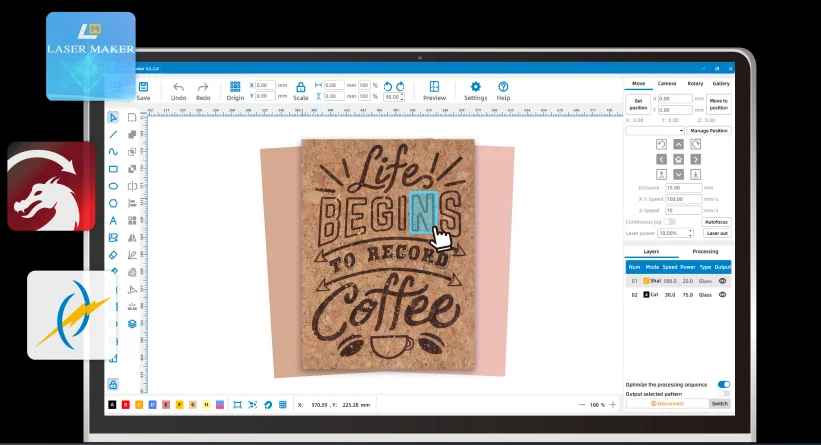
LaserMaker helps boost efficiency in production workflows.
| Feature | Nova Plus | Titan |
| Camera | Overhead camera | Top camera + head camera |
| Software | LightBurn optional | LaserMaker, RDWorks, LightBurn |
| LaserMaker Optimization | Basic compatibility | Optimized for Titan workflow |
| Autofocus | Yes | Yes |
| Mark-Point Recognition | No | Yes |
| Printed Material Alignment | Basic camera positioning | Smarter camera-assisted workflow |
| Variable Data / QR Code Workflow | Basic workflow | Stronger production workflow |
| Daily Ease of Use | Strong | Stronger user-friendly production design |
| Batch Production Workflow | Suitable | Better |
A table that compares the software, camera, and workflow features of Nova Plus and Titan.
In buyer terms, Nova Plus is easier and practical for daily engraving and cutting, while Titan is smarter and more production-oriented. Its software, camera system, and user-friendly workflow designs help reduce setup time, improve alignment accuracy, and make repeated production easier to manage.
Safety is one of the clearest differences between Nova Plus and Titan.
Nova Plus uses a Class 2 safety design and provides practical protection features for daily CO₂ laser use. Titan uses a Class 1 enclosed safety design and adds stronger industrial protection, including PM2.5 monitoring.
| Safety Feature | Nova Plus | Titan |
| Laser Machine Class | Class 2 | Class 1 |
| Enclosed Design | Yes | Yes |
| Lid Opening Sensors | Yes | Yes |
| Lid Interlocks | Yes | Yes |
| Laser Shutter | No | Yes |
| Emergency Stop | Yes | Yes |
| Warning Light | Yes | Yes |
| Fire Alarm / Heat Alarm | Heat alarm system | Fire alarm / temperature warning system |
| Air Pressure Detection | Yes | Yes |
| PM2.5 Monitoring | No | Yes |
| Best For | General safe daily use | Industrial safety and operator protection |
A table that compares the safety and operator protection features of Nova Plus and Titan.
Nova Plus provides important safety and protection features for daily laser engraving and cutting. These include open-cover protection, air-assist protection, heat alarm, warning light, and air-pressure detection.
This safety design is suitable for small businesses, schools, studios, and general workshop use where users need practical protection and easy daily operation.
Titan is designed for stricter industrial safety requirements. Its Class 1 enclosed design, side-panel interlocks, shutter, warning indicators, fire alarm support, and PM2.5 monitoring provide stronger operator protection and better environmental awareness during production.
Titan’s PM2.5 monitoring helps operators understand air-quality changes around the machine during laser processing. It does not replace proper exhaust or filtration, but it gives users an additional layer of air-quality awareness, especially during long production runs.
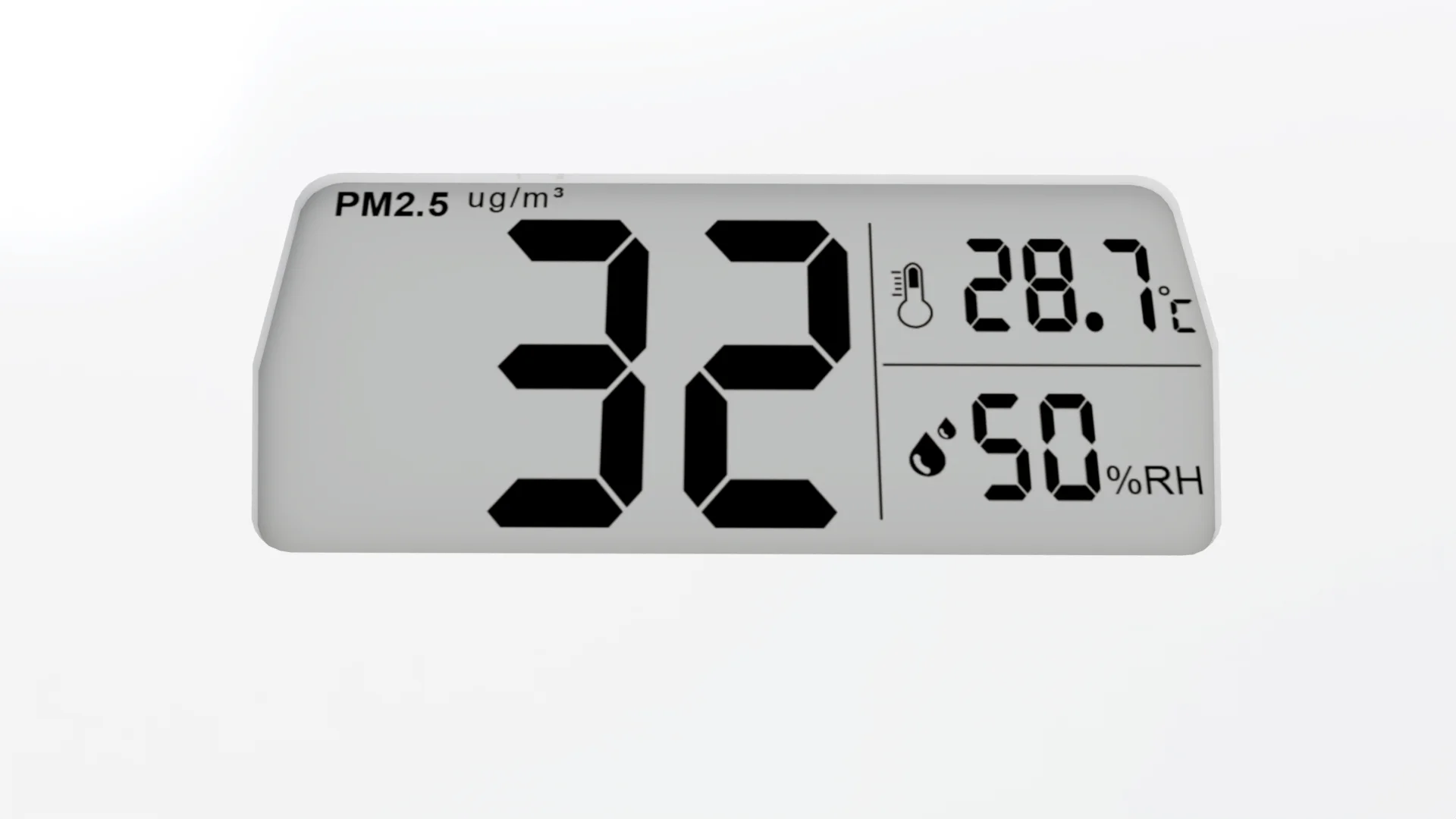
PM2.5 air monitoring system of Titan laser machine.
For buyers who have multiple operators, higher production frequency, stricter safety requirements, or industrial workshop conditions, Titan offers a stronger safety system than Nova Plus.
Learn more about how Titan outperforms basic industrial-grade laser machines in safety protection.
Both Nova Plus and Titan use RF laser sources with a lifespan of about 10,000 hours, so both machines offer better stability and longer service life than traditional glass tube CO₂ laser systems.
The main difference is how each machine is designed to reduce daily maintenance workload.
Nova Plus is already easy to maintain for small businesses, schools, studios, and general workshop users. Its RF laser source is stable, and its daily maintenance mainly focuses on regular cleaning, optical alignment checks, lens and mirror care, and keeping the working area clean. For higher-power Nova Plus configurations, users also need to pay attention to the water-cooling system.
Titan is designed with more production-oriented protection. It uses an air-cooling system, so users do not need to manage water circulation, coolant replacement, or chiller-related maintenance. In addition, Titan has a dust-proof accordion cover and fully enclosed guide rails, which help protect the motion system from dust, smoke, and debris during long production runs.
| Maintenance Factor | Nova Plus | Titan |
| RF Laser Lifespan | About 10,000 hours | About 10,000 hours |
| Cooling System | Air cooling or water cooling depending on power configuration | Air cooling |
| Guide Rail Protection | Standard structure | Fully enclosed guide rails |
| Dust Protection | Standard protection | Dust-proof accordion cover |
| Daily Maintenance Workload | Easy for general users | Lower and simpler for production use |
| Best For | Small business, school, studio, and daily workshop use | Long-hour production and industrial environments |
A table that compares maintenance requirements and long-term use factors between Nova Plus and Titan.
In simple terms, Nova Plus is easy to maintain for daily users, while Titan is designed to further reduce maintenance pressure in production environments. Its air-cooling system, dust-proof accordion cover, and fully enclosed guide rails make maintenance simpler and help the machine stay stable during long-term, repeated use.
Nova Plus and Titan should not be compared only by purchase price. They provide value in different ways.
From the price point of view, the Titan series is more expensive than the Nova Plus series. This is expected because Titan offers a stronger industrial structure, higher speed, stronger acceleration, Class 1 safety design, PM2.5 monitoring, smarter camera workflow, and more production-oriented features.
However, from a long-term point of view, both Nova Plus and Titan are highly cost-effective choices for the right users.
Nova Plus provides excellent value for small businesses, schools, studios, and workshops. It gives users RF CO₂ laser performance, strong engraving quality, reliable cutting ability, large working area options, and easier daily operation without the higher investment of an industrial production machine.
Titan provides long-term value for users who care more about productivity, safety, stability, and production efficiency. A good laser machine can greatly improve work efficiency, reduce setup time, reduce downtime, and help users complete more jobs with better consistency. For industrial users, these advantages can bring more value over time than the initial price difference.
| Buyer Scenario | Recommended Machine |
| Small gift business | Nova Plus |
| School or training center | Nova Plus |
| Studio or maker workshop | Nova Plus |
| First RF CO₂ laser upgrade | Nova Plus |
| Need the largest work area | Nova Plus 63 |
| Need 100W or 120W RF CO₂ power but not industrial workflow | Nova Plus 35 / 51 / 63 |
| Daily custom engraving and cutting | Nova Plus |
| Signage shop with moderate workload | Nova Plus |
| Industrial production workshop | Titan |
| Multi-operator production environment | Titan |
| Printed material alignment / mark-point recognition | Titan |
| High-speed batch engraving | Titan |
| Long-hour batch production | Titan |
| Stronger safety requirement | Titan |
| PM2.5 monitoring requirement | Titan |
| Metal and non-metal processing | Titan Pro |
| Direct metal marking | Titan Pro |
| Maximum long-term production value | Titan / Titan Pro |
A table that maps typical buyer scenarios to the most suitable machine choice.
Nova Plus is the better choice if you need a high-performance RF CO₂ laser machine with strong engraving quality, reliable cutting ability, large work area options, and better cost-performance.
It is especially suitable for non-metal materials, small-to-medium batch production, creative businesses, schools, studios, and users upgrading from traditional glass tube CO₂ laser machines.
Choose Nova Plus if your main priorities are:
Titan is the better choice if you need industrial-level speed, precision, safety, and workflow efficiency.
Compared with Nova Plus, Titan offers stronger production performance, Class 1 safety, PM2.5 monitoring, more advanced operator protection, and better long-term productivity for high-volume environments.
Choose Titan if your main priorities are:
Titan Pro is the better choice if the buyer needs both CO₂ laser processing and fiber laser metal marking.
It should be positioned separately from standard Titan and Nova Plus because its dual-laser capability solves a different production need. For users who need to process acrylic, wood, leather, and other non-metal materials while also marking stainless steel, aluminum, or other metals, Titan Pro offers a more complete production solution.
Talk To Our Experts Now!
Please leave your contact information so that we can serve you better.
FAQS
TAKE THE NEXT STEP WITH THUNDER LASER


 Stable & Consistent MachinesUnlimited ApplicationRobust After-sales SupportFactory Direct Supply


