


Fiber Laser vs. Plasma Cutting Which Is Better for Metal Cutting?
 2026-09-22
WHAT ARE YOU LOOKING FOR?
Search Across Products, Blog Posts, Support Content, And Resources.

Fiber Laser vs. Plasma Cutting Which Is Better for Metal Cutting?
2026-09-22

Fiber laser and plasma can both cut metal quickly, but choosing between them is not as simple as “laser for thin sheet, plasma for thick plate.” Modern fiber lasers are cutting faster and thicker than before, while plasma still holds practical advantages in many heavy-fabrication jobs.
The better choice depends on what you actually produce: material and thickness, part detail, cut quality, production speed, surface condition, and the cost of getting a finished part. This guide compares fiber laser and plasma across those factors to help you decide which process fits your metal-cutting work.
Quick Answer: Fiber laser generally has an advantage when the job requires high precision, narrow kerf, small features, and efficient processing of sheet metal. Plasma remains a practical option for conductive metals, particularly where heavier sections, general fabrication, and lower equipment complexity are priorities.
The distinction is not based on one fixed material thickness. Laser power, plasma current, material type, part geometry, surface condition, and required cut quality can all shift the point at which one process becomes more practical than the other. Research comparing the two methods also shows that performance changes significantly with material thickness and process parameters.
| Factor | Fiber Laser Cutting | Plasma Cutting |
|---|---|---|
| Typical Strength | Precision sheet-metal cutting and detailed parts | General fabrication and heavier plate |
| Thin Sheet | Usually faster and more precise | Generally less advantageous |
| Medium & Thick Plate | Performance depends strongly on laser power | Remains highly competitive, especially with suitable plasma power |
| Cut Quality | Narrow kerf, fine detail, low taper | Strong production-quality cuts; modern high-definition plasma can achieve very good edge quality |
| Small Holes & Fine Features | Generally stronger | More dependent on material thickness and plasma system |
| Heat-Affected Zone | Typically smaller | Typically larger |
| Material Surface Condition | More sensitive to rust, scale, paint, and coatings | Generally more tolerant of imperfect surfaces |
| Initial Equipment Cost | Usually higher | Usually lower |
| Consumables | Fewer routine cutting consumables, but optics and assist gas still matter | Torch electrodes and nozzles are regular consumables |
| Secondary Processing | Often less grinding, deburring, or hole finishing | Can require more finishing depending on cut requirements |
| Automation | Well suited to automated sheet-metal workflows | Also widely used in automated CNC fabrication |
| Best Suited To | Detailed sheet metal, custom parts, precision production | Structural fabrication, heavy plate, larger and less detail-sensitive parts |
Fiber laser and plasma cutting offer different strengths depending on precision, thickness, cut quality, and production requirements.
The key difference is therefore not simply which process can cut a particular thickness. A more useful comparison is how each process performs on the parts you actually produce—and what those parts cost by the time cutting, consumables, finishing, labor, and throughput are taken into account.
Fiber laser cutting is widely used in modern sheet-metal production because it combines concentrated energy, precise CNC motion, and a narrow cutting path. Its performance, however, depends on more than laser wattage alone. Material, thickness, assist gas, focus, cutting speed, and machine setup all influence the result.
A fiber laser uses a solid-state gain medium and optical fiber to generate and deliver laser energy. At the cutting head, the beam is focused into a very small spot on the workpiece, creating enough energy density to melt or vaporize material locally.
A coaxial assist gas then removes molten material from the cut. Depending on the process, gases such as nitrogen or oxygen may be used for different cutting requirements. CNC motion controls the cutting head along the programmed geometry.
The small focused spot is one reason laser cutting can create a narrow kerf and precise contours. TWI describes laser cutting as a thermal, non-contact process in which a focused beam and assist gas create the cut while CNC controls the movement of the beam or workpiece.
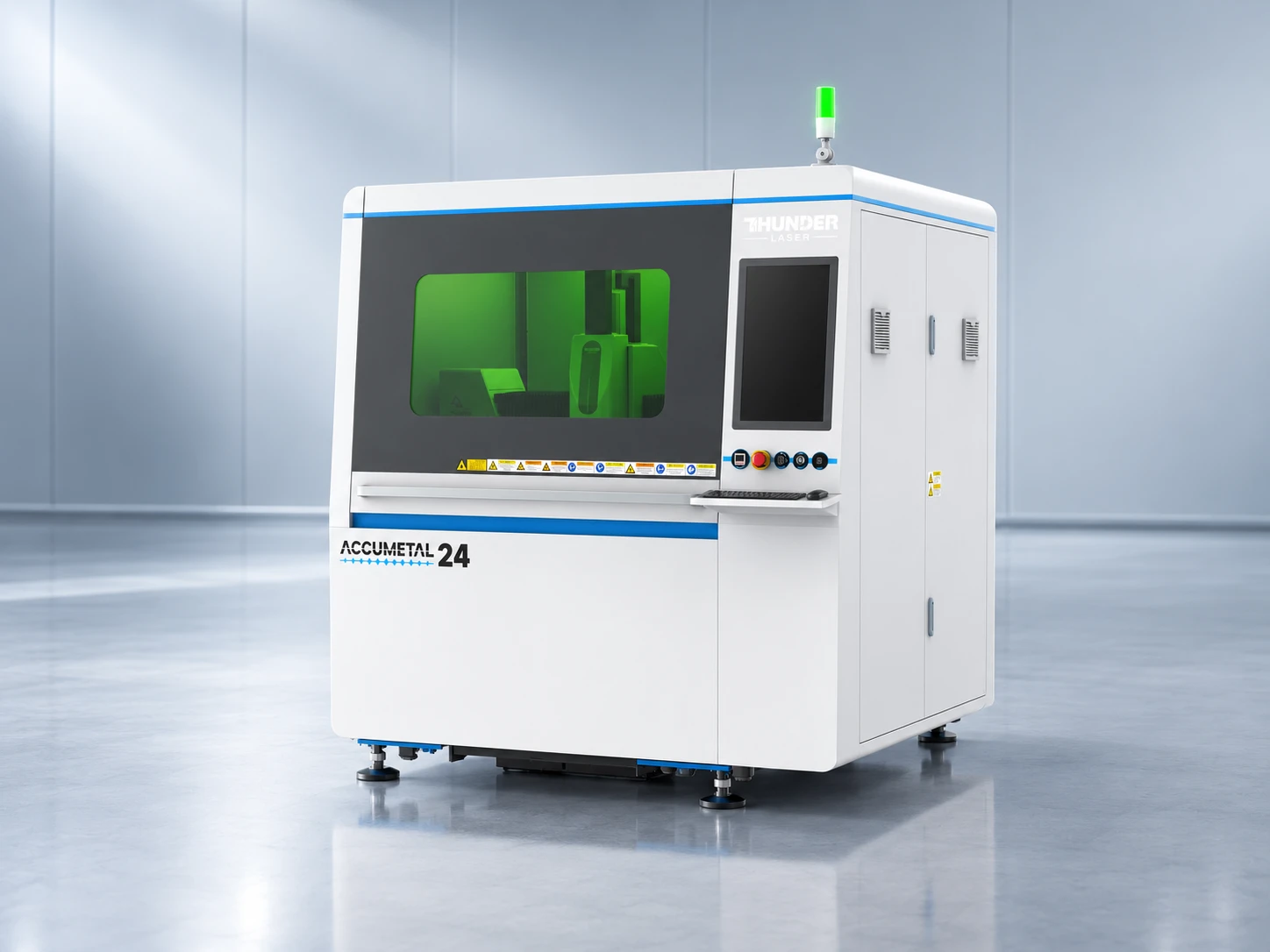
Thunder AccuMetal fiber laser cutting machine for precision sheet-metal processing.
For sheet-metal production, the main advantage of fiber laser is the combination of cutting speed, precision, and flexibility. It is particularly useful when a part contains detailed contours or when the cut itself needs to reduce later finishing work.
Typical advantages include:
The concentrated heat source also limits the amount of heat transferred into surrounding material compared with less concentrated thermal processes. TWI notes that laser cutting can produce high-quality edges, low heat input, limited distortion, and complex geometries.

Fiber laser cutting can produce precise contours, narrow kerfs, and detailed metal parts.
Fiber laser is not automatically the most economical process for every metal-cutting job.
As material becomes thicker, maintaining speed and edge quality generally requires more laser power and more careful control of process parameters. The removal of molten material from a deep, narrow kerf becomes increasingly important, and incorrect settings can lead to dross, rougher lower edges, or reduced cutting stability.
Other practical limitations include:
This means that choosing a fiber laser should not start with the question “How many kilowatts can I buy?” The more useful question is whether the power level matches the materials and thicknesses that make up most of the workload.
Fiber laser is particularly useful when the value of the process comes from precision, flexible geometry, and reduced downstream work rather than simply separating a piece of metal.
Common applications include:
It is especially attractive where several different part geometries must be produced without dedicated cutting tooling.
However, the term “fiber laser cutting” covers a very broad range of systems. A compact lower-power machine and an industrial high-power system should not be expected to process the same thickness range at the same speed. Power level and workload need to be considered together.
Plasma cutting is a well-established thermal process for cutting electrically conductive metals. It is widely used in general fabrication because it can process a broad range of plate thicknesses and is especially practical where large parts, heavier material, or straightforward profiles are common.
Plasma cutting uses a high-temperature jet of ionized gas to melt metal and eject the molten material from the cut.
An electric arc forms between an electrode and the conductive workpiece. The arc is constricted through a nozzle, producing a narrow, high-velocity plasma jet. TWI notes that plasma temperatures can exceed 20,000°C, allowing the process to melt and remove metal rapidly.
Because the electrical circuit passes through the workpiece, plasma cutting is used on electrically conductive materials such as:
Cut quality depends on factors including cutting current, travel speed, torch height, gas conditions, and nozzle condition.

Plasma cutting uses a high-temperature plasma arc to cut electrically conductive metals.
Plasma is particularly useful when fabrication requirements emphasize material thickness, productivity, and practical operation rather than extremely fine geometry.
Typical advantages include:
TWI notes that high-tolerance plasma arc cutting was specifically developed to improve plasma precision and can provide a lower-cost alternative to laser for certain applications.
Plasma also does not depend on optical absorption in the same way as laser processing. For shops dealing with general structural material or variable plate conditions, that can make the process comparatively straightforward to apply.
The trade-off becomes more noticeable when parts require very small details or tighter dimensional control.
Plasma generally produces a wider kerf than laser and subjects a larger surrounding area to heat. Cut angularity, surface roughness, and dross can also become more noticeable depending on material thickness and process settings.
A 2024 comparative study on SS304 stainless steel found that, under the tested conditions, laser cutting produced higher geometric accuracy and smoother cut surfaces, while plasma produced more heat effect and deformation. The study also showed that these differences changed with material thickness, reinforcing that cut quality cannot be judged independently of process parameters.
Other limitations include:
High-tolerance plasma improves many of these characteristics, so it would be inaccurate to treat all plasma cuts as rough or low precision. The relevant question is whether the application actually needs the tighter feature control that laser can provide.
Plasma is particularly practical where parts are relatively large, plate thickness is more important than very fine detail, and the work consists mainly of conductive metals.
Typical applications include:
Plasma can therefore remain highly practical even in a workshop that also has access to laser cutting. The processes solve overlapping but not identical production problems.
As with fiber laser, machine capability varies substantially between systems. Cutting current, torch technology, motion control, material thickness, and process setup all influence the result.
Fiber laser and plasma cutting are both widely used CNC processes for cutting metal, but they use very different methods to remove material.
A fiber laser cutter uses a highly concentrated laser beam to melt or vaporize metal along a programmed cutting path. Assist gas, such as oxygen, nitrogen, or compressed air, helps remove the molten material from the cut. Because the laser beam can be focused into a very small spot, fiber laser cutting is well suited to precise contours, small holes, narrow kerfs, and detailed sheet-metal parts.
A plasma cutter, by contrast, uses an electrical arc to ionize gas and create a high-temperature plasma jet. The plasma melts the metal while the gas flow removes the molten material. Because the process can deliver a large amount of heat into the workpiece, plasma cutting is widely used for conductive metals, particularly in fabrication applications involving thicker plate.
The main differences are not simply about which technology is newer or more powerful. They come down to cutting precision, material thickness, edge quality, operating costs, and the type of work being produced.
| Factor | Fiber Laser | Plasma |
|---|---|---|
| Cutting Method | Focused laser beam | High-temperature plasma arc |
| Typical Strengths | Precision, detail, narrow kerf | Thick plate, heavy fabrication |
| Thin Sheet | Excellent | Suitable |
| Thick Plate | Depends on laser power and application | Strong |
| Cutting Precision | Generally higher | Generally lower |
| Kerf Width | Narrow | Wider |
| Small Holes and Details | Excellent | More limited |
| Edge Quality | Generally cleaner | More bevel and dross may occur |
| Initial Machine Cost | Generally higher | Generally lower |
| Consumables | Relatively limited | Torch consumables required |
| Material Requirement | Wide range of metals, depending on laser configuration | Electrically conductive metals |
Key technical and production differences between fiber laser and plasma cutting.
In practice, there is considerable overlap between the two technologies. A modern high-power fiber laser can handle substantially thicker material than older comparisons might suggest, while plasma remains a practical choice for many thick-plate and heavy-fabrication applications.
When comparing fiber laser and plasma cutting, the most noticeable differences appear in the finished part. Cutting precision, speed, edge quality, and the amount of post-processing required can all affect real production efficiency.
There is no universal thickness at which one process suddenly becomes better than the other. The result changes with laser power, plasma current, material, part geometry, and the quality required from the finished cut. Direct comparison tests have been carried out on several plate thicknesses, including 4, 8, 12, and 16 mm steel, and they show why performance should be judged under specific machine and material conditions rather than by one fixed crossover number.

Fiber laser and plasma cutting performance varies with material thickness, geometry, and process settings.
Fiber laser generally has the advantage when a part requires tight dimensions or fine details.
Its highly focused beam creates a narrow kerf, which makes it easier to cut:
Experimental comparisons between fiber laser and plasma have also found fiber laser to produce a smaller kerf and better edge perpendicularity under the tested conditions.
This matters most when the geometry itself is demanding. A control-panel component with many small openings, for example, benefits much more from laser precision than a large structural bracket with a few simple holes.
Plasma can still produce accurate parts for general fabrication. If the tolerances are moderate and the geometry is relatively simple, the additional precision of fiber laser may not provide much practical benefit.
For buyers, the question is not simply which machine is more precise, but whether your parts actually require that additional precision.
There is no single answer to which process cuts faster.
Fiber laser can achieve very high cutting speeds, particularly when processing relatively thin sheet. As the material gets thicker, however, cutting speed becomes increasingly dependent on laser power. Plasma performance likewise changes with cutting current and plate thickness.
Part geometry also affects real productivity.
A sheet containing dozens of holes and detailed contours places very different demands on the machine from a large rectangular plate with four straight edges. Piercing, acceleration, cornering, and small-feature processing all contribute to total cycle time.
For a buyer comparing machines, a cutting test using your own material, thickness, and drawing is much more useful than comparing maximum speed figures from specification sheets.
Edge quality is important because it determines how much work is left after cutting.
Fiber laser typically produces a narrow kerf and can achieve good edge squareness and dimensional control. This can be valuable when parts need to move directly into bending, welding, coating, or assembly.
Plasma has a wider cutting arc, so edge taper and top-edge rounding can be more noticeable. Modern high-tolerance plasma has improved these characteristics considerably, however, and plasma can produce very usable production-quality parts. TWI notes that high-tolerance plasma was developed specifically to improve kerf width, edge squareness, and overall cut quality.
It is also important not to treat “edge quality” as a single characteristic.
A direct fiber-laser-versus-plasma study found that fiber laser performed better in kerf width, perpendicularity, and top-edge shape under its test conditions, while plasma actually showed lower surface roughness in some measurements.
For structural parts that will later be welded, minor edge cleanup may have little impact. For detailed components produced in quantity, eliminating even one secondary finishing step can save significant labor.
Material thickness is one of the most important factors when choosing between fiber laser and plasma cutting. However, there is no single thickness at which one technology automatically becomes better than the other.
The practical cutting range of each machine depends on factors such as laser power or plasma amperage, material type, assist gas, cutting speed, required edge quality, and the specific machine configuration.
Instead of using a fixed thickness cutoff, it is more useful to look at how the advantages of each process change as material becomes thicker. For additional fiber-laser reference data, see the Fiber Laser Metal Cutting Thickness Guide.
For thin sheet metal, fiber laser cutting generally has a strong advantage.
The focused laser beam produces a narrow kerf and allows the machine to process small holes, narrow slots, and detailed contours with high precision. High cutting speeds and relatively low heat input can also make fiber laser well suited to production environments where many parts are cut from sheet metal.
Plasma can also cut thin metal, but its wider kerf and greater heat input can make very small features and fine geometries more challenging.
For applications such as electrical enclosures, precision brackets, machine components, and detailed sheet-metal parts, the quality and precision advantages of fiber laser can be more important than the machine's maximum cutting thickness.
Medium-thickness material is where the choice between fiber laser and plasma becomes less straightforward.
Both technologies can be suitable, but the better option depends on what the finished parts require.
Fiber laser may be preferable when you need:
Plasma may make more sense when:
At this thickness range, it is particularly important to compare the complete production process rather than looking only at cutting speed.
As material becomes thicker, plasma becomes increasingly competitive and can be a practical choice for heavy-plate applications.
Plasma systems are widely used for structural steel, heavy equipment, construction components, and other fabrication work where thick conductive materials need to be cut efficiently.
Fiber laser technology has also expanded well beyond the thin-sheet applications traditionally associated with laser cutting. Higher-power fiber laser systems can process substantially thicker materials than earlier generations of laser cutters.
However, the ability to cut a particular thickness does not automatically mean that the process is the most economical choice for that application. A high-power fiber laser may require significantly greater equipment investment and supporting infrastructure, so the required production volume, cut quality, and operating costs should all be considered.
Not really.
It is tempting to use a simple rule such as:
This can be useful as a general starting point, but it is too broad for equipment selection.
The practical crossover point can change depending on:
For example, two machines using different power levels can have very different practical cutting ranges, even when they use the same cutting technology.
Rather than asking “How thick can this machine cut?”, start with the thicknesses you actually process most often.
If most of your production involves thin-to-medium sheet metal and requires precise holes, detailed contours, and clean edges, fiber laser may be a better fit for those requirements.
If a large portion of your work involves thick structural plate and relatively simple profiles, plasma may offer a more practical combination of cutting capability and equipment cost.
If your workload covers a wide range of thicknesses, including both precision sheet metal and heavy plate, using different cutting technologies for different material ranges may also make sense.
Material thickness is therefore an important starting point, but it should be evaluated together with cut quality, production volume, material type, and total cost per finished part.
Both fiber laser and plasma cutting can process a range of metal materials, but their practical suitability varies depending on the material, thickness, surface condition, and required cut quality.
For most common fabrication metals, both technologies may be capable of making the cut. The more important question is whether the resulting parts meet your requirements for precision, edge quality, production speed, and finishing. For a broader fiber-laser material reference, see the Fiber Laser Cutting Machine Metal Material Compatibility Guide.

Material type, thickness, surface condition, and required cut quality all influence the choice between fiber laser and plasma.
Mild steel and carbon steel are among the most common materials for both fiber laser and plasma cutting.
Fiber laser is particularly well suited to sheet-metal applications where you need precise contours, small holes, narrow kerfs, and consistent edge quality. It can be a strong choice for machine components, brackets, enclosures, and other parts that require relatively clean finished edges.
Plasma is also widely used for carbon steel, especially in structural and heavy-fabrication applications. When the material is thicker and part geometries are relatively simple, plasma can provide an effective combination of cutting capability and equipment cost.
For carbon steel, therefore, the material itself rarely determines the choice. Thickness, cut quality, production volume, and total cost are usually more important.
Stainless steel is a common application for fiber laser cutting, particularly in precision sheet-metal fabrication.
Fiber laser can produce narrow kerfs and detailed contours while maintaining a clean edge when the machine is properly configured for the material and thickness. This makes it suitable for applications such as equipment enclosures, kitchen and food-service components, architectural parts, and precision machine components.
Plasma can also cut stainless steel because it is electrically conductive. However, the resulting edge characteristics and amount of secondary finishing may differ from those of a properly configured fiber laser.
When stainless steel parts require detailed geometries, tight tolerances, or a finished appearance with minimal post-processing, fiber laser is often the more suitable process.
Both fiber laser and plasma can cut aluminum, but the requirements of the application should be considered carefully.
Fiber laser is widely used for aluminum sheet and plate because it can produce precise contours and small features at high production speeds. It is particularly useful when aluminum parts require detailed geometries or consistent dimensional quality.
Plasma can also process aluminum and may be practical for thicker fabrication work where extreme precision is not the primary requirement.
For aluminum, the choice should therefore be based on the combination of thickness, required edge quality, part geometry, and production volume, rather than material compatibility alone.
Brass and copper require additional consideration because they have high thermal conductivity and, particularly in the case of copper, high reflectivity at common laser wavelengths.
Modern fiber laser systems are capable of processing these materials when the laser source, power level, cutting head, optics, assist gas, and process parameters are appropriate.
This makes fiber laser particularly valuable for manufacturers working with a mixture of metals rather than only conventional carbon steel.
Plasma can also cut electrically conductive copper and brass, but the suitability of either process still depends on the material thickness and the quality requirements of the finished part.
When working with highly reflective metals, it is important to verify the machine manufacturer's stated material capabilities rather than assuming that all fiber laser systems will perform identically.
Surface condition can also affect the choice of cutting technology.
Plasma cutting can be relatively tolerant of certain surface conditions, making it useful for fabrication work involving painted, oxidized, or less-than-perfectly clean metal.
Fiber laser cutting can be more sensitive to changes in surface condition because the laser-material interaction depends on how the material absorbs the laser energy. Coatings, oxidation, contamination, and surface irregularities can therefore affect cutting stability and quality in some applications.
However, this does not mean that fiber laser cannot process coated or oxidized materials. The actual effect depends on the material, coating, thickness, laser configuration, and cutting parameters.
For production work involving inconsistent material surfaces, it is worth testing the actual material rather than relying only on general material compatibility charts.
Material type is important, but it should not be considered on its own.
The same material can lead to very different equipment choices depending on thickness and production requirements. For example, a thin stainless-steel sheet with many small holes has very different cutting requirements from a thick carbon-steel plate used for structural fabrication.
A practical comparison therefore looks at several factors together:
| Material | Fiber Laser | Plasma | Key Considerations |
|---|---|---|---|
| Mild / Carbon Steel | Excellent | Excellent | Thickness, precision, cost |
| Stainless Steel | Strong | Suitable | Edge quality, detail, finishing |
| Aluminum | Strong | Suitable | Thickness, geometry, quality |
| Brass | Suitable with proper configuration | Suitable | Equipment capability, thickness |
| Copper | Suitable with proper configuration | Suitable | Laser configuration, reflectivity, thickness |
| Rusted / Coated Metal | More process-sensitive | Generally more tolerant | Surface condition, consistency |
Material compatibility should be evaluated together with thickness, quality requirements, and production conditions.
For a shop processing mainly thin-to-medium precision sheet metal, fiber laser can provide advantages across a broad range of materials.
For a shop focused on thick carbon steel, structural components, and heavy fabrication, plasma may remain a practical option even when the same material could technically be processed by a fiber laser.
Ultimately, material compatibility should be evaluated together with thickness, required cut quality, production volume, and total cost per finished part. No single material list can determine which cutting technology is the right choice for every application.
Machine price is an important part of the purchasing decision, but it does not tell the whole story.
Fiber laser systems generally require a higher initial investment than comparable plasma systems, while plasma can involve higher consumable usage and, depending on the application, more secondary processing.
The more useful comparison is therefore the total cost of producing a finished part, including equipment, energy, gas, consumables, labor, maintenance, and post-processing.

Machine investment is only one part of the total fiber laser versus plasma cutting cost comparison.
In general, a fiber laser cutting system requires a higher initial investment than a comparable plasma cutting system.
The difference becomes particularly significant when comparing higher-power fiber lasers designed for thicker materials. Higher laser power can increase not only the cost of the laser source, but also the requirements for the cutting head, chiller, electrical supply, exhaust, safety systems, and other supporting equipment.
Plasma systems are often available at a lower initial investment, making them attractive for businesses that primarily need to cut conductive metals and do not require the precision or fine-feature capability of a fiber laser.
However, machine price should be evaluated against the production requirements of the business. A lower purchase price does not necessarily result in a lower cost per finished part. For current fiber-laser budget benchmarks, see How Much Does a Fiber Laser Cutting Machine Cost in 2026?
Both technologies consume electricity and process gases, but the type and amount can vary significantly depending on the machine and cutting application.
Fiber laser cutting may use oxygen, nitrogen, or compressed air as assist gas. High-pressure nitrogen can become a significant operating expense when processing certain materials at higher production rates.
Plasma systems may use compressed air, oxygen, nitrogen, or other gases depending on the plasma power source and material being cut.
Electricity and gas consumption should therefore be compared using your actual material mix and cutting volume rather than a generic hourly estimate.
For example, a shop that cuts large quantities of stainless steel may have very different gas costs from a shop primarily processing carbon steel with compressed air.
Plasma cutting typically involves several torch consumables, such as electrodes, nozzles, and shields. These components wear during normal operation and need to be replaced periodically.
Fiber laser systems generally have fewer process consumables, but they still require routine maintenance. Nozzles, protective windows, filters, cooling systems, and other components may require inspection or replacement depending on machine design and usage.
The actual maintenance cost depends heavily on operating conditions, machine quality, cutting parameters, and service practices.
When comparing machines, it is useful to ask suppliers about the expected service life and replacement cost of major consumable components rather than comparing only the number of consumables.
This is one of the most overlooked parts of the cost comparison.
A cutting process does not end when the machine stops.
Depending on the application, parts may require:
Fiber laser cutting can often produce cleaner edges and finer features, potentially reducing the amount of secondary processing required.
Plasma can produce more dross or edge bevel under certain cutting conditions, which may increase finishing requirements for applications where the cut edge must meet a particular appearance or dimensional standard.
However, the actual amount of post-processing varies with material, thickness, machine settings, and quality requirements. It should therefore be measured using real production parts rather than assumed from the cutting technology alone.
Production volume can significantly change the economics of the two technologies.
A lower-cost plasma system may make sense for a shop with relatively low production requirements or one that mainly cuts thick structural components.
For a high-volume operation, however, cutting speed, piercing time, automation, material utilization, and secondary processing can have a much greater impact on total production cost.
For this reason, a higher initial investment in a fiber laser can potentially be justified when the machine is used intensively and its productivity or reduced finishing requirements provide sufficient value.
The important metric is not simply:
It is:
A more complete comparison should include:
Other factors can also matter, including:
This is why two machines with very different purchase prices can have a much smaller difference in long-term production cost than the initial price suggests.
There is no universal cost winner.
Plasma can offer an attractive cost structure when the primary requirements are thick-plate cutting, heavy fabrication, and a relatively low initial equipment investment.
Fiber laser can make more economic sense when the business places a higher value on precision, high-volume production, detailed parts, material utilization, and reduced secondary processing.
The most useful comparison is therefore based on your own production profile:
| Cost Factor | Fiber Laser | Plasma |
|---|---|---|
| Initial Machine Investment | Generally higher | Generally lower |
| Electricity | Depends on system and workload | Depends on system and workload |
| Process Gas | Can be significant | Can be significant |
| Torch Consumables | Limited | Regular replacement required |
| Optical / Protective Components | Maintenance required | Not applicable in the same way |
| Secondary Finishing | Often lower | May be higher |
| Automation Potential | High | High |
| Best Economic Fit | Precision, high-volume production | Heavy fabrication, thick plate |
Fiber laser and plasma economics depend on both initial investment and the cost of producing finished parts.
Before purchasing, calculate the expected cost using your actual materials, thicknesses, production volume, and part geometries. A cutting test using representative parts can provide a much more useful cost comparison than machine price alone.
The better cutting technology depends less on the machine itself than on the work your shop produces most often. Material thickness, part geometry, required cut quality, production volume, and the amount of secondary processing all influence whether fiber laser or plasma is the better fit.
Instead of choosing by one specification such as maximum thickness or maximum cutting speed, it is more useful to look at the production environment the machine will actually serve.
For precision sheet-metal work, fiber laser is often the stronger fit.
These applications commonly involve:
Typical products include electrical enclosures, panels, machine covers, mounting plates, brackets, and detailed stainless-steel or aluminum components.
Fiber laser is well suited to this type of work because its narrow kerf and focused heat input allow it to produce detailed features with good dimensional consistency.
Plasma can also cut sheet metal, but its wider kerf and greater heat input make very fine features more difficult. If the parts are relatively simple and tolerances are less demanding, plasma may still be suitable.
For shops where detail, consistency, and reduced post-processing matter every day, fiber laser is usually the more natural technology to evaluate first.
General fabrication shops often process a much wider variety of work. One day may involve stainless-steel brackets, while the next may require carbon-steel plates, custom machine parts, or one-off fabrication jobs.
In this environment, flexibility becomes especially important.
Fiber laser can be attractive when the workload is mainly sheet metal and includes:
Because the cutting path is controlled by the CNC program, moving from one design to another generally does not require dedicated cutting tooling.
Plasma is also highly flexible, particularly when the work shifts toward thicker plate, larger parts, and simpler profiles.
For job shops, the decision should therefore be based on the actual mix of work. A shop that earns most of its revenue from detailed sheet-metal components may benefit more from fiber laser, while one that regularly handles heavier structural fabrication may get more value from plasma.
Structural and heavy fabrication usually involves thicker plate, larger parts, and simpler cutting profiles.
Typical work includes:
In these applications, plasma can be a practical choice because very fine kerf or small-feature capability may not be the main priority. The parts may later be welded, machined, or ground, so a moderate amount of edge cleanup may have limited impact on the final product.
Fiber laser can also be used for heavy plate, particularly when higher precision or reduced secondary processing is important. However, as thickness increases, the required laser power and equipment investment generally become more significant.
For heavy-fabrication shops, the key question is therefore not whether fiber laser can cut the plate, but whether the additional precision and cleaner cutting justify the power level and investment required for the normal workload.
High-volume production introduces another set of priorities.
When the same or similar parts are produced repeatedly, small differences in cycle time, material utilization, post-processing, and automation can have a large effect over thousands of parts.
Fiber laser is often well suited to high-volume sheet-metal production where:
This can apply to machinery components, appliance parts, production brackets, enclosures, and many other repeated sheet-metal products.
Plasma can also support automated high-volume production, especially where the workload consists of larger or thicker parts with simpler geometry.
At higher utilization levels, buyers should look beyond the purchase price of the machine. The more useful comparison is the cost of producing the finished part, including cutting time, consumables, labor, material utilization, and secondary finishing.
Some shops do not have one dominant workload. They may cut thin stainless steel, medium carbon steel, and occasional heavy plate on the same production floor.
This makes the decision more difficult because no single specification represents the entire business.
A useful starting point is to ask:
If the majority of work is detailed sheet metal, fiber laser may still be the better primary machine even if thicker plate appears occasionally.
If thick plate and large structural parts dominate the workload, plasma may be more practical.
In some facilities, the two technologies can complement each other: fiber laser handles detailed sheet-metal work, while plasma handles heavier and simpler plate jobs.
| Production Environment | Fiber Laser | Plasma | Main Consideration |
|---|---|---|---|
| Precision Sheet-Metal Fabrication | Strong fit | Suitable | Precision, fine features, edge quality |
| General Fabrication / Job Shops | Strong for sheet-heavy and detailed work | Strong for heavier and simpler work | Actual job mix |
| Structural & Heavy Plate Fabrication | Depends on power and quality requirements | Strong fit | Plate thickness, part size, investment |
| High-Volume Manufacturing | Strong for automated sheet-metal production | Suitable depending on workload | Throughput, automation, finished-part cost |
| Mixed-Production Shops | Strong if sheet and precision work dominate | Strong if heavy plate dominates | Overall production mix |
Fiber laser and plasma suitability varies with the type of production environment and normal workload.
The application should drive the decision.
A precision sheet-metal shop and a structural fabrication shop may both cut steel, but the parts they produce place very different demands on the cutting process. One may benefit most from narrow kerf, small-feature capability, and reduced secondary finishing; the other may place greater value on heavy-plate capability and equipment cost.
The most useful comparison is therefore not which technology has the highest maximum specification, but which one fits the work that keeps your machine busy most of the time.
Choosing between a fiber laser and a plasma cutter starts with your actual production requirements rather than the technology itself. The right choice depends on the materials and thicknesses you cut most often, the level of precision you need, production volume, and how much you are willing to invest in equipment and ongoing operation.
If you are evaluating a fiber laser specifically, the Fiber Laser Cutting Machine Buying Guide covers machine type, power, working area, configuration, and purchasing considerations in more detail.
A fiber laser may be a strong fit if your operation involves:
For these applications, the higher initial investment of a fiber laser may be justified by its combination of precision, productivity, flexibility, and reduced downstream processing.
A plasma cutter may be more appropriate when your operation involves:
Plasma can therefore make practical sense when heavy-duty cutting capability and equipment cost are more important than the fine-feature capability associated with fiber laser cutting.
This is where the decision becomes less straightforward.
If most of your production consists of thin and medium sheet metal, with only occasional thick-plate work, a fiber laser may provide greater value across the majority of your workload. You can evaluate the thickest jobs separately to determine whether they can be handled by the selected laser configuration.
If thick plate and structural components make up most of your production, while precision sheet-metal work is limited, plasma may be a more practical primary cutting technology.
For shops with substantial volumes of both types of work, using separate fiber laser and plasma systems can also be considered. This allows each machine to handle the applications for which it is best suited rather than requiring one machine to cover every possible requirement.
Before choosing either technology, review your production data rather than relying on general rules such as “laser is for thin metal” or “plasma is for thick metal.”
At minimum, identify:
| Factor | What to Evaluate |
|---|---|
| Material | Mild steel, stainless steel, aluminum, brass, copper, etc. |
| Thickness | Most common thicknesses and occasional maximum thickness |
| Part Geometry | Simple profiles, holes, slots, or intricate contours |
| Cut Quality | Required edge quality, dimensional accuracy, and bevel tolerance |
| Production Volume | Parts per day, week, or month |
| Secondary Processing | Grinding, deburring, cleaning, or other finishing |
| Automation | Manual operation versus automated loading and production |
| Operating Cost | Electricity, gas, consumables, maintenance, and labor |
| Initial Investment | Machine, installation, facility, and supporting equipment |
Compare your actual workload before deciding between a fiber laser and plasma cutting system.
The goal is to determine which technology fits the majority of your real production requirements, not which machine has the most impressive specifications.
A cutting test is one of the most useful ways to validate a machine before making a purchase.
Instead of relying only on sample parts supplied by the manufacturer, provide the supplier with your actual material, thickness, and production drawings whenever possible. Ask the supplier to evaluate:
The results can then be compared against your current production process or alternative cutting technology.
A machine that looks attractive on paper may not deliver the same results on your specific materials and parts. Testing your actual workload provides a more useful basis for the final decision. Thunder Laser also provides material testing for buyers who want to evaluate their actual application before purchase.
Ultimately, the choice between fiber laser and plasma should be based on the combination of what you cut, how thick it is, how accurately it must be cut, how much you produce, and what the finished part costs to make.
Fiber laser and plasma cutting are both effective metal-cutting technologies, but they serve different production needs. Fiber laser is generally better suited to precision sheet-metal work and detailed parts, while plasma remains a practical choice for heavy plate and structural fabrication.
The right choice depends on your actual workload—not one specification alone. Compare the materials, thicknesses, part geometry, required cut quality, production volume, and total cost of producing a finished part before making a decision.
Talk To Our Experts Now!
Please leave your contact information so that we can serve you better.
FAQS
Not in every application. Fiber laser is generally better suited to precision sheet-metal work, small features, narrow kerfs, and applications where reducing secondary finishing is important. Plasma can be more practical for heavy plate, large structural parts, and simpler profiles.
It depends on material, thickness, machine power, and part geometry. Fiber laser can be very fast on sheet metal, especially for detailed parts, but there is no single speed advantage that applies to every thickness and machine configuration.
Plasma remains a strong option for regular heavy-plate cutting. High-power fiber lasers can also cut thick metal, but the required power, cutting speed, edge-quality requirements, and equipment investment should be considered before choosing between them.
Fiber laser generally provides higher precision, a narrower kerf, and better capability for small holes, narrow slots, and intricate contours. Plasma is usually more suitable when the geometry is simpler and very tight dimensional requirements are not necessary.
Both can cut common metals such as carbon steel, stainless steel, and aluminum. Plasma requires electrically conductive materials, while fiber laser compatibility depends on the material and machine configuration. Copper and brass, for example, should be confirmed against the specific fiber laser system.
It can. Plasma-cut parts may show more dross, bevel, or edge angularity depending on the material and cutting conditions. Fiber laser can often reduce secondary operations such as grinding or deburring, particularly on precision sheet-metal parts.
Plasma systems generally have a lower initial equipment cost, but purchase price is only part of the comparison. Cutting speed, consumables, gas, labor, maintenance, material utilization, and secondary processing all affect the final cost per part.
Start with the work you produce most often. Compare your normal materials and thicknesses, part geometry, required cut quality, production volume, post-processing needs, and total operating cost. Before purchasing, a cutting test using your own material and drawings can provide a much more useful comparison than machine specifications alone.
NEED HELP FINDING THE RIGHT SOLUTION?
Talk to our team for machine recommendations, application advice, and support based on your needs.


 Stable & Consistent MachinesUnlimited ApplicationsRobust After-sales SupportFactory Direct Supply


