


12 Best-Selling UV Printer Products to Sell with a Laser Cutter (2026)
 2026-08-19
WHAT ARE YOU LOOKING FOR?
Search Across Products, Blog Posts, Support Content, And Resources.

12 Best-Selling UV Printer Products to Sell with a Laser Cutter (2026)
2026-08-19

Acrylic keychains, character standees, photocard holders, shaker charms, magnets, and other full-color custom merchandise have become common product categories for artists, fandom sellers, personalization businesses, and small brands. A UV printer can create the artwork, photos, white ink layers, and full-color graphics, while a laser cutter can turn the printed sheet into precise contours, slots, holes, layered structures, and finished product shapes.
This guide focuses specifically on products where UV printing and laser processing both contribute to the finished product. For product ideas that rely mainly on laser processing alone, see our profitable laser engraving ideas.
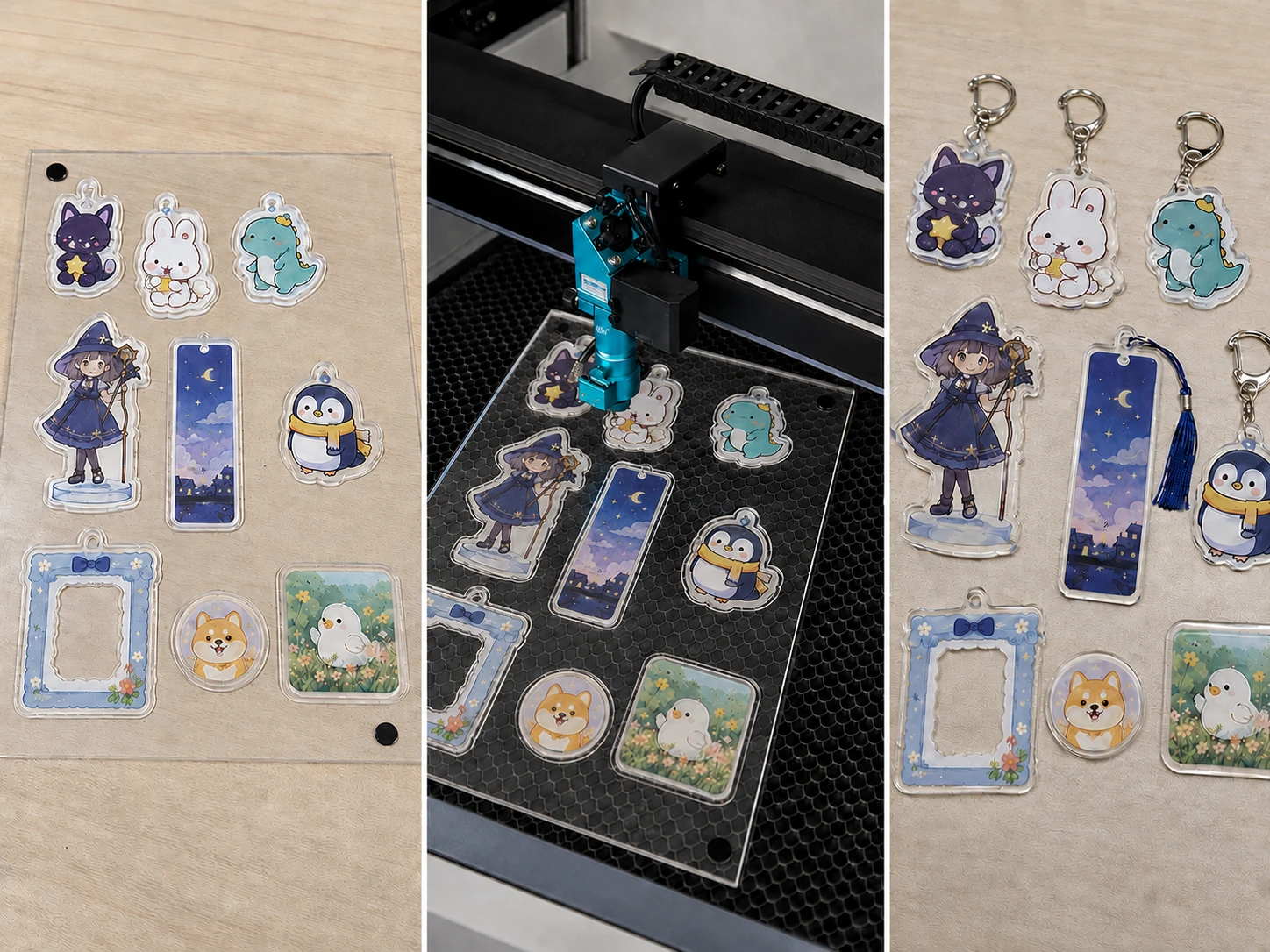
UV-printed acrylic keychains prepared for laser contour cutting.
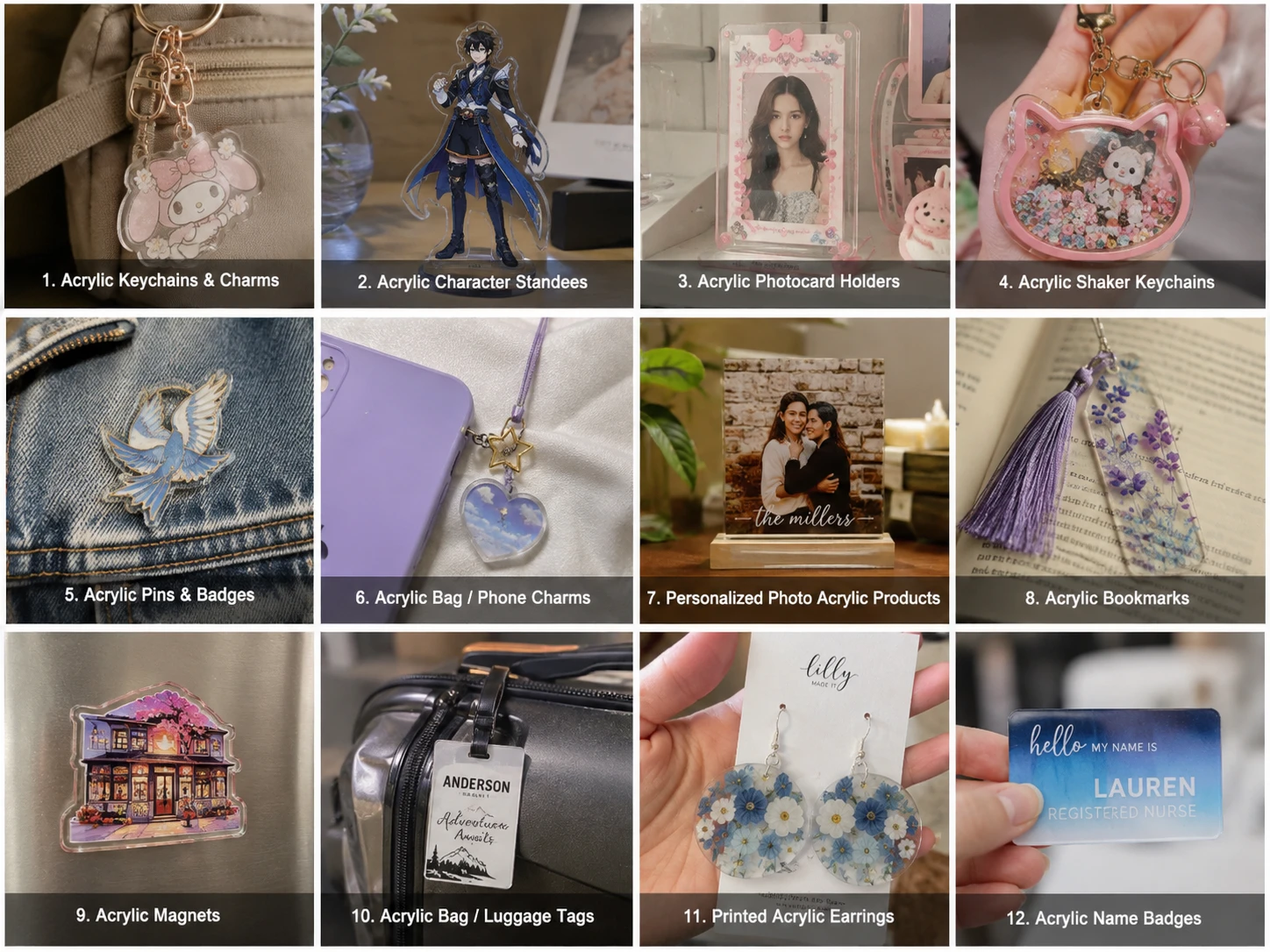
Examples of custom products that combine full-color UV printing with laser cutting.
Quick Answer: What Are the Best-Selling UV Printer Products to Make with a Laser Cutter?
Some of the strongest product ideas for a combined UV printer and laser cutter workflow are acrylic keychains and charms, character standees, photocard holders, shaker keychains, pins and badges, bag and phone charms, custom earrings, personalized photo and pet products, bookmarks, magnets, luggage tags, and name badges.
These products make practical use of both machines: the UV printer creates full-color artwork, photographs, logos, white ink layers, and other printed details, while the laser creates the final contour, holes, windows, slots, layered components, or other structural features.
The table below compares 12 product categories that are especially relevant to a UV printing + laser cutting business. Their business value depends on more than popularity alone, so later in this guide we will also compare sampling cost, labor, batchability, machine occupancy, achievable selling price, and profit per production hour.
| Product | Typical Market | Why Customers Buy It | UV Printing Role | Laser Role | Main Business Consideration |
|---|---|---|---|---|---|
| Acrylic Keychains & Charms | Anime, games, artists, creators, events | Collectible, affordable, easy to personalize and sell in sets | Full-color character art, logos, photos, white ink, double-sided graphics | Contour cutting and hanging holes | Excellent batch potential; hardware assembly and licensing costs should be included |
| Acrylic Character Standees | Anime, games, VTubers, artists, creator merchandise | Displayable collectible with more visual presence than a small charm | Character artwork, backgrounds and decorative graphics | Character contour, base and slot cutting | Good batch potential; base fit, packaging and material thickness affect production cost |
| Acrylic Photocard Holders | K-pop, anime, trading-card and fandom communities | Combines card protection, display and fandom decoration | Decorative borders, illustrations, text and themed graphics | Outer contour, card window, slots and hanging holes | Good repeatability; multi-layer designs increase assembly time |
| Acrylic Shaker Keychains | Fandom, artist merchandise, collectible gifts | Interactive construction creates a more premium collectible product | Character graphics, backgrounds and printed decorative layers | Outer contour, internal cavity and multiple structural layers | Higher selling-price potential comes with more laser time, assembly and failure risk |
| Acrylic Pins & Badges | Artist alleys, conventions, brands, clubs, fandom merchandise | Small collectible format that works well as individual products or themed sets | Full-color artwork, names, logos and illustrations | Custom outer shape | Strong batch efficiency; small selling prices make setup and fulfillment time important |
| Acrylic Bag & Phone Charms | Personalized gifts, pet products, fandom and lifestyle accessories | Turns artwork into wearable or everyday accessories | Photos, character artwork, patterns and custom graphics | Custom contour and attachment holes | Hardware inventory and assembly need to be included in the final unit cost |
| Personalized Photo & Pet Acrylic Products | Pet owners, couples, families, memorial and personalized gifts | Personal photos create high emotional and customization value | Customer photos, portraits and personalized artwork | Face, pet or object silhouette cutting | Higher customization value comes with additional image preparation, proofing and one-off labor |
| Acrylic Bookmarks | Readers, authors, book clubs, fandom and creator merchandise | Affordable gift and collectible that supports detailed themed artwork | Illustrations, photographs, quotes and character graphics | Outer shape, decorative cutouts and holes | Low material use and good nesting support efficient batch production |
| Acrylic Magnets | Souvenirs, tourism, artists, personalized gifts, fandom merchandise | Compact product suited to photos, illustrations, landmarks and collectible designs | Full-color artwork, photography and branding | Custom contour cutting | Simple shapes batch efficiently; magnet attachment and packaging add manual labor |
| Acrylic Bag & Luggage Tags | Schools, sports teams, travel, kids, corporate gifts | Practical identification product with clear personalization value | Names, logos, patterns, mascots and full-color graphics | Tag shape, holes and custom contours | Standardized sizes and repeat orders can produce strong batch economics |
| Custom Printed Acrylic Earrings | Fashion, sports teams, events, personalized gifts | Lightweight wearable product with strong design and personalization potential | Photos, patterns, team graphics, illustrations and custom artwork | Earring contour and hardware holes | Small material usage supports batching, while assembly and finishing can become the labor bottleneck |
| Custom Acrylic Name Badges | Offices, hospitality, healthcare, events and retail teams | Businesses need repeatable branded identification for staff and events | Employee names, company logos and brand colors | Badge contour and custom shape | Repeat B2B orders and reusable layouts can reduce design and setup cost per unit |
UV printing adds the visual design, while laser processing creates the final shape and structural features required by these products.
Most of these products follow a similar production logic: start with a material that can deliver the look, durability, and cost you need, print the artwork, then use the laser to create the final contour or structure. Acrylic is especially common for keychains, standees, badges, magnets, and similar merchandise because it works well for both full-color UV printing and CO₂ laser cutting. If you are still deciding which substrate fits your product, see our guide to the best materials for UV printing and laser cutting, where we compare options by cost, appearance, durability, and application.
Once the material and product are chosen, the next practical question is how to keep the printed artwork aligned with the laser-cut shape. This becomes especially important for contour-cut products such as keychains, standees, bookmarks, badges, and magnets, where even a small positioning error can create uneven borders or rejected parts. Our UV Printing and Laser Cutting: Print First or Cut First? guide covers the complete workflow, including file preparation, registration, positioning, and when to print or cut first.
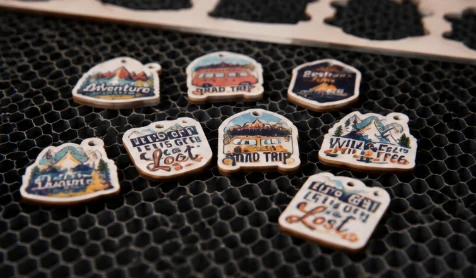
A Print & Cut workflow aligns UV-printed graphics with the final laser-cut contours.
A product can sell well and still be a poor use of your time or equipment. Before adding a UV-printed and laser-cut product to your catalog, look beyond material cost and selling price. Sampling, failed pieces, artwork preparation, setup, finishing, customer communication, packaging, selling fees, and machine occupancy can all change the economics of the job.
The better question is: after paying for the full cost of producing and selling the product, does it generate enough return for the labor and production capacity it consumes?
For a broader view of equipment, pricing, product selection, and operating costs, see our guide to starting and growing a laser engraving business.
Start with the cost of producing a product that is actually ready to ship. This means accounting for the entire workflow rather than only the acrylic sheet and UV ink used in the final piece.
| Cost Category | What to Include |
|---|---|
| Materials | Acrylic, wood, metal blanks, backing material and other substrates |
| UV Printing Consumables | CMYK ink, white ink, varnish, primer, cleaning consumables and other printer-related supplies |
| Hardware & Assembly | Key rings, magnets, pins, chains, stands, adhesive, screws and other components |
| Sampling & Development | Test materials, failed samples, color tests, laser parameter tests and prototype iterations |
| Production Waste | Misprints, alignment failures, damaged surfaces, failed cuts and other rejected pieces |
| Direct Labor | Artwork preparation, customer revisions, setup, alignment, loading, unloading, finishing, assembly, QC and packing |
| Machine Cost | Equipment depreciation, maintenance, electricity, extraction and other operating costs |
| Packaging | Boxes, bags, protective film, inserts, labels and protective materials |
| Selling Cost | Marketplace fees, payment fees, advertising, commissions and shipping subsidies |
| Rework & After-Sales | Remakes, replacements, returns, damaged shipments and other expected after-sales losses |
| Business Overhead | Rent, software, insurance, utilities, administration and other fixed operating expenses |
A realistic product cost includes the complete production and selling workflow, including expected losses and the labor required to deliver a sellable product.
New products usually require several iterations before they are ready for repeat production. You may need to adjust UV color, white ink layers, artwork bleed, laser settings, contour alignment, material thickness, hardware, or assembly methods. Those tests consume real materials, ink, machine capacity, and labor.
For a one-off custom job, much of this development cost belongs to that order and may need to be recovered through a design, setup, or sampling charge.
For a repeatable SKU, development cost can be spread across a conservative estimate of future sales:
Use a realistic sales estimate. Spreading development cost across an optimistic sales forecast can make an unproven product appear much more profitable than it really is.
Unit economics can change dramatically with batch size. A job that requires 30 minutes of artwork preparation and machine setup may be expensive when the customer buys one piece and much more efficient when the same setup supports 50 pieces.
Calculate profitability at realistic order quantities rather than relying on a single theoretical unit cost.
For batch products, pay particular attention to:
This is especially important for keychains, pins, magnets, bag tags, name badges, and other products where batching can spread the same design and setup work across many units.
Your own labor still has a cost when you operate the business yourself. Track the time spent on activities such as customer communication, artwork changes, file preparation, machine setup, alignment, finishing, assembly, quality control, and packing.
Set an internal hourly labor rate and treat that amount as a production cost:
This separates compensation for your work from the profit earned by the business. A product that only appears profitable because your own time is valued at zero has weak economics.
Machine time and labor time should be tracked separately. A laser may run for an hour while the operator works on another order, so one hour of laser processing does not automatically equal one hour of labor.
That machine hour still consumes production capacity.
When orders are limited and the laser often sits idle, machine occupancy may have relatively little opportunity cost. Once production becomes busy, every hour assigned to one job is an hour that cannot be assigned to another job on the same machine.
This makes two efficiency metrics especially useful:
The bottleneck may be the laser cutter, UV printer, assembly process, or even the operator. Identify the resource that limits the number of orders you can complete and judge products against that constraint.
A universal “good profit margin” does not work well for custom UV printing and laser production because businesses have different labor costs, rent, equipment investment, order volumes, selling channels, and production capacity.
A more practical approach is to determine how much contribution your products need to generate at the volume you can realistically produce.
Start with:
Then work backward to determine how much each order or unit needs to contribute. This gives you a business-specific margin requirement instead of an arbitrary percentage.
Profit margin is still useful as a buffer. Products with more customization, higher reject risk, expensive licensed artwork, frequent revisions, or complicated assembly generally need more room between full cost and selling price to absorb variation.
Once the full economic cost and required business return are known, calculate the minimum price at which the product makes sense for your business.
Then compare that number with the price customers are actually willing to pay for comparable products.
A product has a stronger business case when:
A popular product can therefore fail the business test when its market price is too low for your workflow. A lower-priced product can still be attractive when it is fast to produce, easy to batch, and generates a better return per labor or machine hour.
| Metric | Question to Ask |
|---|---|
| Demand | Are enough customers actively buying this type of product? |
| Market-Supported Price | Can buyers support the price your business needs? |
| Full Economic Cost | Have sampling, waste, labor, fees, packaging and overhead been included? |
| Profit Margin | Is there enough buffer after the full cost is covered? |
| Active Labor Efficiency | Is the return worth the amount of hands-on work required? |
| Bottleneck Machine Efficiency | Is the return worth the production capacity the job consumes? |
| Batchability | Can setup and design work be spread across multiple sellable units? |
| Reject & Rework Risk | How much profit disappears when a piece needs to be reprinted, recut, or replaced? |
| Repeat-Order Potential | Can the same design, customer, or setup generate future orders? |
| Opportunity Cost | Could the same labor and machine time generate a better return on another product? |
The strongest product opportunity combines real demand with sustainable pricing, efficient labor, efficient machine use, repeatable production, and enough financial room to absorb normal production risk.
Before moving a new material or product into regular production, use a controlled test process to confirm the cutting result and production window. Our laser material settings testing guide explains how to compare parameters systematically.
The strongest UV printer and laser cutter product opportunities tend to fall into three broad groups: fandom and creator merchandise, personalized products, and repeatable custom merchandise. Acrylic is especially common because full-color artwork can be printed directly onto the surface and then laser cut into the finished contour, opening up far more product formats than printing a standard rectangular blank.
The product categories below reflect strong current marketplace activity and their suitability for a combined UV printing and laser cutting workflow. Actual sales and profitability still depend on the design, audience, selling channel, production efficiency, pricing, and competition.
For more information about acrylic as a laser-processing material, see the Thunder Laser acrylic material guide.
Character merchandise can be particularly attractive, but copyrighted characters, logos, games, anime, movies, and other protected intellectual property require proper commercial rights. Original artwork, authorized creator collaborations, and licensed merchandise provide a more sustainable basis for building this type of product line.
Acrylic keychains are one of the clearest examples of a product where UV printing and laser cutting work well together. The format is widely used for anime and game merchandise, VTuber products, artist merchandise, original characters, musicians, events, and brand collaborations.
The UV printer handles full-color character artwork, gradients, photographs, logos, white backing layers, and double-sided designs. The laser then follows the artwork to create the final silhouette and hanging hole, allowing the finished product to follow the shape of a character, mascot, logo, pet, or object.
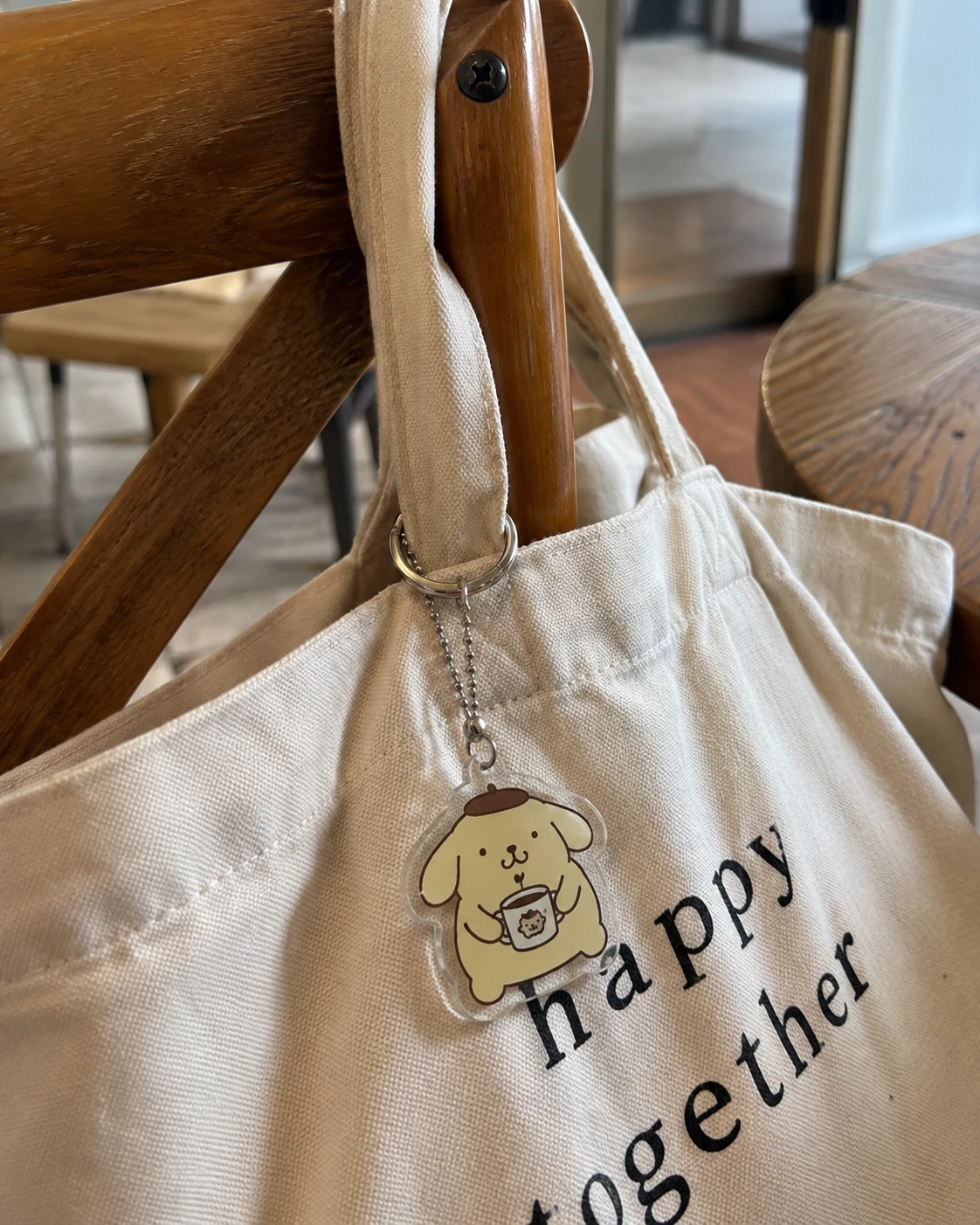
A UV-printed character keychain with a custom laser-cut acrylic contour.
Keychains become especially attractive when one design can be sold repeatedly. A licensed character collection or an artist's original merchandise line spreads artwork preparation and setup across many units, creating very different economics from a one-off personalized keychain.
Acrylic standees take the same full-color character artwork into a higher-value display format. They are common in anime, game, VTuber, artist, original-character and fan-collectible markets because buyers can display them on desks, shelves, gaming setups or collection displays.
UV printing creates the character and any background artwork. Laser cutting creates the character contour, base, tabs and slots required for the standee to assemble correctly. A single product can also contain several printed and cut pieces, such as a character, background, logo plate and decorative base.
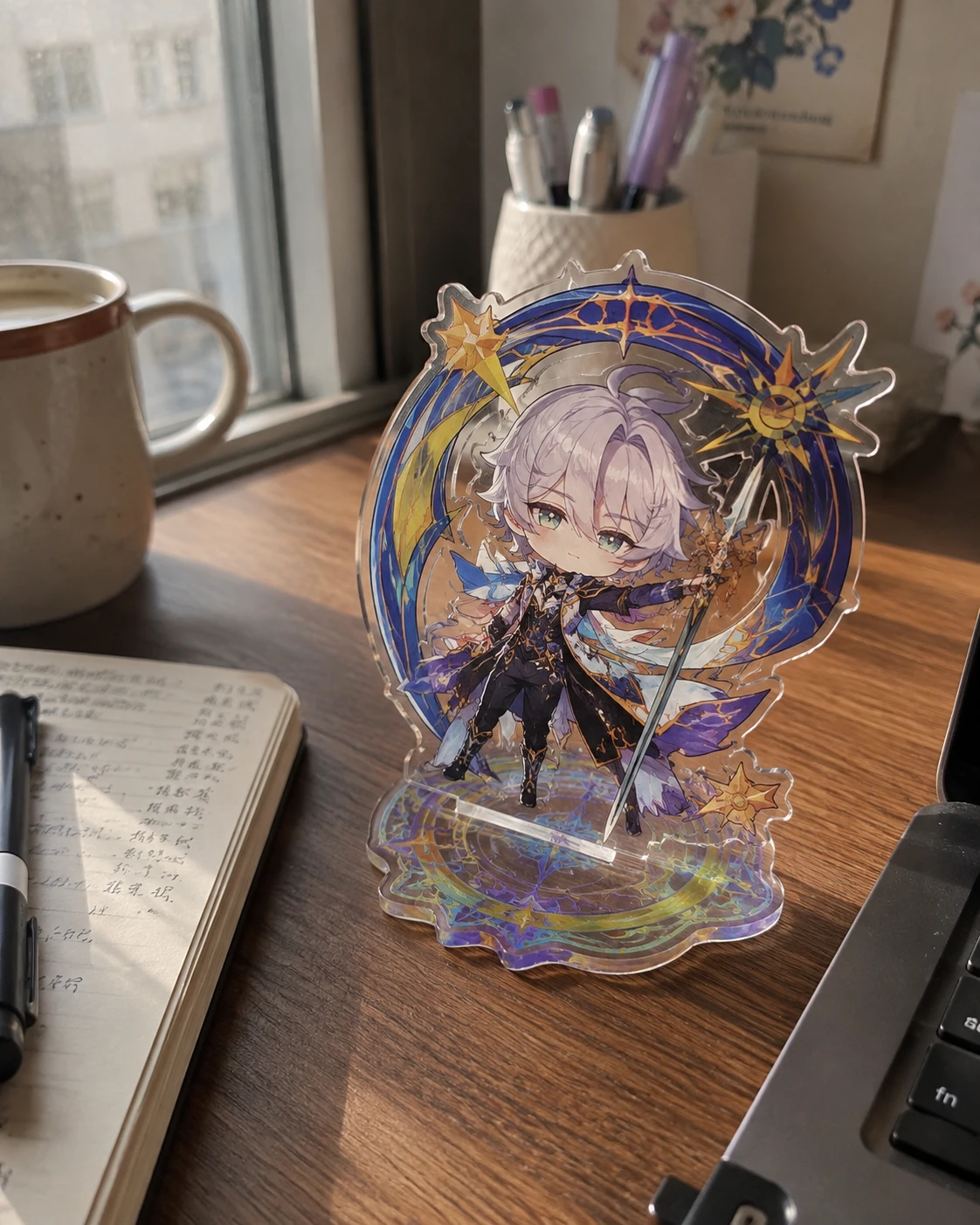
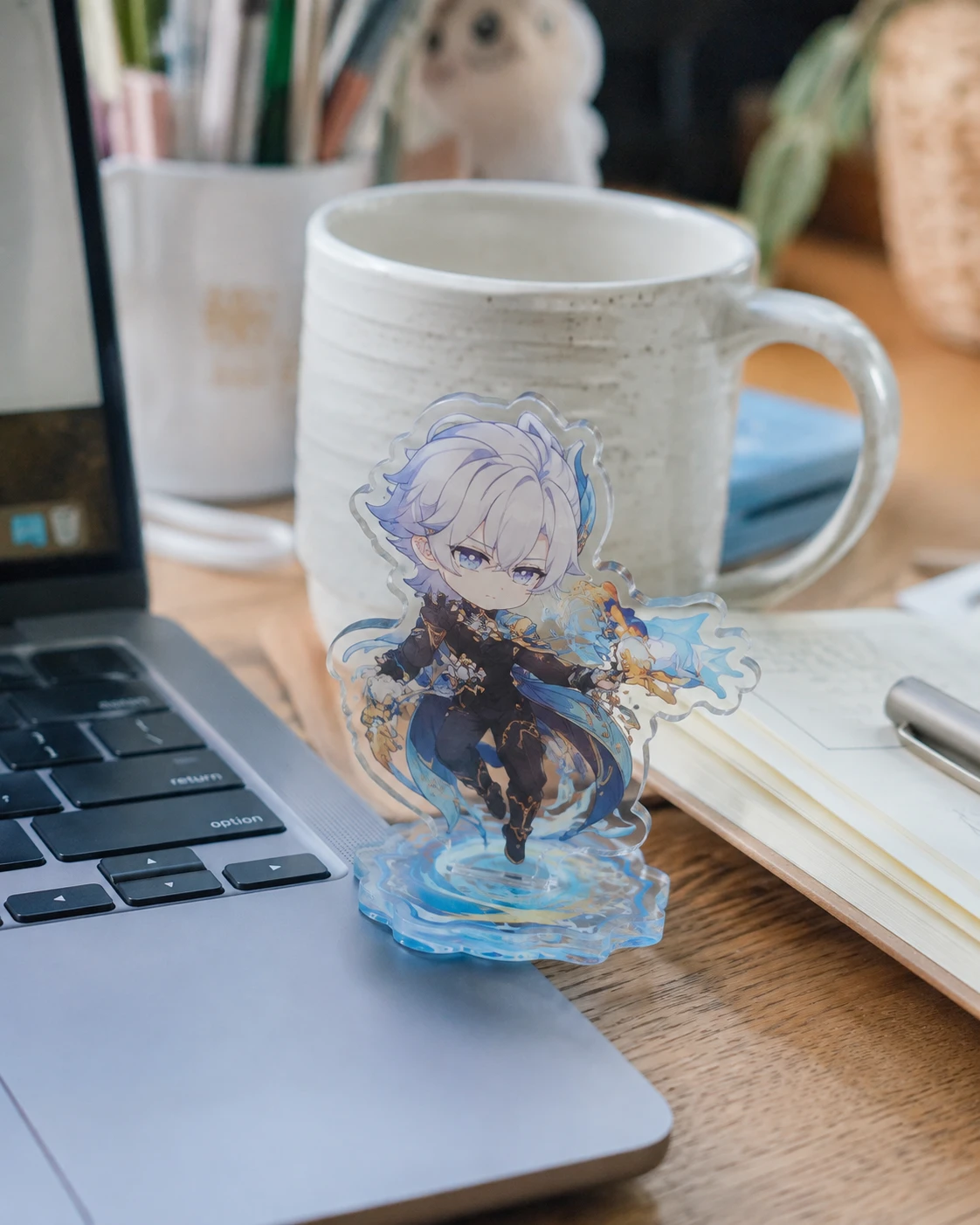
Standees are particularly useful for comparing revenue per order with production efficiency. A larger standee can command a higher selling price than a keychain, but it also occupies more sheet area and laser cutting capacity.
Shaker keychains add movement and multiple layers to the standard acrylic charm. Small decorative pieces move inside a transparent cavity, creating a collectible product that can support a higher selling price than a basic single-layer keychain.
UV printing can be used for characters, backgrounds, borders and decorative elements. Laser cutting is used to produce the external contour, internal cavity, spacer layers and small moving components required by the shaker structure.
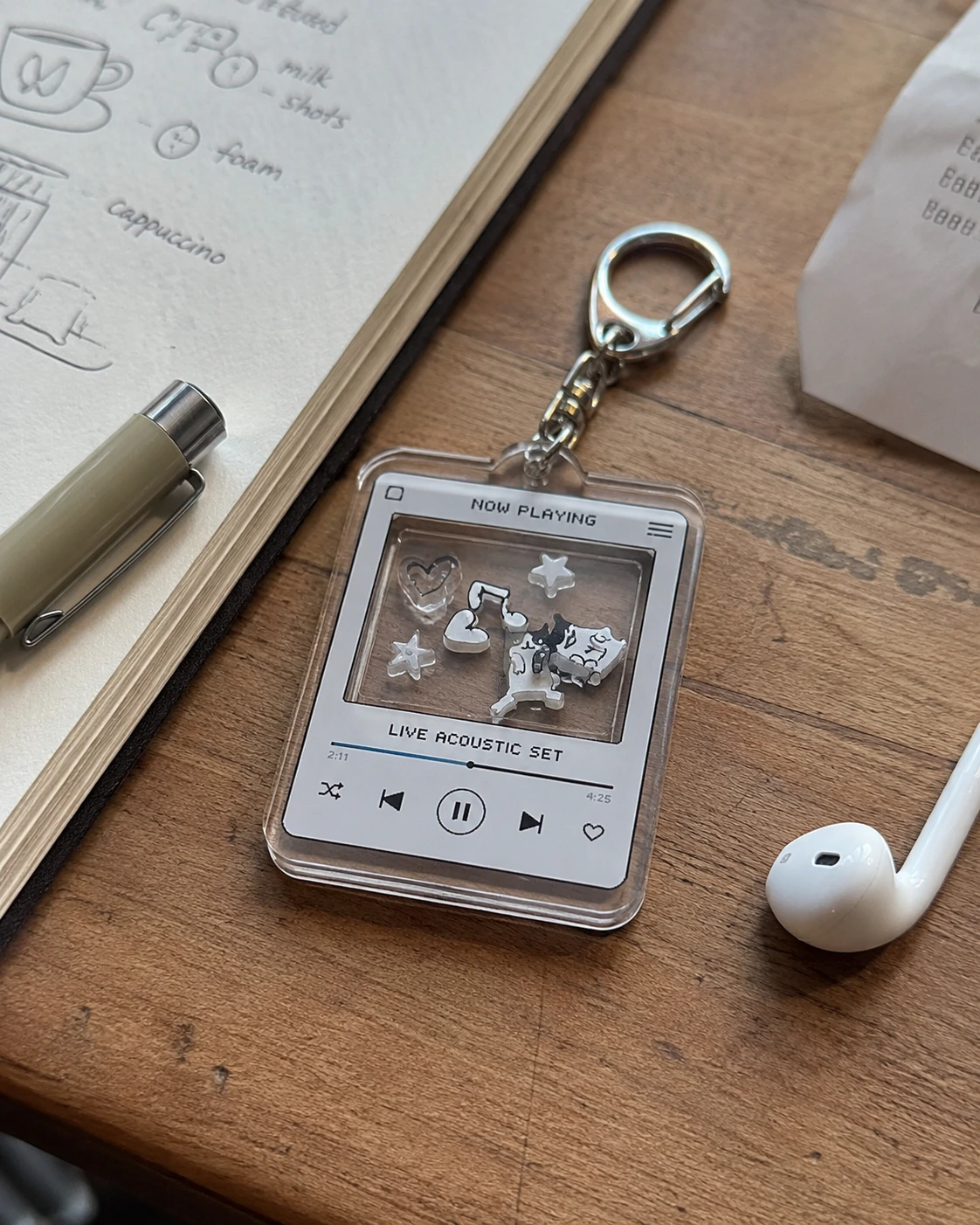
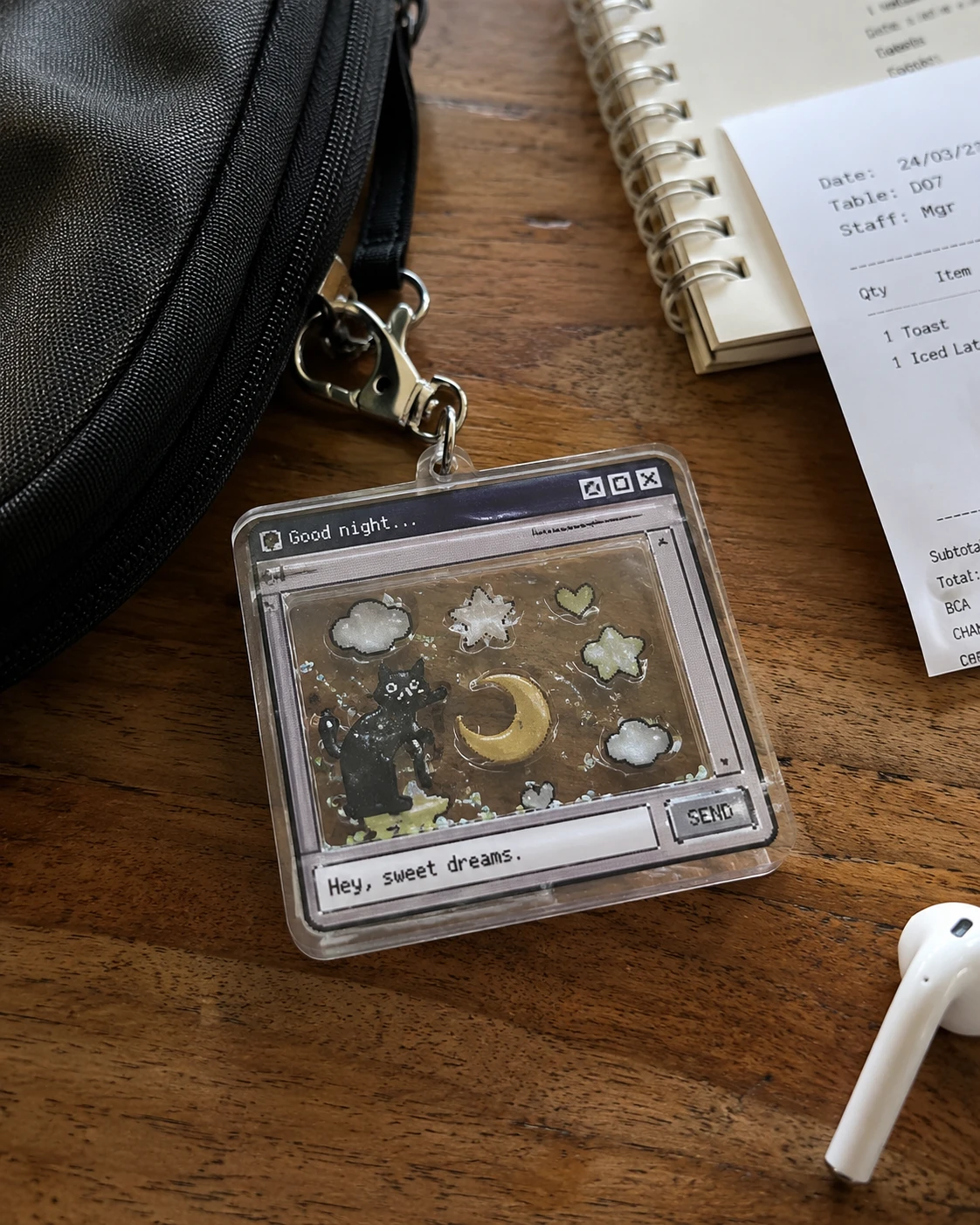
Shaker charms are a good example of why selling price alone can be misleading. Their premium construction creates more pricing room, while the additional laser operations and manual assembly can reduce profit per labor hour when the workflow becomes inefficient.
Photocard holders have become a recognizable product category around K-pop, idol, anime and trading-card communities. Buyers use them to protect and display photocards while turning the card itself into a bag charm, concert accessory or collectible display.
The UV printer adds themed illustrations, decorative borders, text, colors and character-inspired graphics. The laser cuts the outer contour, card window, hanging holes and any layered components needed to hold the photocard.
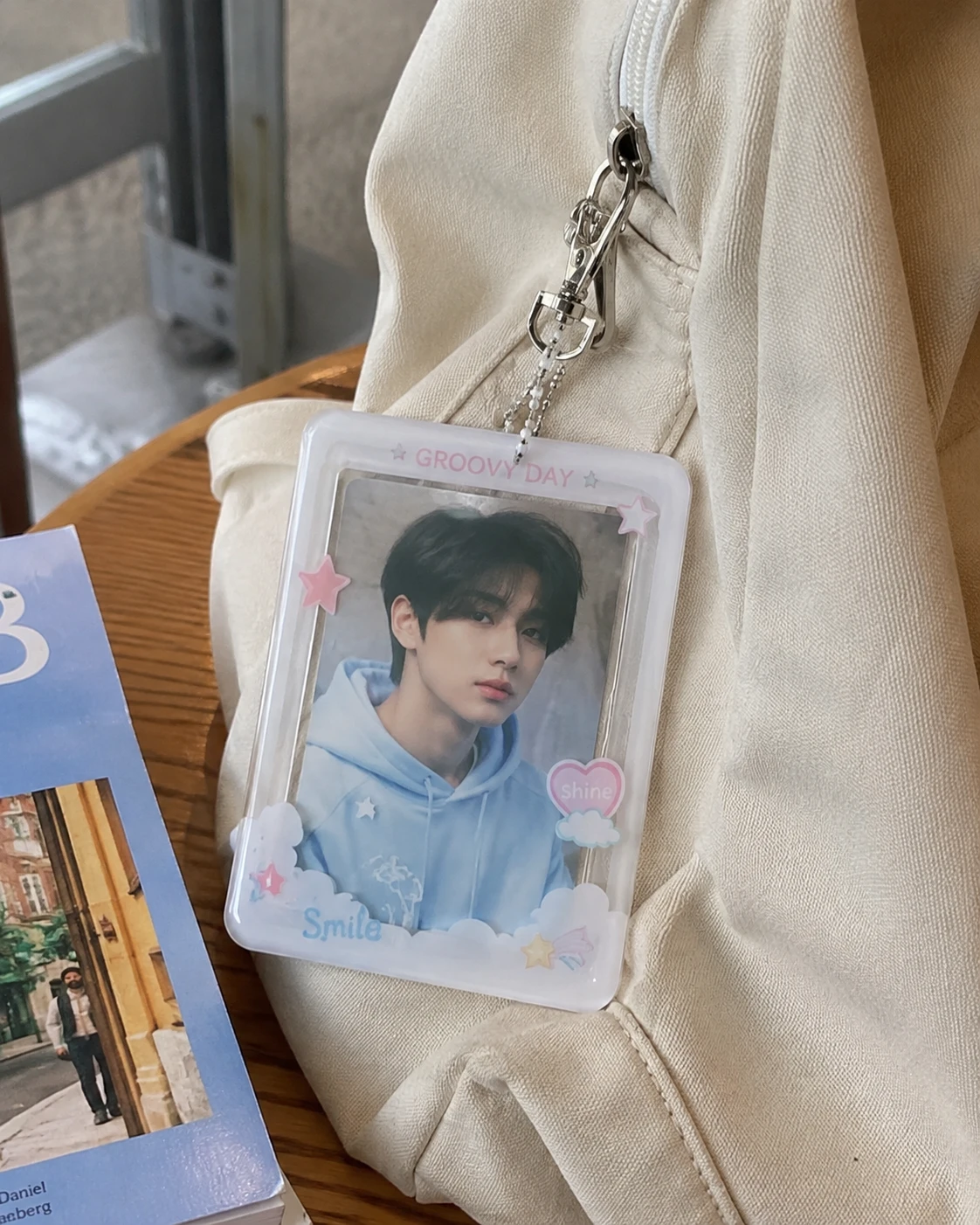
A printed acrylic photocard holder used as a decorative backpack accessory.
Photocard holders also work well as part of a larger fandom merchandise collection. The same artwork direction can be extended across keychains, standees, charms and other products without creating an entirely new visual identity for every SKU.
Printed acrylic pins and badges provide a lower-cost collectible format for artwork, characters, logos, mascots and short messages. Their small size makes them particularly suitable for artist alleys, conventions, clubs, promotional merchandise and themed collections.
UV printing provides the full-color face of the product, while the laser cuts each design to its final shape. A pin or magnetic backing is then attached during finishing.
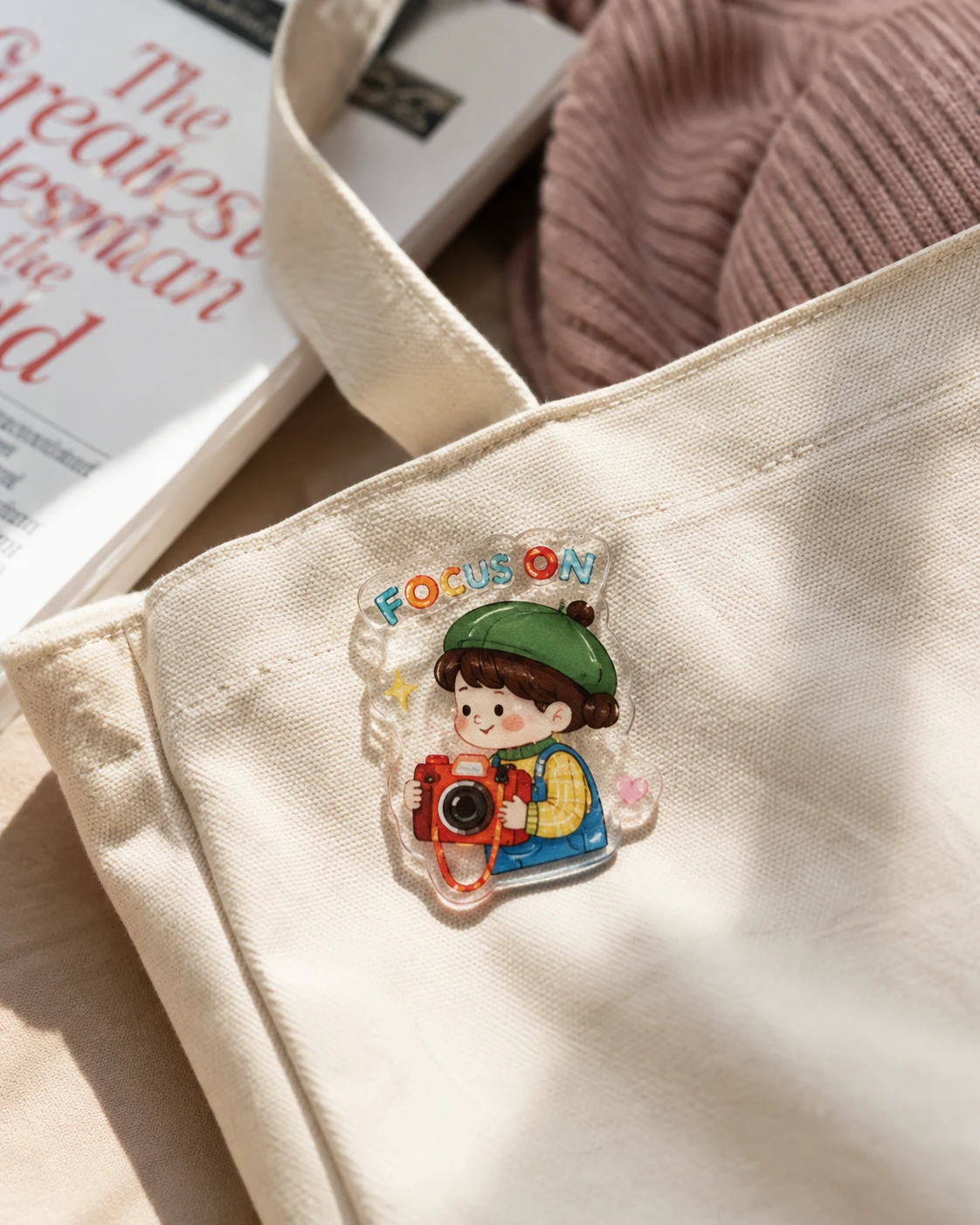
A UV-printed acrylic pin with a custom laser-cut outer shape.
Pins can have relatively low individual selling prices, so batch efficiency matters. Their economics generally become more attractive when several pieces share the same artwork setup or when they are sold as sets.
Small acrylic charms can extend beyond traditional keyrings into tote bags, backpacks, purses, phone straps, zipper pulls and other accessories. This gives creators and brands several ways to reuse the same artwork across different product formats.
The UV printer produces the artwork, photograph, character or logo. Laser cutting creates the individual silhouette and attachment hole, after which different straps, chains or clasps can turn the same printed component into different products.
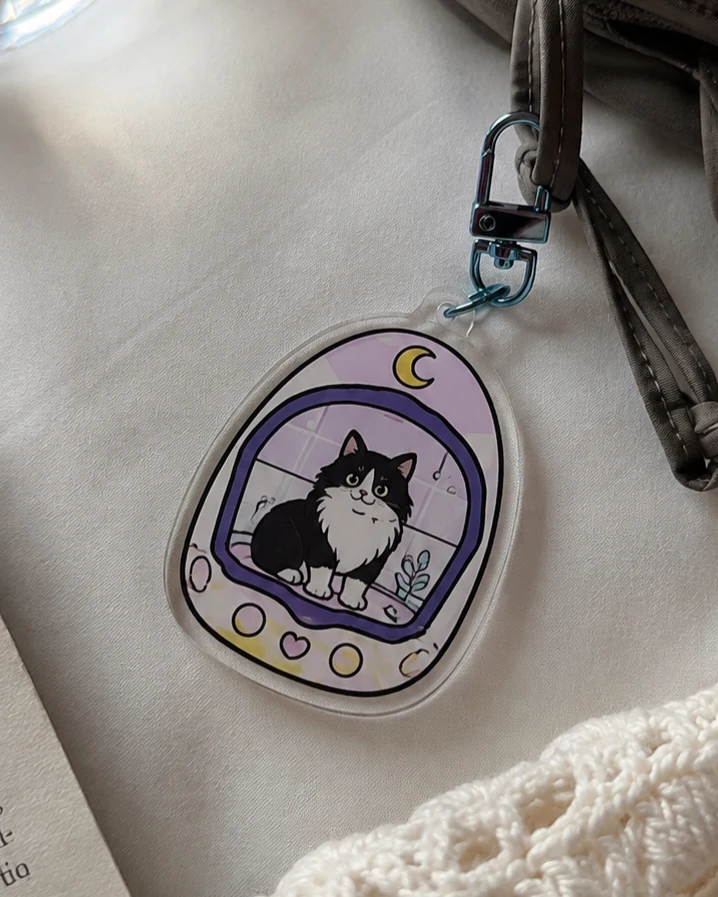
A printed cat-shaped acrylic charm attached to a shoulder bag.
This category can be useful for increasing the value of an existing design library. Artwork already created for a keychain may also support a phone charm or bag charm with relatively little additional design work.
Personalized photo products operate under a different business model from repeatable fandom merchandise. Customers provide a pet photo, portrait, family picture, baby photo or other personal image, and the seller converts it into a custom-shaped product.
UV printing reproduces the photograph in full color. Laser cutting follows the subject's silhouette or another custom outline to create products such as pet keychains, photo charms, mini standees, ornaments, magnets and memorial keepsakes.
This is also where labor accounting becomes particularly important. A personalized product may use very little acrylic while requiring considerably more image preparation and customer communication than a repeatable merchandise SKU.
Acrylic bookmarks work across book communities, author merchandise, fandom products, personalized gifts, school products and reading-themed collections. They provide a relatively large printable surface while using little material.
UV printing can add illustrations, photographs, patterns, quotations and character artwork. Laser cutting produces the bookmark profile, decorative edges, holes and custom shapes.
Bookmarks become more commercially interesting when sold as collections, personalized gifts or complementary merchandise rather than competing only as a low-priced single item.
Acrylic magnets can carry almost any visual theme, including characters, artwork, pet photos, landmarks, food illustrations, family photos and branded graphics. That makes the format relevant to both personalized online sellers and physical souvenir businesses.
UV printing produces the visual face of the magnet, and laser cutting turns the printed image into a custom silhouette. A magnetic backing is added during finishing.
Custom tags combine decoration with a practical identification function. Popular uses include school backpacks, lunch bags, sports bags, luggage, diaper bags and team equipment.
UV printing adds names, mascots, logos, photographs, patterns and themed graphics. Laser cutting creates the tag outline and attachment openings.
Team, school and group orders can produce much stronger economics than individual one-off tags because the same overall design, material and machine setup can be reused across many names.
Acrylic earrings are well suited to highly visual niches such as school spirit, sports teams, seasonal designs, event merchandise, artistic patterns and statement fashion. UV printing allows much more visual detail than relying only on the color of the acrylic itself.
The UV printer applies full-color patterns, logos, illustrations or photographs, while the laser cuts lightweight custom shapes and precise holes for the earring hardware.
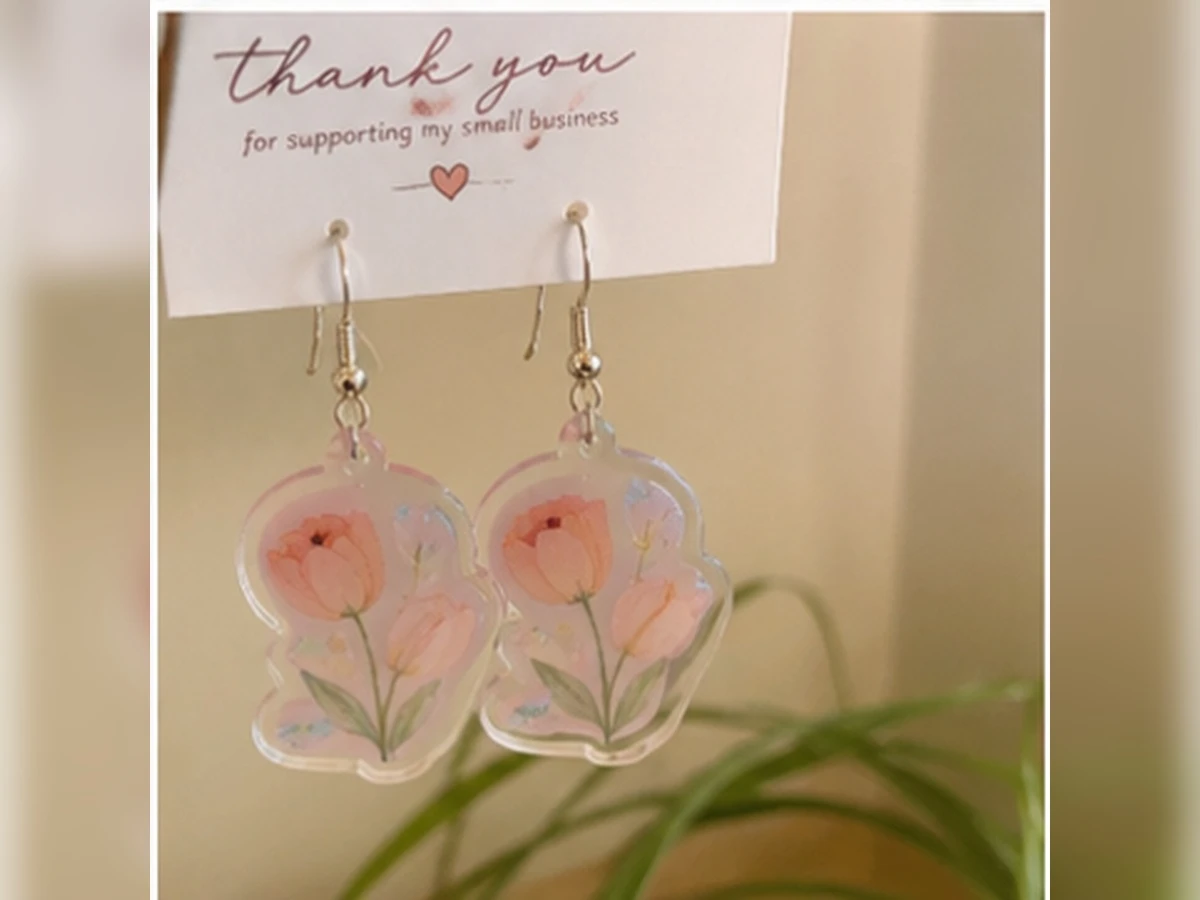
Floral acrylic earrings combining detailed UV printing with precision laser cutting.
Earrings can be efficient at the machine stage while becoming labor-heavy during assembly. For this category, profit per active labor hour can therefore be more important than laser cutting time alone.
Name badges bring the UV printing and laser cutting workflow into a more repeatable B2B market. Restaurants, hotels, offices, schools, healthcare businesses, retailers and events regularly need staff identification with names, logos and brand colors.
UV printing handles the employee name, company logo and brand graphics. Laser cutting creates the finished badge shape, including custom contours that help a business move beyond a standard rectangular name tag.
Name badges illustrate why the flashiest consumer product is not always the strongest business opportunity. A repeat business customer may reorder the same badge format whenever employees join, names change or new locations open, allowing the original layout and production workflow to keep generating value.
For more ideas across acrylic, wood, leather, metal, signs, gifts, accessories, and other product categories, explore the Thunder Laser Inspiration Library.
Best-selling and best-performing answer two different business questions. A product with a higher selling price may consume more acrylic, more machine time, and more assembly labor, while a lower-priced product may generate a better return because it can be nested efficiently, produced in batches, and repeated with very little setup.
The comparison below focuses on the production economics of the 12 product categories in this guide. These are relative assessments rather than fixed industry benchmarks; actual results will vary with product size, artwork complexity, batch quantity, equipment, selling channel, labor cost, licensing fees, and your own workflow.
| Product | Typical Order Model | Setup Burden | Active Labor | Machine Occupancy | Batchability | Repeat-Order Potential | Best Economic Fit |
|---|---|---|---|---|---|---|---|
| Acrylic Keychains & Charms | Collections, batches, individual designs | Low–Medium | Low–Medium | Low | Excellent | High for creator and licensed merch | Strong when the same artwork can be sold repeatedly or produced in larger batches |
| Acrylic Character Standees | Collections and individual merchandise | Medium | Medium | Medium | Excellent | High for established characters or creators | Strong when the higher selling price offsets greater acrylic use and cutting time |
| Acrylic Shaker Keychains | Premium collectible batches | High | High | Medium–High | Medium | Medium–High | Works best when premium pricing covers multi-layer cutting, assembly and higher reject risk |
| Acrylic Photocard Holders | Themed collections and fandom accessories | Medium | Medium | Medium | Good | High within active fandom niches | Strong when designs are reused across collections and assembly is standardized |
| Acrylic Pins & Badges | Batch merchandise and sets | Low | Low–Medium | Low | Excellent | High | Strong for high-volume batches, sets, clubs, events and repeat merchandise designs |
| Acrylic Bag & Phone Charms | Collections, accessories and personalized orders | Low–Medium | Medium | Low | Excellent | Medium–High | Strong when one printed design can be reused across several accessory formats |
| Personalized Photo & Pet Products | Mostly one-off personalized orders | High | High | Low–Medium | Low | Low | Strong when personalization pricing adequately covers image preparation, proofing and customer communication |
| Acrylic Bookmarks | Collections, sets and personalized gifts | Low | Low | Low | Excellent | Medium–High | Strong for collections and sets because material use and machine time can remain relatively low |
| Acrylic Magnets | Souvenir batches, merchandise and personalized products | Low | Low–Medium | Low | Excellent | High for wholesale and souvenir customers | Particularly attractive for repeated wholesale designs and destination merchandise |
| Acrylic Bag, Backpack & Luggage Tags | Personalized batches, school and team orders | Low–Medium | Medium | Low | Excellent | High for groups and organizations | Strong when one template supports many names, team members or employees |
| Custom Printed Acrylic Earrings | Collections and seasonal batches | Low | Medium–High | Low | Excellent | Medium–High | Machine economics can be strong, while hardware assembly and finishing often determine labor efficiency |
| Custom Acrylic Name Badges | B2B batches and recurring replacement orders | Low after initial setup | Low | Low | Excellent | Excellent | One of the strongest repeat-order models because layouts, materials and production settings can be reused |
Production economics improve when artwork, setup and machine preparation can be reused across many sellable units or future orders.
Acrylic keychains, pins, bookmarks, magnets and tags generally have some of the strongest batch-production characteristics. Their small size allows many pieces to be nested on one sheet, while relatively simple contours can keep laser occupancy per unit low.
These products become especially attractive when the artwork is reusable. A creator can release the same character keychain repeatedly, a souvenir shop can reorder the same magnet design, and a school can use the same bag-tag template while changing only individual names.
Character standees, shaker keychains and highly personalized photo products can support more value per finished item because the product contains more visual detail, customization or structural complexity.
Their economics depend more heavily on production time. Larger printed areas consume more material and printer capacity, while layered products add laser operations and assembly. For these products, compare the additional selling price with the additional labor and bottleneck machine time required to create that premium.
Custom name badges, team tags, branded magnets and other organization-based products can have particularly attractive long-term economics. The first order carries most of the artwork, proofing and setup work. Later orders can often reuse the same layout, material specification and machine settings.
This reduces the effective acquisition and setup cost of future orders. A company that orders 50 employee badges today may return for replacements and new hires, while a tourist shop can continue reordering the same magnet designs throughout the season.
The final decision should come back to the constraint identified in Section 1. A product that generates more profit per order can still be a weaker use of production capacity when it occupies the laser or UV printer for much longer than other available jobs.
If your laser is already the production bottleneck, compare products by profit per laser hour. If finishing and assembly consume most of the working day, compare profit per active labor hour. If the UV printer is fully booked, evaluate how much contribution each product creates from the printable area and printer time it consumes.
This is why products such as simple keychains, magnets or name badges can sometimes outperform more complex premium products from a business perspective: their value comes from repeatability, batching and efficient use of limited production capacity.
The same UV-printed and laser-cut product can perform very differently depending on where and how it is sold. A custom pet charm may work well as a one-off personalized online order, while a magnet or name badge can become more attractive when sold in batches to stores, schools, teams, or businesses.
Match the product to the sales model before deciding what to add to your catalog.
| Sales Model | Strong Product Categories | What Usually Drives Value | Main Production Consideration |
|---|---|---|---|
| Anime, Game & Licensed IP Merchandise | Keychains, standees, shaker charms, photocard holders, pins | Collectibility, recognizable characters, limited editions and coordinated product series | Batch efficiency, consistent print quality, licensing or royalty costs |
| Artist & Creator Merchandise | Keychains, charms, standees, pins, bookmarks, magnets | Original artwork, creator identity and reusable designs across multiple products | Building several SKUs from the same artwork can improve development efficiency |
| Personalized Online Store | Pet products, photo charms, personalized magnets, bag tags, bookmarks | Emotional value and individual personalization | Artwork preparation, customer communication and proofing can become the main labor cost |
| Conventions & Artist Alleys | Keychains, pins, standees, shaker charms, bookmarks | Collectible designs, impulse purchases, product sets and exclusive merchandise | Inventory needs to be produced before the event, so forecasting and batch size matter |
| K-pop & Fandom Merchandise | Photocard holders, charms, standees, keychains | Collecting behavior, coordinated accessories and themed product releases | Product launches can create short periods of concentrated demand |
| Tourism & Souvenir | Magnets, keychains, charms, bookmarks | Local landmarks, destination artwork and easy-to-carry souvenirs | Wholesale quantities and repeat designs favor efficient batch production |
| Schools, Clubs & Sports Teams | Bag tags, keychains, badges, magnets, charms | Mascots, team colors, names and group identity | Variable names can be combined with one reusable design template |
| B2B & Employee Identification | Name badges, branded tags, magnets and small promotional merchandise | Brand consistency, repeat orders and standardized specifications | Initial setup can be reused for replacements, new employees and future batches |
The best sales model usually aligns the product's customization level, batch size and repeat-order potential with the way customers actually buy it.
Keychains, standees, shaker charms, pins and photocard accessories are especially well suited to merchandise built around characters, artists, creators and communities. One illustration can often be adapted into several products, allowing the original design work to support an entire collection.
For example, the same character artwork could become a keychain, standee, pin and bookmark. This increases the number of products available from one creative asset and can also make bundles and coordinated collections easier to build.
Merchandise based on anime, games, movies, brands or other protected intellectual property requires appropriate commercial rights. Original creator artwork and authorized collaborations can use the same production model without relying on unauthorized IP.
Personalized photo and pet products work differently. Each customer supplies unique information or artwork, so the product can support stronger personalization value while also requiring more individual preparation.
The production bottleneck may come from image cleanup, customer revisions and proof approval rather than UV printing or laser cutting itself. Products in this category should therefore be priced around the complete custom workflow.
Standardizing the available sizes, shapes and personalization options can make these orders easier to quote and produce consistently. For more examples of laser-based personalization workflows, see our personalization industry applications.
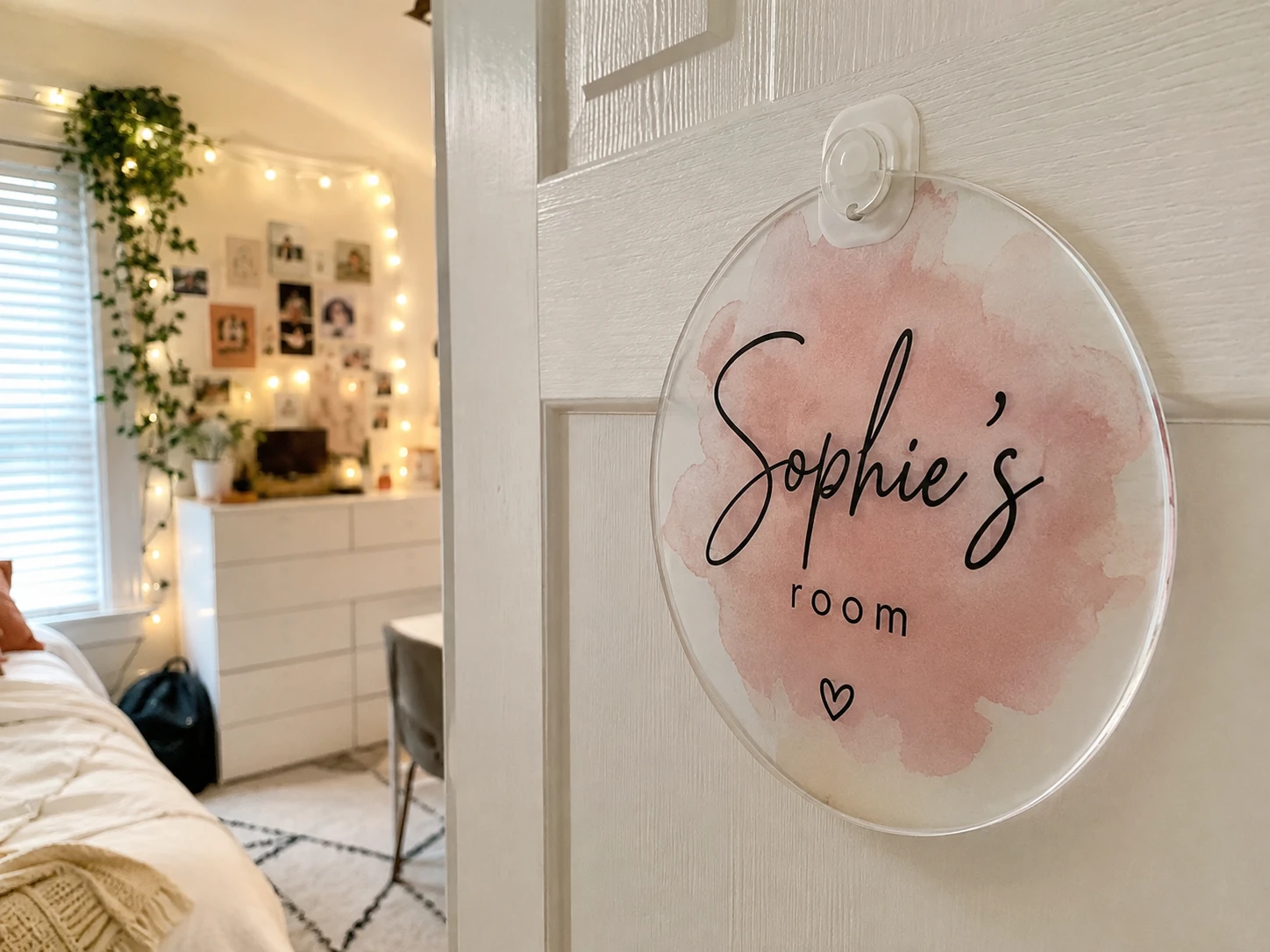
A personalized acrylic room sign shows how printed graphics and custom-cut shapes can support made-to-order products.
Small collectible products such as keychains, pins, charms and bookmarks are practical for in-person selling because they take up little display space and can be offered across several price points.
This sales model rewards batch production. Sellers usually prepare inventory before the event, allowing many pieces to share the same sheet layout, UV print run and laser setup.
Sets and coordinated collections can also increase the value of each customer transaction without requiring every product to be individually customized.
Magnets, keychains, charms and bookmarks can be built around local landmarks, food, attractions, museums, cities and regional artwork. These products combine the visual flexibility of UV printing with custom laser-cut silhouettes that help distinguish them from generic printed souvenirs.
The commercial advantage often comes from repetition. Once a destination design has been approved, the same artwork can be produced repeatedly for gift shops, attractions or other retail partners.
This makes wholesale quantity, packaging and production consistency particularly important.
School mascots, club logos and team graphics can be reused across bag tags, keychains, badges, magnets and other small products. The core design remains consistent while names, numbers or roles change between individual pieces.
This creates a useful balance between personalization and batch production. One order may contain dozens of unique names while sharing the same material, artwork style, machine setup and hardware.
Name badges and branded merchandise can offer some of the strongest repeat-order characteristics in this list. A business may approve its logo, dimensions, material and badge layout once, then place additional orders as staff change or new locations open.
The original design and setup work can therefore continue creating value over multiple orders. This reduces the amount of new preparation required for each sale and can improve both labor efficiency and overall customer value.
When comparing product opportunities, consider the sales model together with the economics from the previous section. A high-demand consumer product may generate frequent individual orders, while a less visible B2B product can produce larger batches and repeated purchases from the same customer.
Most of the products in this guide rely on the laser for one critical step: turning a printed sheet into accurate, repeatable finished parts. For acrylic keychains, standees, magnets, badges, bookmarks, tags, and similar merchandise, the most relevant machine factors are cutting capability, usable work area, positioning workflow, batch capacity, and the amount of laser time required per sheet.
For small and medium custom-product businesses, the Bolt Series is our preferred Thunder Laser starting point. As order volume grows and laser capacity becomes a production bottleneck, the Titan Series provides a larger production platform and higher motion-performance ceiling.
| Series | Bolt Series | Titan Series |
|---|---|---|
| Best Fit | Small-to-medium custom merchandise production | Higher-volume and production-oriented batch processing |
| Laser Source | RF CO₂ | RF CO₂ |
| Current Standard Power Options | 30W / 60W / 80W | 50W / 60W / 80W |
| Working Area | 508 × 305 mm to 915 × 610 mm | 700 × 500 mm to 1300 × 900 mm |
| Max. Engraving Speed | Up to 2000 mm/s | Up to 3000 mm/s |
| Acceleration | Up to 5G | Up to 8G |
| Positioning Support | 5MP mounted camera for visual positioning | Overhead camera + 5MP Mark Point head camera |
| Why It Matters for UV-Printed Products | A practical balance of work area, RF CO₂ cutting, positioning, and production capability for everyday custom merchandise | More sheet capacity, higher motion-performance ceiling, and stronger positioning support for repeated contour-cutting jobs |
Choose the laser around the size of your printed sheets, the number of products placed on each sheet, and how much laser capacity your order volume requires.
For businesses producing acrylic keychains, character standees, photocard holders, pins, magnets, bookmarks, bag tags, name badges, and similar products, Bolt provides a strong balance between production capability and day-to-day workflow.
Key Specifications
These specifications are particularly relevant to custom merchandise because small parts can be nested across the available work area and processed as batches. The RF CO₂ platform is also well matched to acrylic and other common non-metal materials used in custom-product production.
This makes Bolt particularly relevant to artist merchandise businesses, personalization shops, online sellers, convention merchandise producers, schools, small brands, and other operations producing small-to-medium batches of printed acrylic products.
Model selection should follow the actual workflow. A seller working with small sheets and modest daily volume may need relatively little bed space, while a business filling larger printed sheets with dozens of keychains or standees can benefit from the larger work area available within the series.
The economics change once order volume becomes high enough that laser capacity limits daily output. In that production environment, fitting more products on each sheet and moving more jobs through the laser each day can directly affect revenue.
Key Specifications
For UV-printed merchandise production, the larger work area allows more keychains, badges, magnets, standees, or other parts to be nested into each production run. The higher motion-performance ceiling becomes more relevant as production volume and machine occupancy increase.
Titan's head-mounted Mark Point camera can also work with LaserMaker for mark-point recognition and contour-cutting alignment, which is particularly useful when printed artwork must match the final cut path.
The larger Titan 51 provides a 1300 × 900 mm work area. For a business producing hundreds of small printed parts, the value of the larger bed comes from fitting more sellable products into each setup and reducing the number of separate production runs required to complete the batch.
This connects directly to the profitability model discussed earlier in this guide. Once the laser becomes your bottleneck machine, profit per laser hour becomes one of the most useful metrics for deciding whether additional production capacity has real business value.
For a real purchasing decision, use your own product files, material thicknesses, printed sheet sizes, and expected batch quantities as the basis for comparison. Thunder Laser Material Testing can also evaluate actual materials and processing results before you commit to a production workflow.
For a broader comparison based on material, laser source, work area, production volume, and business requirements, see our Thunder Laser machine selection guide.
Best-selling UV printer products such as acrylic keychains, standees, photocard holders, charms, magnets, badges, and other custom merchandise show strong potential because they combine full-color printing with precise laser-cut shapes and structures. The strongest opportunities usually come from products that can be batched efficiently, sold repeatedly, or personalized at a price that adequately rewards the additional work.
Demand is only the starting point. Before committing to a product, calculate the full cost of sampling, materials, ink, waste, labor, finishing, packaging, fees, and machine use. Then compare the achievable selling price with your profit per active labor hour and profit per bottleneck machine hour. Those numbers show whether the product deserves space in your production schedule.
A strong product line should make efficient use of both your UV printer and laser cutter while giving customers something that is difficult to achieve with either process alone: full-color artwork, custom shapes, personalization, and repeatable professional production.
When your product range is ready to scale, compare Thunder Laser machines by work area, laser source, positioning workflow, and production capacity to find a platform that matches your actual order mix.
Talk To Our Experts Now!
Please leave your contact information so that we can serve you better.
WOOD LASER ENGRAVING
& CUTTING FAQS
The new Bolt Series has been upgraded with faster engraving speeds (up to 2000 mm/s), higher RF power options (up to 80W), larger working areas, improved Z-axis height, and Standard dual-air assist. We also added a recessed tray design for larger rotary objects and included new accessories such as a conical nozzle.
The new Bolt Series has been upgraded with faster engraving speeds (up to 2000 mm/s), higher RF power options (up to 80W), larger working areas, improved Z-axis height, and Standard dual-air assist. We also added a recessed tray design for larger rotary objects and included new accessories such as a conical nozzle.
The new Bolt Series has been upgraded with faster engraving speeds (up to 2000 mm/s), higher RF power options (up to 80W), larger working areas, improved Z-axis height, and Standard dual-air assist. We also added a recessed tray design for larger rotary objects and included new accessories such as a conical nozzle.
The new Bolt Series has been upgraded with faster engraving speeds (up to 2000 mm/s), higher RF power options (up to 80W), larger working areas, improved Z-axis height, and Standard dual-air assist. We also added a recessed tray design for larger rotary objects and included new accessories such as a conical nozzle.
The new Bolt Series has been upgraded with faster engraving speeds (up to 2000 mm/s), higher RF power options (up to 80W), larger working areas, improved Z-axis height, and Standard dual-air assist. We also added a recessed tray design for larger rotary objects and included new accessories such as a conical nozzle.
FIND THE RIGHT LASER FOR YOUR NEXT PROJECT
Explore Thunder Laser solutions designed for different materials, workflows, and production needs.


 Stable & Consistent MachinesUnlimited ApplicationsRobust After-sales SupportFactory Direct Supply


