Focal Length vs. Focal Distance CO2 Laser Lens
 2026-05-25
WHAT ARE YOU LOOKING FOR?
Search Across Products, Blog Posts, Support Content, And Resources.

Focal Length vs. Focal Distance CO2 Laser Lens
2026-05-25

In CO2 laser engraving and cutting, focus is everything. A perfectly focused beam delivers clean cuts, sharp engraving details, and consistent results across different materials. Yet many users, especially beginners, often confuse focal length with focal distance, assuming they refer to the same concept. They do not.
This article breaks down the difference between focal length and focal distance in CO2 laser lenses, explains how each affects laser engraving performance, and helps you achieve better engraving and cutting results.
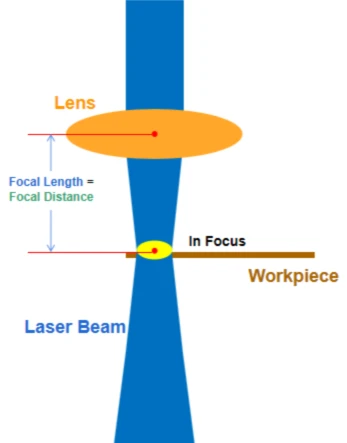
The focal length of a CO2 laser lens is a fixed optical property that defines how the lens concentrates the laser beam. In simple terms, it refers to the distance from the lens to the point where the laser beam converges into its smallest and most concentrated spot, known as the focal point.
Unlike machine settings or worktable adjustments, focal length is determined by the lens design itself and does not change during operation. Focal length directly influences three critical aspects of laser engraving performance:
Common focal lengths used in CO2 laser engraving and cutting systems include 1.5", 2.0", 2.5", and 4" lenses, each optimized for different processing needs.
Short focal length lenses produce an extremely small laser spot, allowing the beam to concentrate energy into a very narrow area. This results in outstanding detail and high engraving resolution.
Key advantages:
Typical applications:
Medium focal length lenses offer a balanced combination of engraving precision and cutting capability. Because of their versatility, they are commonly used as standard lenses on many CO2 laser engraving machines.
Key advantages:
Typical applications:
Long focal length lenses provide a larger depth of focus, allowing the laser to remain effectively focused over a greater vertical range. This makes them especially useful for thick materials or uneven surfaces.
Key advantages:
Typical applications:
| Feature / Focal Length Lens | Short: 1.5"–2" | Medium: 2.5" | Long: 4"–5" |
|---|---|---|---|
| Spot Size | Extremely small | Moderate | Larger |
| Energy Density | Very high | Balanced | Lower |
| Advantages | Maximum engraving detail and precision | Balanced performance | Cutting thick material |
| Typical Applications | Photo engraving | Engraving and medium-thick material cutting | Thick material cutting |
Common CO2 laser lens focal lengths and their applications.
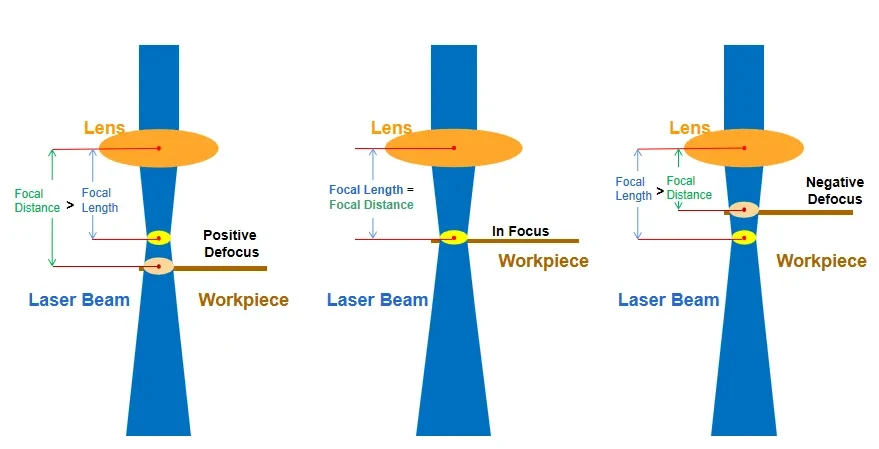
While focal length is a fixed property of the CO2 laser lens, focal distance refers to the actual distance from the lens to the material surface where the laser beam comes to perfect focus. Unlike focal length, focal distance is variable and depends on how the machine is set up and the thickness of the material being processed.
Focal distance should be carefully adjusted to achieve optimal results. The laser spot reaches its smallest size and highest energy density only when the focal point is precise, producing the clearest engraving and the most efficient cutting. Because material thickness can vary, the Z-axis height should be readjusted each time a new material is loaded to ensure the laser remains properly focused.
So when we talk about “focusing” the laser machine, we are usually referring to adjusting the focal distance to match the focal length of the lens, or in some cases, slightly offsetting it to achieve a specific engraving or cutting effect.
| Feature | Focal Length | Focal Distance |
|---|---|---|
| Definition | Lens property | Distance to material |
| Adjustable | No | Yes |
| Depends On | Lens design | Machine setup and material thickness |
| Spot Size | Fixed by lens design | Changes depending on focus accuracy |
| Energy Density | Determines the potential energy concentration | Optimal only when correctly adjusted |
| Impact on Quality | Determines potential detail and focus depth | Directly affects engraving and cutting results |
| Typical Adjustment | None | Z-axis or worktable height |
| Use in Focusing | Reference value | Adjusted to get desired results |
Focal length vs. focal distance comparison table.
Related reading: How to Focus Your Laser Machine: A Beginner’s Guide
Focal length is a fixed lens property that determines potential spot size, energy density, and focus depth. Focal distance is adjustable, depending on material thickness and machine setup, and must be set correctly to achieve sharp engraving and efficient cutting.
Short focal length lenses produce extremely small laser spots, delivering high-detail engraving and excellent results for photo engraving and intricate patterns. Medium focal length lenses provide balanced performance, suitable for general-purpose engraving and cutting medium-thickness materials. Long focal length lenses offer a larger depth of focus, making them ideal for thick materials or uneven surfaces.
Properly adjusting the focal distance ensures the laser spot reaches maximum energy density, resulting in consistent engraving and cutting quality across different projects.
Need Help Choosing the Right CO2 Laser Lens Setup?
Contact Thunder Laser to discuss your lens focal length, material thickness, focusing method, and laser processing goals.
Contact UsTalk To Our Experts Now!
Please leave your contact information so that we can serve you better.
CO₂ LASER FOCUS
SETTING FAQS
Focal length is a fixed property of the lens that determines potential spot size, energy density, and focus depth. Focal distance is the adjustable distance from the lens to the material surface, which must be set correctly for optimal engraving and cutting.
Short focal lengths produce very small spots for high-detail engraving, medium lengths balance detail and cutting ability, and long lengths provide greater depth of focus for thick or uneven materials.
Use the Z-axis adjustment or built-in focusing tools. Measure from the lens to the material surface to match the lens’s focal length, adjusting slightly if needed for specific material thickness or surface irregularities.
The focal length of a CO₂ laser lens is usually marked on the lens barrel or housing. Look for numbers such as 1.5", 2", 2.5", 4", etc., which indicate the lens’s focal length. If there is no marking, you can measure it manually: focus the laser beam on a flat surface and adjust the distance from the lens until the spot is smallest; this distance approximates the focal length. Always refer to the manufacturer’s specifications for accurate identification.
NEED HELP FINDING THE RIGHT SOLUTION?
Talk to our team for machine recommendations, application advice, and support based on your needs.


 Stable & Consistent MachinesUnlimited ApplicationsRobust After-sales SupportFactory Direct Supply