


Fiber Laser Cutting Safety Guide Hazards, PPE & Safe Operation
 2026-09-24


Bolt Series
Professional High-Precision Laser Engraving Machine

Nova Series
Large Format Glass Tube Laser Cutting Machine

Nova Plus Series
Business-grade RF CO₂ Laser Cutter

Nova Pro Series
Professional Laser Cutting & Engraving System

Titan Series
Industrial-grade Laser System

Titan Pro Series
Industrial-grade Dual-laser System


WHAT ARE YOU LOOKING FOR?
Search Across Products, Blog Posts, Support Content, And Resources.

Fiber Laser Cutting Safety Guide Hazards, PPE & Safe Operation
2026-09-24

A fiber laser cutter combines high-energy optical radiation, hot metal, moving machinery, electrical power, high-pressure assist gas, and metal fumes in one production system. These risks can be controlled effectively, but only when the machine safeguards, facility setup, maintenance, and operator procedures are all treated as part of the safety system.
This guide explains the main hazards of fiber laser metal cutting, the safety features a machine should have, when PPE may be required, and what to check before, during, and after cutting.
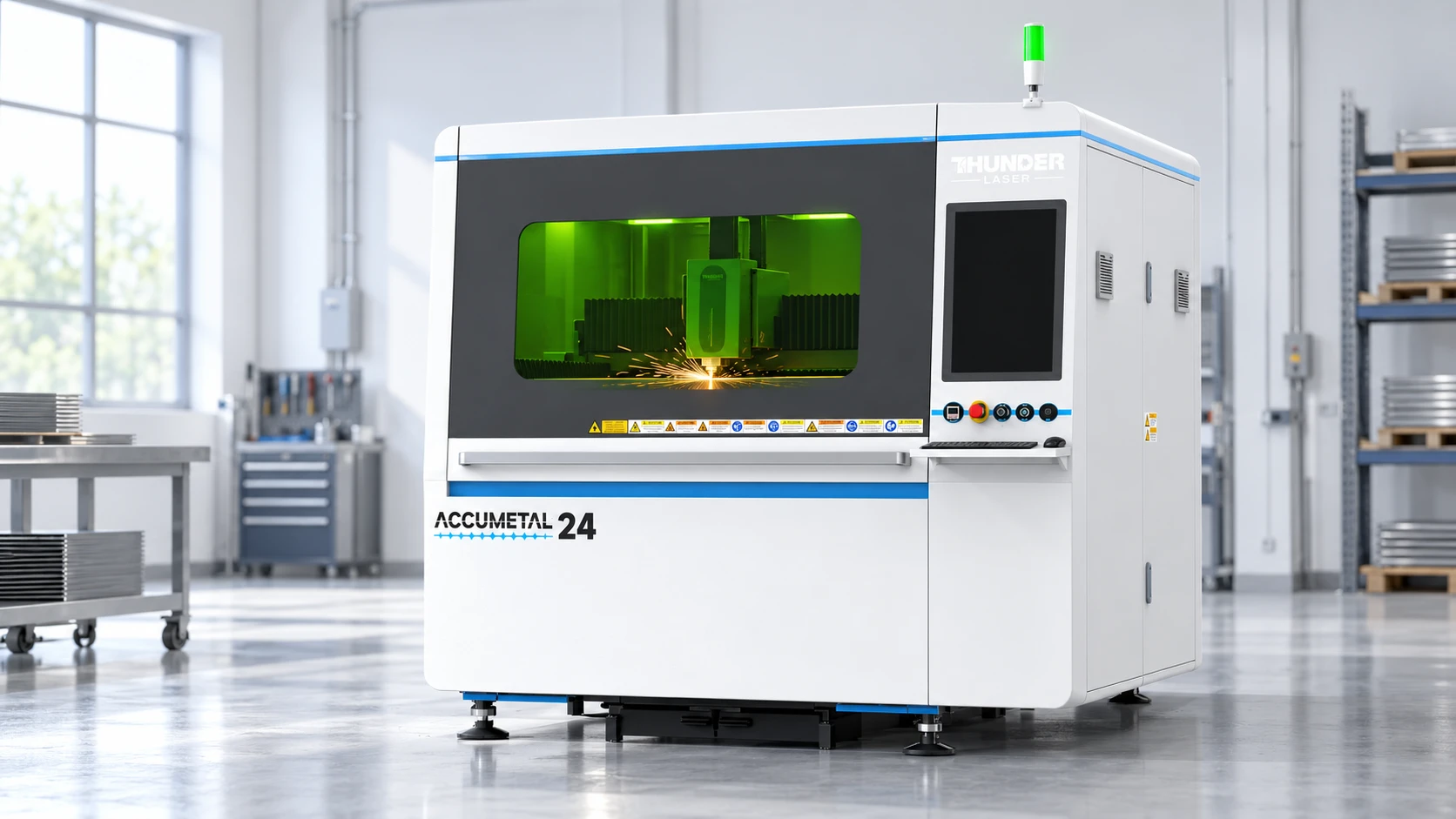
Quick Answer: Is Fiber Laser Cutting Safe?
Yes - when the machine is properly designed, installed, maintained, and operated according to its laser classification and manufacturer instructions. The primary controls should come from engineering measures such as enclosures, interlocks, extraction, access control, and emergency systems. PPE supports those controls; it does not replace them.
Important Safety Note
This guide is general educational information. Always follow the machine label, user manual, site-specific risk assessment, and applicable local regulations. Service work, interlock bypass, electrical work, or open-beam procedures should be performed only by qualified and authorized personnel.
Fiber laser metal cutting is not a single-hazard process. The cutting beam is only one part of the risk picture; fire, fumes, hot parts, assist gas, electricity, and motion also need to be controlled.
| Hazard | Why It Matters | Primary Control |
|---|---|---|
| Laser radiation | Direct or reflected exposure can injure eyes or skin | Enclosure, interlocks, controlled access |
| Fire and hot material | Sparks, molten metal, slag, and hot parts can ignite nearby materials | Housekeeping, monitoring, fire-response plan |
| Fumes and particles | Cutting and coatings can generate airborne contaminants | Effective source extraction and ventilation |
| Assist gas | High pressure; oxygen can intensify fire; nitrogen can displace oxygen | Rated gas system, ventilation, trained handling |
| Electrical energy | High-voltage and stored-energy hazards may exist inside the system | Guards, isolation, qualified service |
| Moving machinery | Axes, doors, tables, and handling systems can create pinch or crush hazards | Guards, interlocks, safe operating zones |
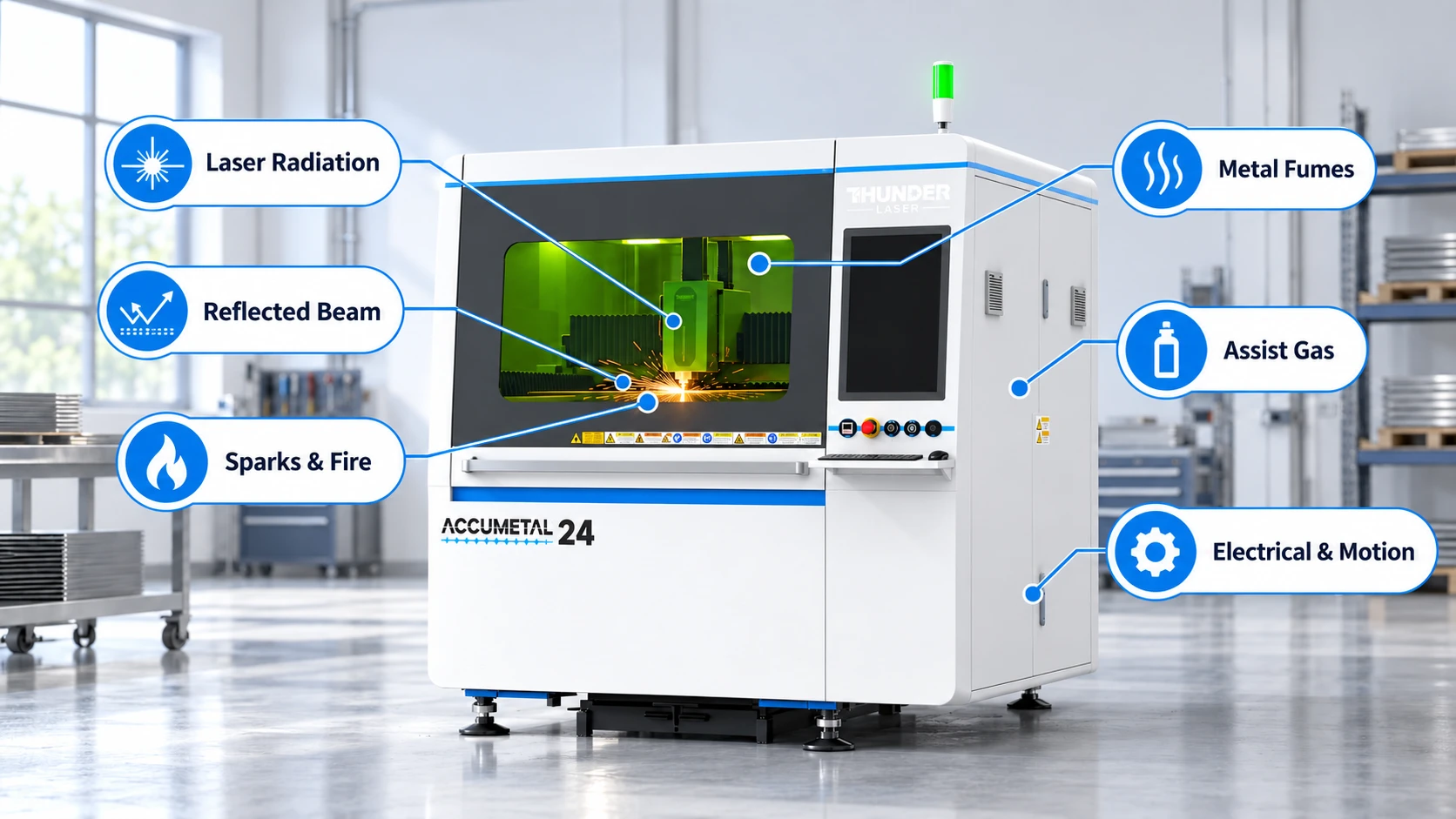
Industrial fiber cutting lasers typically operate in the near-infrared, so the cutting beam is not visible to the eye. That makes visual judgment unreliable: an operator cannot assume there is no hazard simply because no bright beam is visible. The FDA notes that Class 4 laser products can present eye and skin hazards from direct or reflected beams and may also create a fire hazard.
Metal surfaces can also create specular reflections. For that reason, safe operation depends on beam containment and machine safeguards rather than trying to avoid the beam by sight.
Cutting produces sparks, molten metal, hot scrap, and slag. Fire risk increases when combustible debris accumulates, the wrong parameters are used, extraction is poor, or flammable materials are stored near the machine. Operators should know the site fire-response procedure and keep the cutting area clean.
Thermal cutting can generate metal fumes, oxide particles, and decomposition products from coatings or surface treatments. The composition of the material matters: stainless steel, galvanized steel, painted metal, plated parts, and unknown coatings may require different controls. Source extraction is therefore a core safety measure, not only a cleanliness feature.
Fiber laser cutting may use oxygen, nitrogen, or compressed air at significant pressure. Oxygen can intensify combustion, while nitrogen can create an oxygen-deficient atmosphere if released into a poorly ventilated space. The machine also contains electrical and moving systems that should remain guarded during normal operation. Operators should not open electrical cabinets, alter gas circuits, or access internal motion systems unless the procedure specifically authorizes it.
Laser class describes accessible laser radiation from a laser product under defined conditions. It should not be guessed from source wattage alone. A machine may contain a high-power cutting source internally while its enclosure and interlocks reduce accessible radiation during normal operation.
IEC 60825-1 provides the international classification framework for laser products. In simple terms, Class 1 products have accessible emissions below the Class 1 limit under the classification conditions, Class 2 applies to certain visible lasers, and Class 4 represents the highest hazard category. The product label and manual - not marketing shorthand - should be the reference for the machine you are using.
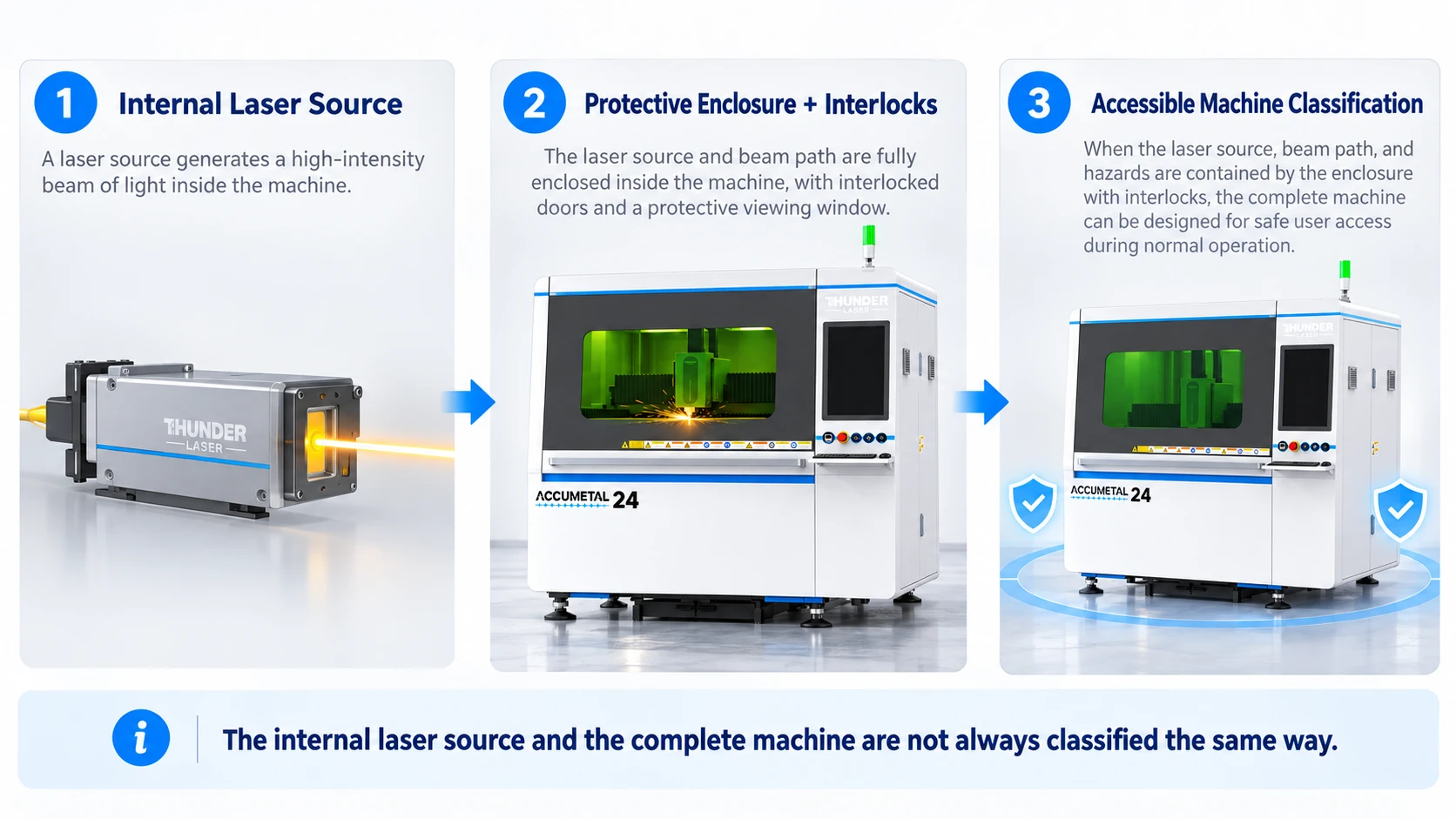
A protective enclosure is an engineering control designed to contain hazardous radiation during normal use. Interlocks are intended to trigger the machine's designed safety response when protected access points are opened. MIT EHS specifically warns that tampering with or bypassing laser-cutter interlocks can expose users to hazards that the enclosure was designed to control.
Check the product label, user manual, and compliance documentation supplied with the machine. Also distinguish normal operation from maintenance or service: opening guarded areas or performing authorized service can change the accessible hazard even when normal production is well contained.
A safer machine starts with engineering controls. When evaluating a fiber laser cutter, look beyond power and speed and ask how the system controls radiation, motion, fumes, fire risk, and abnormal conditions.
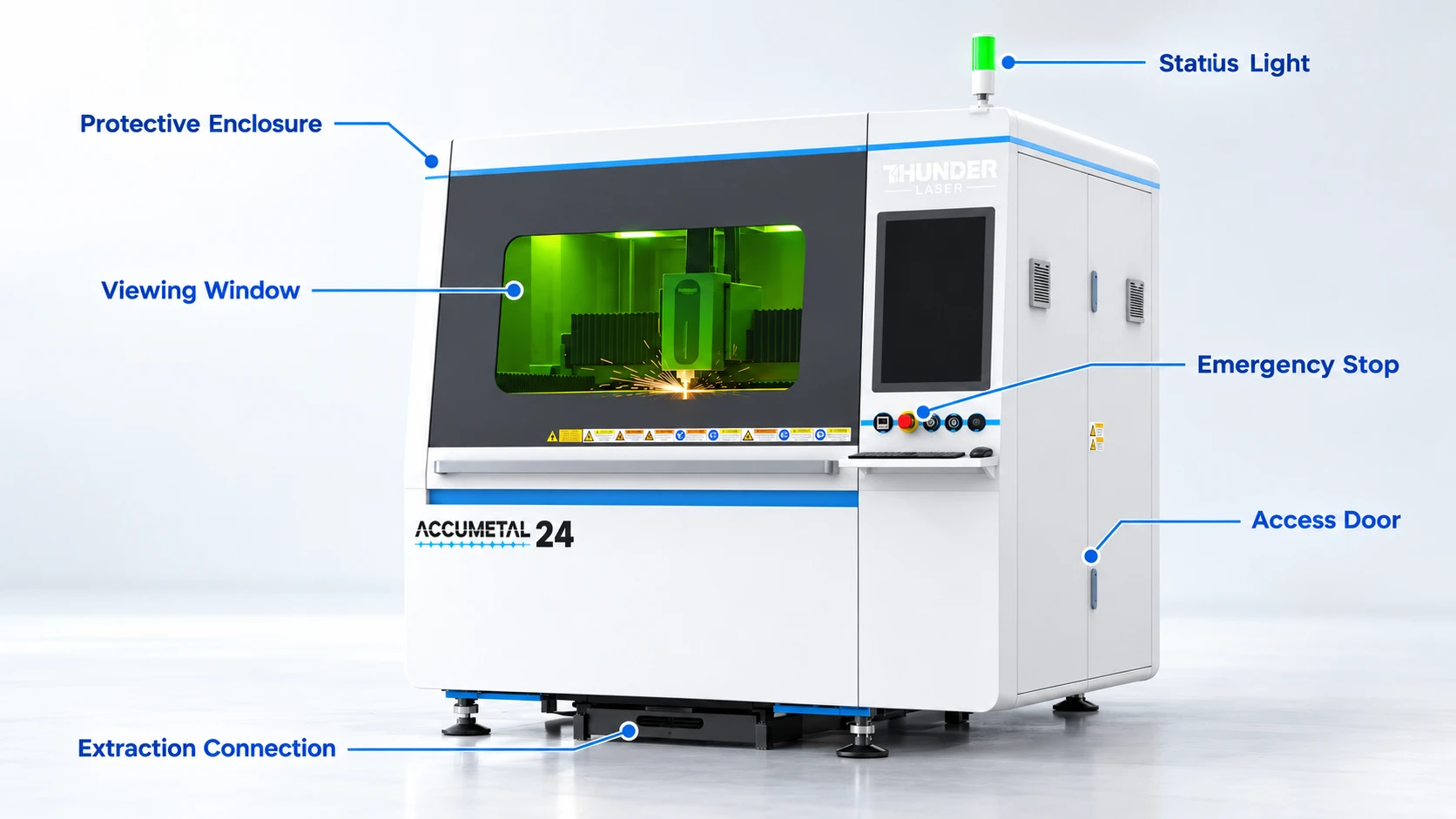
The enclosure should contain hazardous cutting radiation during normal operation, and the viewing window should be designed for the relevant laser wavelength and machine configuration. A viewing window should never be modified, replaced with ordinary transparent material, or covered in a way that defeats its intended function.
Access doors and other protected openings should use interlocks appropriate to the machine design. Never bypass an interlock simply to save setup time or continue production with a fault present. A recurring interlock fault is a service issue, not an operating workaround.
Operators should know where the emergency-stop controls are and what conditions they stop. Access to the machine should also be limited to trained personnel. Emergency stops support abnormal-event response, but they are not a substitute for a normal shutdown procedure or energy isolation during service.
A production fiber laser should also monitor supporting systems that affect safe operation, such as cooling, gas delivery, exhaust, and machine faults. If the machine reports an abnormal condition, the cause should be resolved before production resumes rather than repeatedly resetting the alarm.
PPE requirements depend on the machine classification, operating state, task, and site risk assessment. For normal operation of a properly enclosed system, engineering controls should do most of the work. PPE becomes more important when handling hot or sharp parts, dealing with fumes, or performing authorized tasks where hazardous exposure may remain.
Laser eyewear should never be selected by color or by a generic label such as “fiber laser glasses.” OSHA guidance states that laser eye protection must match the specific wavelength and provide optical density adequate for the exposure. When engineering controls eliminate accessible hazardous radiation during normal operation, laser eyewear may not be the primary control; during open-beam service or other higher-risk conditions, the requirement can be very different.
Gloves are mainly useful for handling hot, sharp, or unfinished metal parts. They should not be treated as a substitute for laser beam containment. Clothing and footwear should match the shop's general metalworking hazards and fire-risk assessment.
Respirators and hearing protection should be based on exposure assessment, not applied as a universal rule. NIOSH emphasizes engineering controls such as local exhaust ventilation as a primary method for controlling airborne contaminants. If respiratory protection is still required, it should be selected and managed under an appropriate respiratory-protection program.
Daily safety is easiest to manage when the operator follows the same short routine every time. The exact checklist should come from the machine manual and site SOP, but the following items are useful starting points.
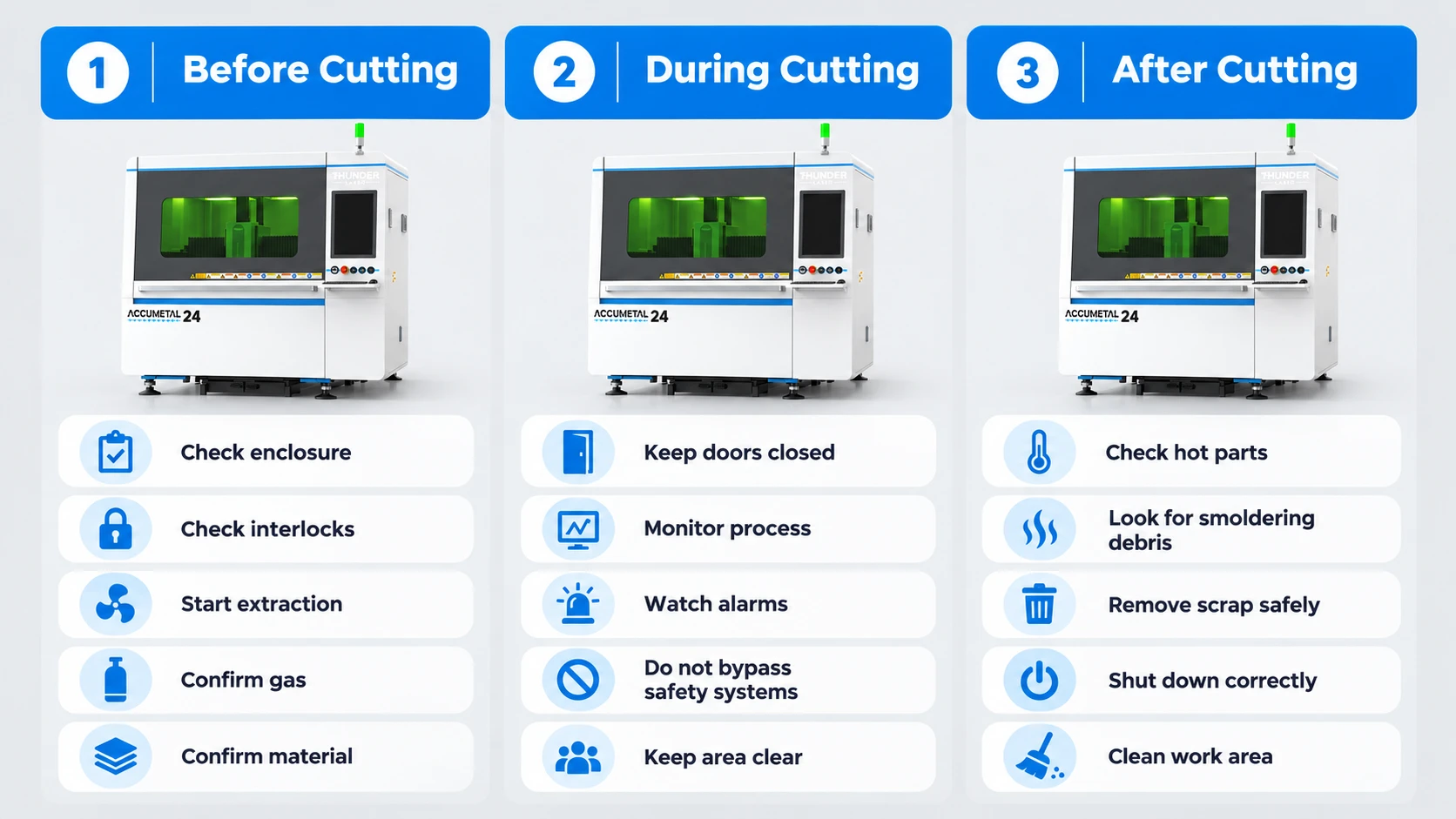
Monitor the process for abnormal flame, excessive smoke, unusual sound, collisions, or repeated alarms. Do not reach into moving equipment, defeat an interlock, or open protected access during cutting. If something looks wrong, stop the process and investigate the cause.
Do not treat unattended operation as the default. Unmanned production should only be used when the machine manufacturer, site risk assessment, engineered monitoring, and fire-response systems explicitly support that operating mode.
For metal cutting, non-beam hazards often determine how safe and practical the installation is. Extraction, fire prevention, and gas handling should be planned before the machine arrives, not added later as an afterthought.
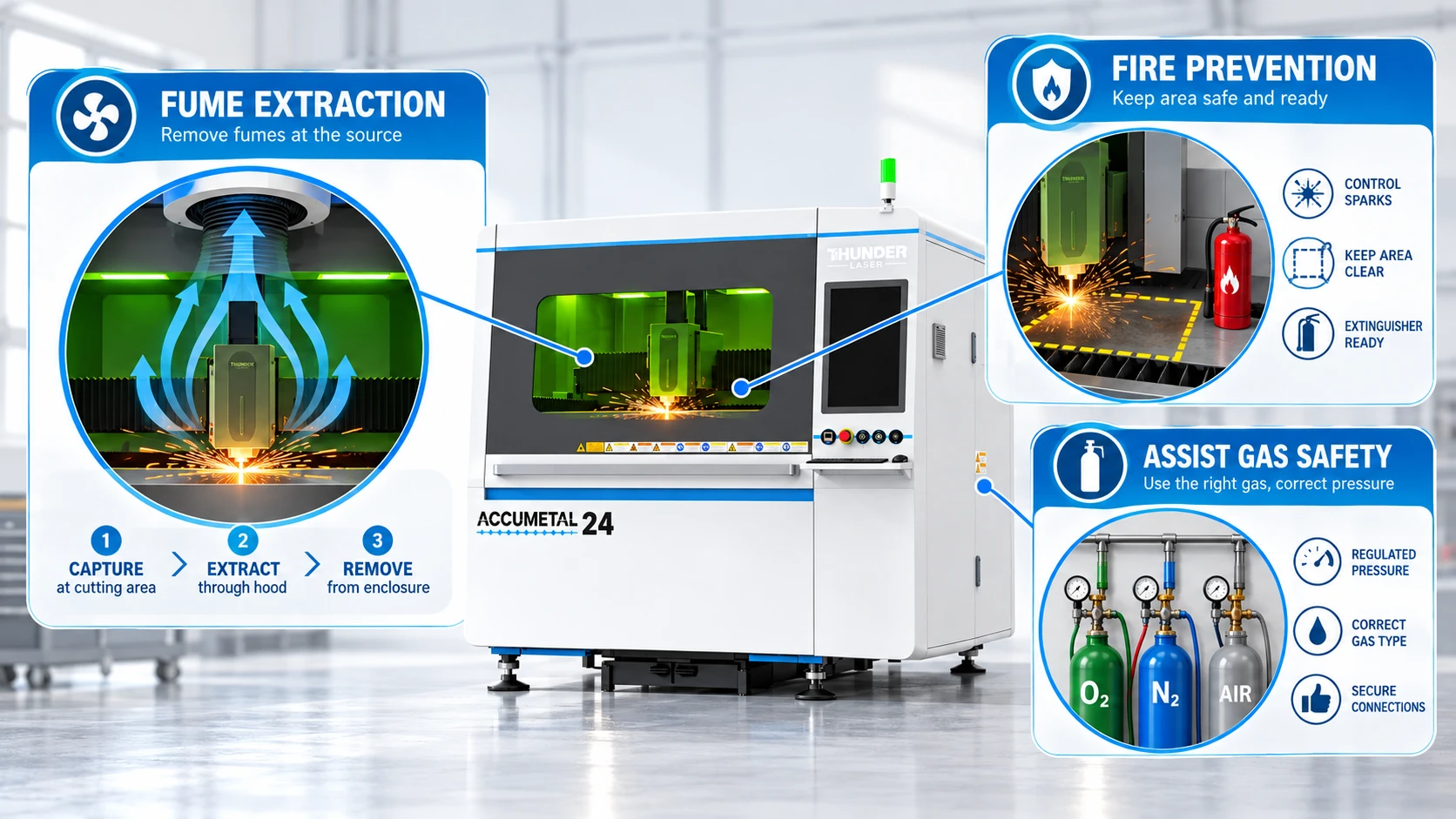
Local exhaust should capture fumes and particles as close to the cutting source as the machine design allows. General room ventilation alone may not provide adequate control. NIOSH describes local exhaust ventilation as an engineering control that captures airborne emissions before they spread through the workplace.
Material composition matters. Stainless steel, galvanized steel, painted or coated metal, and plated materials can produce different airborne contaminants. Review the material and coating information, including the Safety Data Sheet where applicable, before approving a new material for production.
Fire prevention starts with housekeeping and process control. Keep the machine interior, cutting bed, scrap zones, and surrounding floor free of unnecessary combustible debris. Investigate repeated flare-ups rather than treating them as normal. The site should have a written fire-response procedure and suitable fire-response equipment selected for the materials and facility by qualified safety personnel.
Assist gases create different safety concerns. Oxygen supports combustion and must be kept away from oil, grease, and incompatible materials. Nitrogen is inert but can displace oxygen if released into an inadequately ventilated area. Compressed air still involves pressure hazards and requires suitable hoses, fittings, filtration, and maintenance.
Use only the gas types, pressure ranges, regulators, piping, and connections approved for the machine and application. Do not improvise adapters or modify the gas circuit to increase cutting pressure.
Related Thunder Laser guide: Assist Gas for Fiber Laser Metal Cutting Machines: Oxygen vs. Nitrogen vs. Air.
Maintenance can create a higher-risk condition than normal cutting because guards may be opened, stored energy may remain, and internal laser, electrical, gas, or motion systems may become accessible.
Operators should perform only the maintenance tasks assigned to them by the manufacturer and site SOP. Internal optical alignment, electrical troubleshooting, high-pressure gas work, or service that changes the normal enclosure condition should be limited to qualified personnel.
Before service, follow the required energy-isolation procedure for electrical power, compressed gas, stored pressure, motion systems, and any other hazardous energy. Local lockout/tagout rules and the manufacturer's service instructions take precedence over generic online advice.
Some authorized service procedures may require controlled access to conditions that are never acceptable in routine production. Interlock bypass should therefore be treated as a specialized service condition with specific controls, not as a troubleshooting shortcut for operators.
Safe operation depends on people understanding both the machine and the production environment. Training should be machine-specific and should cover normal operation, alarms, prohibited actions, material approval, fire response, gas handling, routine maintenance, and emergency shutdown.
A written SOP should define who may operate the machine, what materials are approved, what checks are required before use, how abnormalities are handled, what maintenance operators may perform, and when service personnel must be called. Training should be refreshed when the machine, process, or facility changes.
| Standard / Organization | What It Covers |
|---|---|
| IEC 60825-1:2014 | Laser product classification and manufacturer requirements |
| IEC TR 60825-14:2022 | User guidance for laser safety management and risk control |
| ISO 11553-1:2020 | Laser processing machine safety requirements; confirmed current in 2025 |
| ANSI Z136.1 | Safe use of lasers; referenced by OSHA as a consensus standard |
| OSHA | U.S. workplace requirements and guidance relevant to laser hazards, PPE, and safe work |
| FDA / 21 CFR 1040 | U.S. laser product performance, labeling, and classification requirements |
Requirements vary by country, machine classification, and installation. A standard or certification label does not remove the need for a site-specific safety assessment and correct use of the machine.
Safety should be evaluated during machine selection, because enclosure design, extraction requirements, gas infrastructure, documentation, and service access can affect both installation cost and daily operation.
| What to Check | What to Ask the Supplier |
|---|---|
| Laser classification | What is the complete machine's certified laser class, and what does that classification apply to? |
| Enclosure | How is hazardous radiation contained during normal cutting? |
| Interlocks | What happens if a protected access door or panel is opened? |
| Viewing window | Is it designed and rated for the machine's laser wavelength and accessible emission conditions? |
| Emergency stop | Where are the E-stops, and what hazards do they stop? |
| Fume extraction | What airflow, ducting, filtration, and facility requirements are specified? |
| Assist gas | What gas types, pressure ranges, regulators, and facility connections are required? |
| Training | What operator and maintenance training is included? |
| Documentation | Are the manual, safety procedures, labels, and compliance documents supplied? |
| Service | Who is authorized to service the laser, electrical, gas, and safety systems? |
For a current Thunder Laser metal-cutting system, see the Thunder AccuMetal Series. Its product page lists machine specifications, assist gases, and safety information that should be reviewed together with the installation manual and local requirements.
Fiber laser cutting safety depends on both machine design and how the machine is used. Enclosures, interlocks, extraction, gas controls, and emergency systems reduce risk, while trained operators, good housekeeping, and correct maintenance keep those controls effective.
Before buying or operating a fiber laser cutter, verify the machine classification, facility requirements, approved materials, and service procedures for the specific system. The manufacturer's documentation and a site-specific risk assessment should remain the primary references.
Talk To Our Experts Now!
Please leave your contact information so that we can serve you better.
FAQS
It can be operated safely when hazards are controlled through suitable machine design, installation, training, extraction, maintenance, and operating procedures. A lower accessible laser class does not remove non-beam hazards such as fire, fumes, gas pressure, electricity, and moving machinery.
There is no single class for every fiber laser cutter. The internal cutting source may be high hazard, while the complete machine classification depends on accessible emission and protective design. Check the product label, manual, and compliance documentation for the specific machine.
It depends on the machine classification and task. For normal operation of a properly enclosed system, engineering controls may eliminate hazardous accessible radiation. If hazardous exposure is possible, eyewear must be selected for the specific wavelength and required optical density rather than by a generic “fiber laser” label.
Yes, hazardous reflected radiation can injure the eye under conditions where a high-power beam is accessible. FDA and OSHA guidance both recognize reflected-beam hazards for high-class lasers. The correct control is beam containment and access control, not relying on the beam being invisible.
Metal cutting generates airborne particles and fumes, and coatings can add additional contaminants. Effective extraction is a core engineering control. The required airflow, filtration, and exhaust arrangement should follow the machine specification and a workplace exposure assessment.
Do not assume unattended operation is acceptable. Use unmanned operation only when the manufacturer, machine design, site risk assessment, monitoring systems, and fire-response plan explicitly support it. Otherwise, the cutting process should be observed by a trained operator.
NEED HELP FINDING THE RIGHT SOLUTION?
Talk to our team for machine recommendations, application advice, and support based on your needs.

 Stable & Consistent MachinesUnlimited ApplicationsRobust After-sales SupportFactory Direct Supply


