RF Lasers in Manufacturing: Advantages and Future Trends
 2025-09-27
WHAT ARE YOU LOOKING FOR?
Search Across Products, Blog Posts, Support Content, And Resources.

RF Lasers in Manufacturing: Advantages and Future Trends
2025-09-27

Even small changes in laser beam quality can have a noticeable impact on cutting efficiency, production stability, and operating costs. As manufacturing enters a new era of accelerated product cycles, stricter compliance requirements, and Industry 4.0 transformation, factories need tools that deliver speed, intelligence, repeatability, and flexibility.
In this context, RF CO₂ lasers have become an increasingly important capability for modern industrial production. Their balance of speed, precision, stability, and material versatility allows manufacturers to improve efficiency, maintain consistent quality, and move toward cleaner, more sustainable production models.
RF laser sources offer a set of advantages that help factories meet today’s production challenges while preparing for future manufacturing demands. From speed and consistency to flexibility, durability, and sustainability, RF lasers provide clear benefits over many traditional processing methods.
The pace of global manufacturing leaves little room for slow or unreliable processes. Customers now expect orders to be fulfilled quickly, and production lines must keep up without compromising quality.
RF laser sources provide the performance needed for high-speed processing. Because RF lasers can pulse thousands of times per second, they can achieve processing speeds beyond many mechanical tools and older laser systems. This makes them valuable in high-throughput industries such as packaging and textiles, where both speed and accuracy matter.
For manufacturers, this means shorter lead times, fewer bottlenecks, and faster responses to changing demand.
In industrial manufacturing, consistency defines quality. Unlike traditional DC-excited CO₂ lasers, which may experience output fluctuations, RF laser sources deliver stable energy and uniform beam quality.
This stability helps manufacturers maintain precise, repeatable results in applications such as medical devices, electronics, and aerospace components. It also reduces scrap and rework during long production runs, helping teams achieve predictable quality with fewer interruptions.
Modern manufacturing demands flexibility. Companies can no longer rely only on producing one product in massive volumes. They must adapt quickly to custom runs, prototype builds, and frequent design updates.
RF laser systems allow operators to move between cutting, marking, and engraving across many materials without constantly swapping tools or reconfiguring equipment. By covering multiple processes with one system, RF lasers help reduce overhead, shorten production changeovers, and support fast-moving product development cycles.
From a financial perspective, RF laser sources can offer important long-term advantages, even when the initial investment is higher. Glass tubes often need replacement after thousands of hours of use, while RF lasers can run for much longer service periods with no gas refills and minimal cleaning.
This durability helps reduce downtime, maintenance costs, and production uncertainty. For manufacturers working under tight delivery schedules, predictable uptime can be just as important as processing speed.
Tighter environmental rules and workplace safety expectations are reshaping production. Methods such as chemical etching, mechanical cutting, or processes that require oils and coolants can generate waste and create additional handling risks.
RF lasers offer a cleaner alternative. As a non-contact process, laser processing does not require cutting fluids or toxic solvents, helping manufacturers reduce waste, protect workers, and maintain efficient production at the same time.
Learn more: What Makes RF Laser Sources Unique: Key Technologies You Should Know and Why Choose an RF Laser Source? Key Advantages Explained.
RF CO₂ lasers have become valuable tools in industrial manufacturing because they combine versatility, precision, and efficiency. Their ability to process different materials makes them suitable for a wide range of applications that require stable quality and repeatable results.
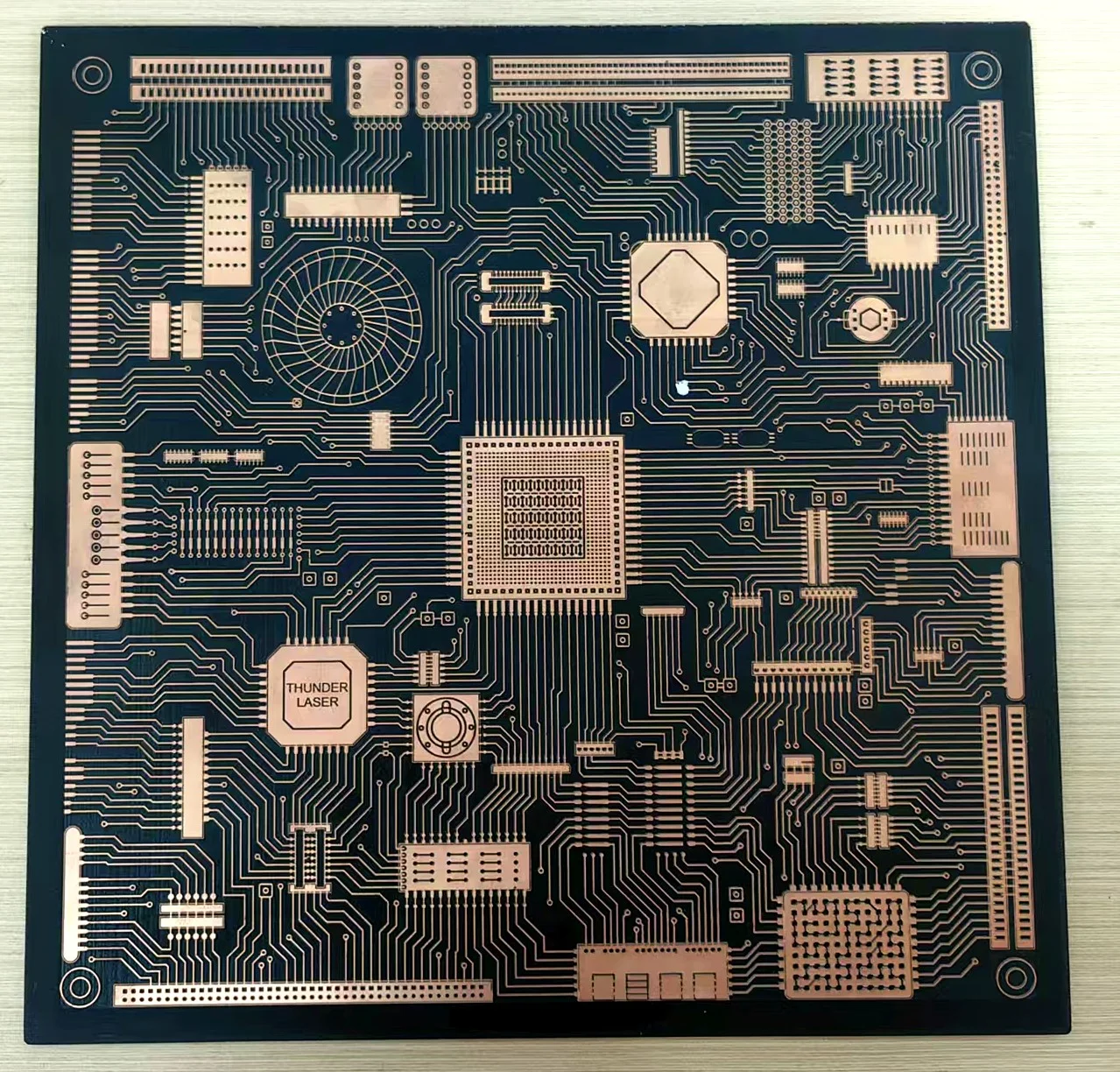
RF lasers are useful in electronics manufacturing because they can process small components with high precision. In printed circuit board fabrication, lasers can drill micro-vias with consistent accuracy across repeated production cycles.
Beyond drilling, RF lasers can support selective solder mask removal, exposing copper pads without affecting surrounding areas. They can also be used for component trimming, allowing fine adjustments that manual methods cannot easily achieve. This combination of precision and repeatability makes RF lasers valuable in modern electronics production.
The automotive sector uses RF laser technology for both functional and aesthetic applications. Interior trim components can be precisely cut or perforated for speaker grilles, airbag deployment zones, or decorative design details.
Dashboard marking can also support day-night designs, where markings remain subtle in daylight but visible under backlighting. In addition, RF lasers can cut technical textiles with clean edges, helping prevent fraying in materials used for airbags, seats, and performance fabrics.
Food, beverage, and consumer goods manufacturers need marking and perforation systems that can match the speed of automated production lines. RF lasers meet this need through rapid pulsing capability and precise, high-throughput processing.
RF lasers can mark expiration dates, batch codes, and lot numbers directly onto packaging materials such as PET bottles, glass jars, paper cartons, and flexible films. Because laser marking is non-contact, it can create permanent and legible codes at production-line speeds while supporting traceability and regulatory compliance.
In the medical field, precision, sterility, and permanence are critical. The non-contact nature of laser marking and cutting makes RF laser technology suitable for many medical device applications.
RF lasers are highly versatile and can process materials such as nonwoven fabrics, composites, hybrid textiles, leather, and technical fabrics. This adaptability allows manufacturers to switch between products and designs with minimal setup changes.
In textile production, lasers can create detailed patterns, worn effects, and distressing on denim. Leather engraving can produce fine details with controlled depth, while synthetic and technical fabrics benefit from edge sealing during cutting. This helps prevent fraying and improves durability in performance apparel, outdoor gear, and specialty fabric applications.
By combining material adaptability, speed, and non-contact precision, RF laser systems help manufacturers produce high-quality customized products while reducing waste and improving throughput.
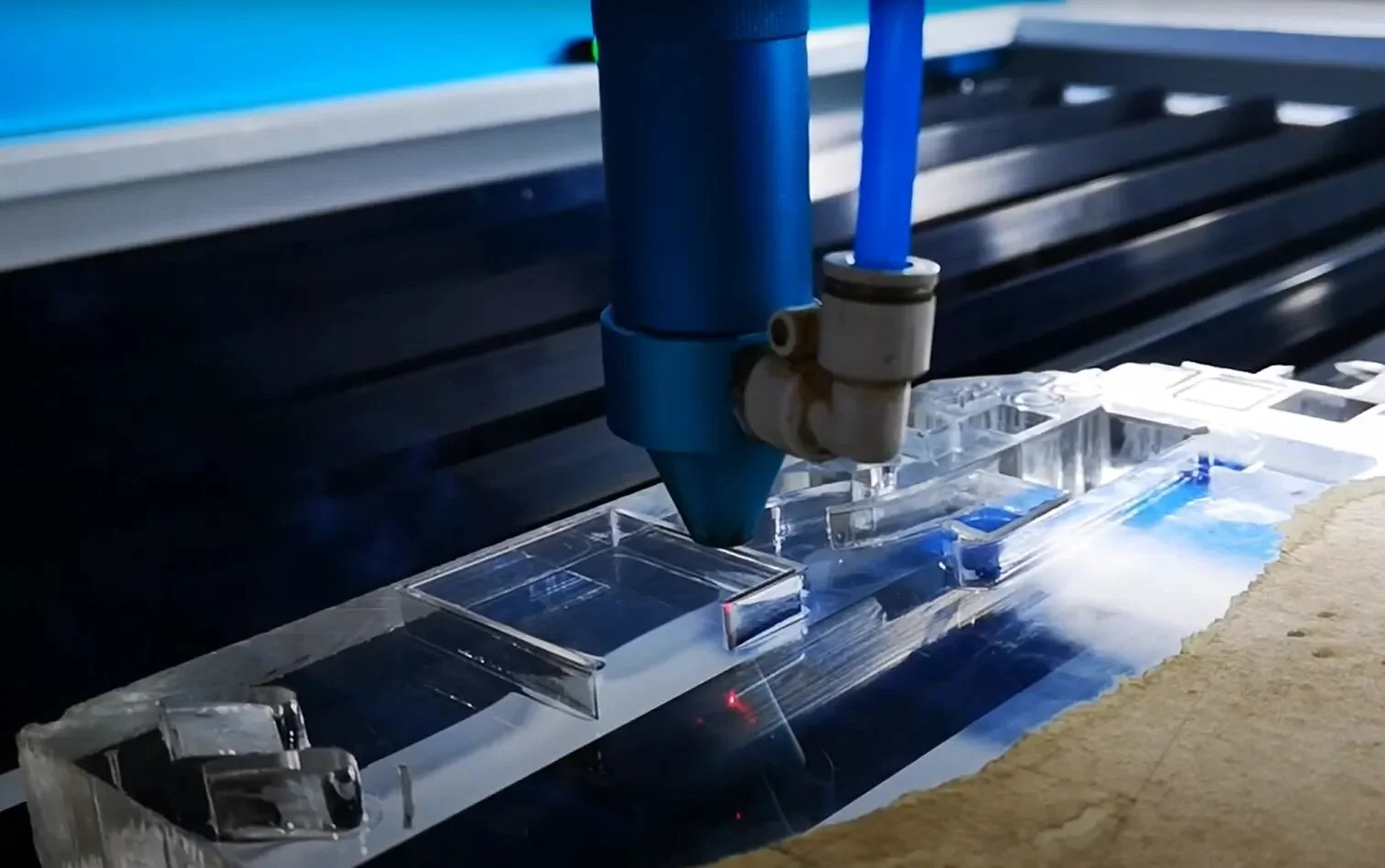
In signage and display manufacturing, RF lasers enable precise cutting and engraving of acrylic, wood, and other materials. Complex shapes can be cut with clean, polished-looking edges, while variable-depth engraving can create dimensional textures that enhance visual appeal.
The ability to process thicker materials while maintaining edge quality gives architects, designers, and display manufacturers more creative flexibility. From electronics and automotive parts to packaging, medical devices, textiles, and signage, RF laser systems are becoming essential tools across many industrial sectors.
Manufacturing is at a decisive moment. Industry 4.0 has raised expectations for automation, flexibility, and traceability, while markets such as medical devices, consumer electronics, and electric vehicles are driving demand for smaller, more complex components made from a wider range of materials.
Conventional processes are finding it harder to keep pace. Mechanical methods can introduce stress into thin or brittle substrates, while older laser systems may struggle with slower response, unstable beam quality, or limited lifespan. In terms of efficiency, accuracy, and process quality, these older tools are increasingly showing their limits.
RF CO₂ lasers address these challenges in three important ways:
For businesses planning beyond short-term production needs, RF CO₂ lasers provide a capability that is precise, efficient, and sustainable. As manufacturing becomes more automated, flexible, and data-driven, RF laser systems are likely to play an increasingly important role in the next generation of industrial production.
The industrial landscape is evolving quickly, and the demands placed on manufacturers are becoming more complex. RF CO₂ lasers are more than a technical upgrade. They are a strategic asset for factories that need speed, stability, versatility, and cleaner production.
By supporting precision processing across electronics, automotive, packaging, medical devices, textiles, signage, and custom fabrication, RF laser sources help manufacturers meet immediate operational needs while aligning with long-term trends in smart and sustainable manufacturing.
Explore RF CO₂ Laser Solutions for Your Production Needs
Thunder Laser offers RF CO₂ laser machines for precise cutting, engraving, and marking across a wide range of industrial and creative applications.
Contact UsTalk To Our Experts Now!
Please leave your contact information so that we can serve you better.
FAQS
FIND THE RIGHT LASER FOR YOUR NEXT PROJECT
Explore Thunder Laser solutions designed for different materials, workflows, and production needs.


 Stable & Consistent MachinesUnlimited ApplicationsRobust After-sales SupportFactory Direct Supply