


What Are the Advantages of an RF Laser Source?
 2025-10-03
WHAT ARE YOU LOOKING FOR?
Search Across Products, Blog Posts, Support Content, And Resources.

What Are the Advantages of an RF Laser Source?
2025-10-03

When it comes to laser technology, the quality of the laser source determines everything else—precision, consistency, and material compatibility. The RF (radio frequency) laser source stands out as one of the most reliable and efficient solutions available today.
In this article, we explore the key advantages of RF laser sources, why professionals prefer them, and how they outperform CO₂ glass tubes.
Learn more: RF Laser vs DC Glass Laser: Which One to Choose? - Thunder Laser
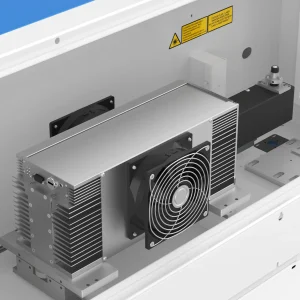
A sealed RF metal laser tube
An RF laser source is a type of CO₂ laser that uses radio frequency excitation to energize the laser medium—in most cases, a sealed mixture of carbon dioxide, nitrogen, and helium. Unlike other excitation methods, which can suffer from uneven output or faster wear, RF excitation introduces energy through an electromagnetic field, eliminating the need for electrodes inside the gas chamber.
This design brings several important benefits:
By focusing on efficient energy transfer and a stable emission profile, RF laser sources deliver the kind of reliability that engineers and manufacturers rely on for demanding, high-precision applications.
RF laser sources are engineered for long-term accuracy, delivering the same high-quality results after thousands of operating hours as they do on day one. This exceptional consistency is the result of three interrelated factors: minimal thermal distortion, stable power delivery, and uniform beam geometry.
Any laser will generate heat during operation, but if that heat builds up unevenly, it can cause stress inside the structure, bend components, and subtly shift the beam’s focus. RF laser sources solve this by integrating precision-engineered cooling channels directly into the metal housing, drawing heat away evenly from all sides. This balanced cooling keeps the cavity temperature stable, prevents hot spots, and allows safe, continuous operation without risking thermal damage to the internal optics or surrounding equipment.
Moreover, the short, high-frequency pulses produced by RF excitation minimize the continuous thermal load on the gas medium. This prevents fluctuations in refractive index within the cavity—one of the main causes of beam drift in conventional glass tubes. As a result, RF laser sources can sustain stable output and beam geometry even under high-duty operation, making them ideal for applications that demand precision over extended periods.

Even a perfectly shaped beam loses effectiveness if its power fluctuates. RF laser sources deliver remarkably stable output power thanks to their sealed metal construction and non-contact RF excitation method. Because the electrodes are positioned outside the gas chamber, there is no direct contact with the laser gas—eliminating electrode erosion, carbon buildup, and gradual contamination that can reduce efficiency in DC-excited glass tubes. The purity of the gas mixture remains intact for years, allowing the laser to operate at its rated power for far longer.
In addition, RF excitation responds almost instantly to control signals, producing precise and repeatable energy pulses with minimal fluctuation. This stability ensures that every pulse carries nearly the same energy, maintaining consistent cutting or marking performance over extended production runs. Even after thousands of hours of use, an RF tube can continue delivering close to its original power rating, reducing downtime and ensuring predictable results.
In an RF laser tube, the gas mixture is sealed inside an airtight, all-metal chamber, protecting it from leaks, moisture, and airborne contaminants. This controlled environment keeps the gas composition pure and stable over time, which in turn ensures a consistent laser output. As a result, the beam maintains a stable shape and mode, with minimal distortion from vibrations or uneven thermal expansion.
This stability is reflected in the M² (M-squared) factor—a metric that measures how closely the beam matches an ideal Gaussian profile. RF CO₂ tubes typically achieve M² values between 1.1 and 1.3, indicating a nearly perfect beam geometry. In practice, this means the laser can deliver the same clean, uniform output after thousands of hours of operation as it did on the very first day.
RF laser sources achieve faster and more precise operation due to their unique high-frequency excitation method. Unlike traditional DC-excited tubes, RF excitation generates laser pulses almost instantaneously, with nanosecond-level switching speeds. This allows for rapid modulation of the laser output, enabling high pulse repetition rates and precise energy delivery.
The fast response of RF tubes ensures that each pulse is accurately timed and consistent in energy, minimizing wasted emissions between pulses. As a result, the laser can perform tasks more quickly and efficiently, maintaining uniform output even during high-speed or intricate operations. In essence, the inherent design of RF tubes directly translates to faster processing capabilities and improved operational efficiency at the light source level.
RF CO₂ lasers emit light at a wavelength around 10.6 μm, which is naturally absorbed by many organic and polymer materials such as wood, acrylic, leather, and certain plastics, as well as some coated metals. The high absorption ensures that energy is efficiently transferred into the material, producing clean cuts or precise engraving without excessive heat spreading. Unlike other sources that may require frequent adjustments or specialized coatings for different materials, an RF laser can switch between jobs with minimal tuning.
Additionally, the uniform beam and stable energy delivery make it compatible with materials that are sensitive to localized overheating. Materials like thin plastics, laminated composites, or delicate coatings can be processed without burning, warping, or discoloration. This is particularly valuable in settings where multiple materials are used in rapid succession, such as custom signage, model making, or prototyping.
In short, an RF laser source provides one versatile, reliable beam capable of handling a broad spectrum of materials, allowing operators to confidently take on varied projects without worrying about compatibility or unpredictable results.
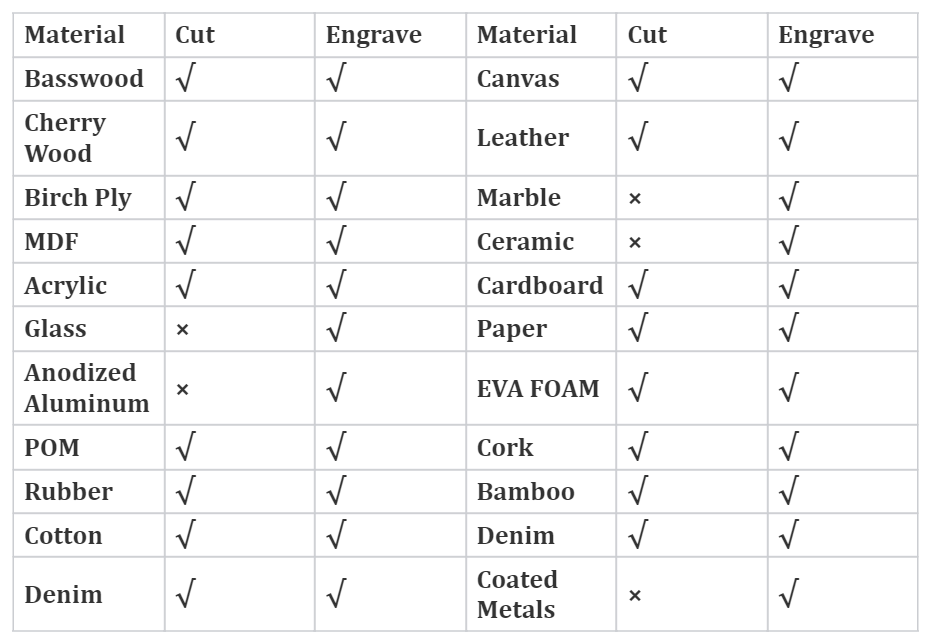
A comprehensive table that shows what you can cut and engrave with an RF laser source.
One of the primary advantages of RF laser sources is their significantly lower maintenance requirements. Unlike glass tube lasers, which necessitate regular gas refills and frequent replacement of consumable components, RF lasers operate in a sealed system, eliminating the need for such interventions. This sealed design not only reduces the frequency of maintenance tasks but also enhances the overall reliability of the laser system.
Laser sources don’t last forever. Over time, the internal components of a laser tube gradually wear out, and eventually the tube reaches the end of its rated lifespan. Unlike traditional CO₂ glass tubes, which often require replacement after 8,000 to 20,000 hours, high-quality RF laser tubes can reliably operate for 20,000 to 40,000 hours.
The longer service life of RF laser tubes is largely attributed to their metal-ceramic resonator structure, integrated RF excitation method, and better thermal stability, which together reduce electrode erosion and gas contamination compared with glass tubes. In addition, RF tubes maintain more consistent beam quality and power output across their lifetime, whereas glass tubes tend to show faster degradation and unstable performance.
For businesses, the significant extension in lifespan can be translated into tangible advantages:
RF laser sources stand out by offering a combination of high beam quality, broad material compatibility, fast and responsive operation, low maintenance, and extended lifespan. These make RF tubes a preferred choice for professionals in engraving, cutting, and marking industries who demand dependable performance and predictable results. By investing in an RF laser source, you can ensure efficient production, reduced downtime, and consistent output for years.
Talk To Our Experts Now!
Please leave your contact information so that we can serve you better.
FAQS
FIND THE RIGHT LASER FOR YOUR NEXT PROJECT
Explore Thunder Laser solutions designed for different materials, workflows, and production needs.


 Stable & Consistent MachinesUnlimited ApplicationsRobust After-sales SupportFactory Direct Supply


