


Why Are RF CO2 Laser Machines More Expensive? Are They Worth It?
 2025-06-30


Bolt Series
Professional High-Precision Laser Engraving Machine

Nova Series
Large Format Glass Tube Laser Cutting Machine

Nova Plus Series
Business-grade RF CO₂ Laser Cutter

Nova Pro Series
Professional Laser Cutting & Engraving System

Titan Series
Industrial-grade Laser System

Titan Pro Series
Industrial-grade Dual-laser System


WHAT ARE YOU LOOKING FOR?
Search Across Products, Blog Posts, Support Content, And Resources.

Why Are RF CO2 Laser Machines More Expensive? Are They Worth It?
2025-06-30

Why does an RF CO₂ laser machine cost more than a glass-tube machine, sometimes with a lower wattage on the specification sheet? The answer starts with the laser source, but the purchasing decision comes down to what the complete machine can do for your work.
RF machines are particularly attractive for detailed engraving, responsive power control, and repeated production. Those capabilities can be valuable to a business selling personalized products, photographs, stamps, and intricate graphics.
This guide explains what contributes to the price, how focused power affects processing, and how to decide whether the extra investment is worthwhile.
Quick Answer: RF CO₂ machines generally cost more because of their laser-source assembly and dedicated radio-frequency drive electronics. Differences in motion hardware, positioning features, accessories, and service packages can further increase the complete machine price.
RF is worth considering when fine detail, engraving speed, and controlled surface processing improve products you sell regularly. For cutting-focused work, compare the required thickness, working area, edge finish, and production cost before choosing.
A conventional glass CO₂ tube uses a high-voltage DC power supply to excite its gas mixture. An RF source uses a dedicated system that generates, amplifies, and delivers radio-frequency electrical power.
The RF source combines this specialized drive system with the laser assembly, controls, protection, and thermal management. These components contribute to its higher purchase cost.
This is why comparing machines only by watts can be misleading. Wattage describes rated optical output; the source architecture and the capabilities built around it also contribute to the price.
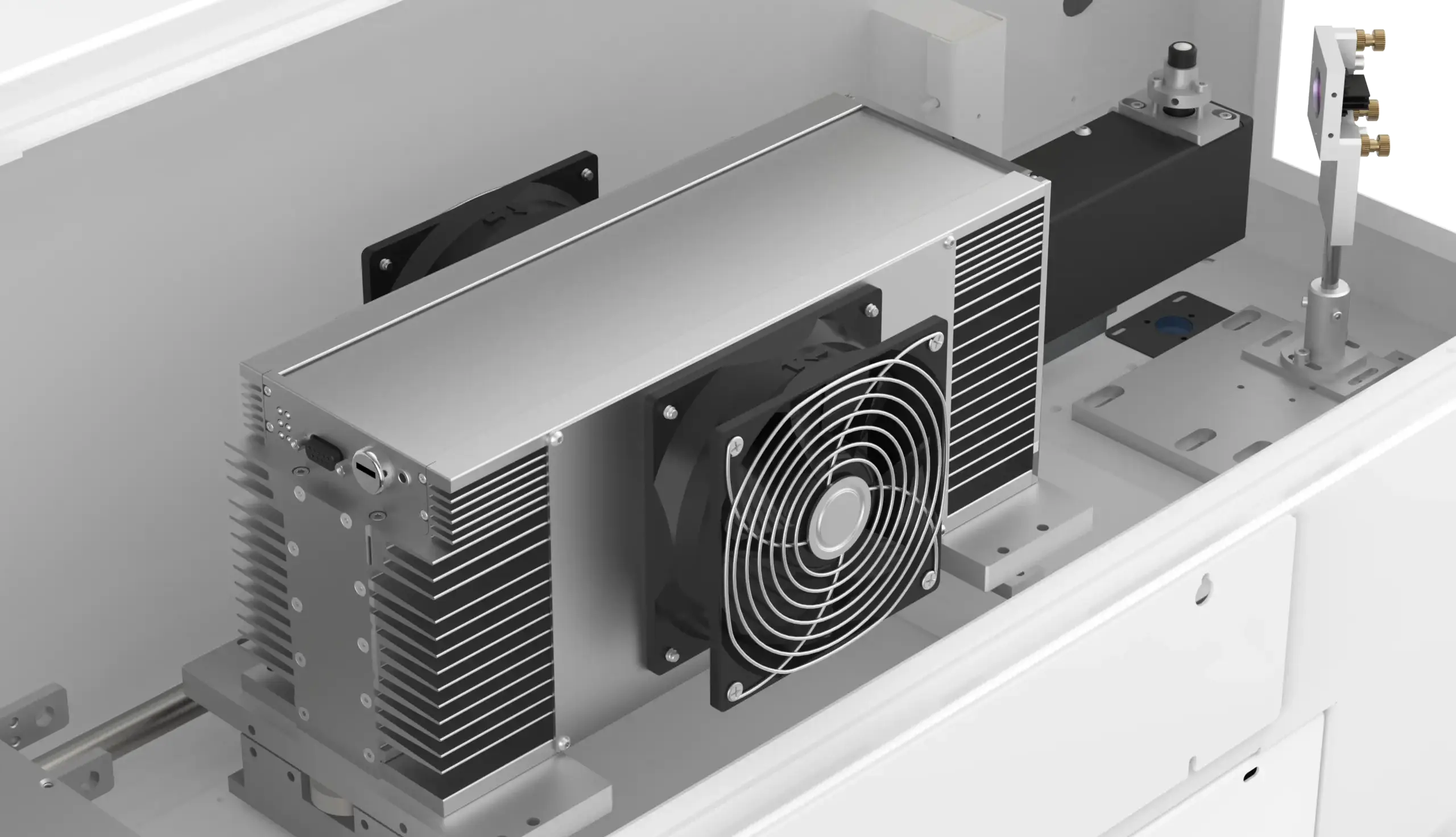
The RF source and its dedicated drive system account for part of the machine’s price premium.
The rest of the price difference comes from what surrounds the source. A fast engraving platform may include different motors, drivers, a lighter laser head, and a more capable motion system.
Camera positioning, autofocus, a motorized table, rotary equipment, extraction, and software also affect the quotation. Installation, training, warranty coverage, and local service can add further value.
Compare these items line by line. This separates the cost of RF technology from the cost of a larger machine, additional automation, or a more complete support package.
The most useful benefits are visible in the finished product and measurable in the job cycle. The source, optics, focus, and motion system work together, so evaluate them as a complete machine.
A well-designed RF CO₂ system can produce a small focused spot, helping reproduce narrow lines, small text, fine textures, and closely spaced image features.
This is particularly valuable for photographic engraving, detailed logos, rubber stamps, and personalized products. A small logo needs clear spaces inside its letters; a photograph needs distinct tonal detail; a stamp needs fine features that remain readable in the impression.
These are practical ways to assess engraving quality. Compare the smallest feature that remains clear at the intended product size.
Optical power describes how much energy the laser delivers per second. Power density describes how tightly that power is concentrated on the material.
For a Gaussian beam, the peak power density at the focus is:
I0 = 2P / (πw02)
At the same power, halving the focused beam radius increases the peak power density fourfold. This illustrates why concentrating light into a smaller spot can make a significant difference to local processing.
For engraving, a small spot helps address fine features. For cutting, concentrated power can support a narrow kerf and effective material removal along the cutting path.
This relationship follows established Gaussian-beam optics, as covered in the MIT Fundamentals of Photonics course notes.
During raster engraving, the laser repeatedly changes output as the head scans across the design. Fast power modulation helps preserve the boundaries between engraved and unengraved areas.
RF sources generally offer rapid output response, which is useful when engraving small text, patterns, and images at speed. A suitable motion platform turns that source capability into productive scanning.
The benefit to a business is straightforward: completing an acceptable engraving in less time releases capacity for other work.
Some products need a shallow mark, a subtle texture, or a controlled surface effect. Responsive output control helps establish a usable processing window for this work.
Examples include light graphics on wood, fine lettering on suitable engraving laminates, and surface engraving on compatible coated products.
The commercial value comes from producing the intended appearance consistently, with less need to repeat or discard a piece.
Focused power and source response help explain why a lower-wattage RF machine can perform competitively against a higher-wattage glass-tube machine on selected applications.
There is no fixed RF-to-glass wattage conversion. For cutting, compare the required material thickness, accepted edge quality, number of passes, and completion time. That provides a useful answer for the product you need to make.
For a broader technical comparison, read RF vs. DC Glass Laser Tubes.
RF deserves consideration when your products rely on small lettering, image detail, intricate patterns, or carefully controlled surface effects.
Personalized gifts, stamps, awards, branded merchandise, and photographic products are examples where engraving quality contributes directly to the finished product’s value.
Start with a design that challenges your current process. Identify the exact feature you need to improve and use it as the acceptance standard for a demonstration.
A shorter cycle becomes valuable when engraving occupies your machine while orders wait. Record a representative batch from setup through unloading, including any cleaning or finishing required.
Compare how much of that time a candidate machine can save. The financial benefit may come from reduced overtime, lower outsourcing costs, or additional orders that you have the demand and staff to complete.
Rejected products consume material, operator attention, and machine capacity. If a tested RF process improves the proportion of acceptable pieces, that improvement belongs in the investment calculation.
Track the reason for each rejected piece. This distinguishes a genuine equipment limitation from issues that can be resolved through maintenance, focus, file preparation, or material control.
If your business mainly cuts acrylic signs, wooden components, packaging, or large sheet layouts, the required cutting power and working area may offer the strongest return.
A suitable glass-tube machine can be an economical way to obtain that capacity. Compare regular production thicknesses, sheet utilization, edge finish, and completed parts per hour.
Continued use can be financially sensible when your machine produces acceptable work, completes orders on schedule, and has dependable service support.
Consider where the next investment would make the largest difference. Fixtures, extraction, finishing equipment, or improved production organization may address the more immediate need.
Some businesses spend most of their time on design approvals, positioning, painting, assembly, or packing. Measure those stages alongside laser processing.
This helps establish how much a faster engraver could improve total output and whether another workflow change should come first.
Use quotations based on the same production requirements. Include the machine, required accessories, delivery, installation, extraction, cooling, software, and training.
Check future source-service options and warranty coverage as well. These affect the cost of keeping the machine productive over time.
For a representative batch, add material, paid labor, machine operating costs, and finishing costs. Divide the total by the number of acceptable finished pieces.
This captures both processing speed and yield. It also reveals whether setup or post-processing accounts for more of the cost than engraving itself.
When comparing two new machines, use the additional installed investment. When replacing an existing machine, include the purchase cost and any confirmed resale or trade-in proceeds.
Estimate the net monthly benefit using:
Simple payback = additional investment ÷ net monthly benefit.
For example, an additional investment of $6,000 with a net benefit of $300 per month produces a simple payback of 20 months. This is an illustrative calculation, not a machine quotation or promised return.
Count each benefit once. Time released for additional orders and labor-cost savings can overlap.

Base the investment on measured production improvements and realistic order demand.
An existing glass-tube cutter can remain useful alongside a new RF engraver. One machine handles sheet cutting while the other produces detailed engraving and personalized work.
This arrangement preserves useful equipment and allows the two processes to run separately. Evaluate the available space, staffing, and order volume before adding capacity.
Replacement can make sense when the working area, motion performance, loading access, positioning, or overall condition of the current machine limits your work.
Compare continued operation, repairs, and replacement using the complete workflow. A source change addresses only part of the machine.
Converting a glass-tube machine to RF requires assessment of source mounting, electrical supply, controls, cooling, optics, and protective systems.
Obtain a written compatibility assessment and complete quotation from a qualified provider. Compare the proposed result, downtime, and service coverage with a purpose-built RF system.
The Thunder Laser Bolt Series is our primary recommendation for professional workshops producing detailed engraving, personalized gifts, and repeated small-to-medium products.
For an engraving-focused business, these features address both processing and handling. Compare their effect on a normal batch, including positioning and the changeover between products.
Consider the Thunder Laser Nova Plus Series when your products require a larger working format or higher RF power.
Select the working area around your regular part dimensions and batch layouts. Choose power around the material thickness and production rate you need to achieve.
Bring a real product to the comparison: a small logo that loses detail, a photograph that takes too long, or a cutting job you need to evaluate.
Prepare:
Compare feature clarity, surface finish, cutting quality, and complete batch time. Keep the samples and recorded settings as the basis for your purchase decision.
See What RF Can Bring to Your Products
Share your material, artwork, current result, and production requirements with Thunder Laser. Discuss a suitable machine and sample test before making the investment.
Discuss My ApplicationRF CO₂ machines cost more because of their source and drive system, with additional price differences coming from the complete machine configuration and service package.
Their value is clearest when fine detail, concentrated power, and responsive engraving improve products you sell regularly. Use your own samples, complete job times, and finished-part costs to decide whether that improvement justifies the investment.
Talk To Our Experts Now!
Please leave your contact information so that we can serve you better.
Frequently Asked Questions
FIND THE RIGHT LASER FOR YOUR NEXT PROJECT
Explore Thunder Laser solutions designed for different materials, workflows, and production needs.

 Stable & Consistent MachinesUnlimited ApplicationsRobust After-sales SupportFactory Direct Supply


