


Laser Engraving a Gun: Legal, Safety & Part Considerations
 24-01-29
WHAT ARE YOU LOOKING FOR?
Search Across Products, Blog Posts, Support Content, And Resources.

Laser Engraving a Gun: Legal, Safety & Part Considerations
24-01-29

Laser engraving can add logos, names, identification information, decorative artwork, and other permanent details to firearm components and compatible accessories. The process can produce clean and repeatable results, but firearm-related work requires more planning than ordinary product engraving because the item may be regulated, structurally critical, coated, curved, or made from an uncertain material.
Quick answer: Before laser engraving a gun or firearm component, confirm the legal status of the work, identify the exact material and finish, protect all functional and required markings, secure the part correctly, and select a process that will not affect safe operation. Commercial engraving in the United States is treated by the ATF as gunsmithing activity and requires the appropriate federal firearms license.
This article focuses on legal, safety, material, and part-specific considerations. For a detailed comparison of fiber, MOPA, and CO2 systems, fixtures, and machine-selection factors, see the Laser Engraving Gun Guide: Machines, Materials & Setup.
Laser engraving a gun means using a controlled laser beam to create text, numbers, logos, patterns, or decorative details on a firearm component or a compatible accessory. Depending on the laser source, material, finish, and settings, the process may remove material, alter the surface, remove a coating, or create a contrast mark.
The term “laser engraving” is often used broadly, but several different processes can be involved. Understanding the difference is important because each process creates a different result and may have different compliance, durability, and material risks.
Decorative engraving includes names, artwork, logos, commemorative text, patterns, and personalized designs. The goal is usually visual customization rather than a legally required identification mark. Decorative work must still avoid existing serial numbers, required manufacturer information, safety-critical areas, and surfaces where material removal could affect fit or function.
Required identification marking is different from ordinary personalization. It may involve serial numbers, manufacturer or importer information, model details, caliber or gauge, or other legally required information. The applicable requirements depend on who is performing the work, the firearm category, the jurisdiction, and the purpose of the marking.
Some firearm components are painted, anodized, blued, plated, Cerakoted, or otherwise finished. A laser may remove or change the coating without deeply engraving the base material. Coating removal can create strong contrast, but it should not automatically be described as deep engraving. The exposed surface may also need appropriate post-process protection against corrosion or wear.
A surface mark changes the appearance of the material with limited material removal. Deep engraving removes more material and creates measurable depth. The correct process depends on the application. A decorative logo, a high-contrast identification mark, and a regulated marking should not be treated as the same job.
Laser engraving can create text, logos, identification details, and decorative patterns on compatible firearm components.
Firearm ownership, possession, transfer, customization, and marking rules vary by country, state, province, and locality. The information below summarizes important U.S. federal considerations and does not replace legal advice or local compliance review.
The ATF states that a person engaging in the business of engraving, customizing, refinishing, or repairing firearms is considered a gunsmith within the definition of a dealer. In practice, a business that receives firearms from customers for engraving should confirm the correct federal firearms license, recordkeeping procedures, transfer requirements, and state or local obligations before offering the service.
ATF identifies a Type 01 Federal Firearms License as the dealer license that includes gunsmithing. Business circumstances can differ, so operators should review the current ATF guidance and consult a qualified firearms compliance professional before accepting regulated items.
A personal project may be treated differently from operating an engraving business, but that does not eliminate all restrictions. The firearm must be legally possessed, required markings must remain legible and unobstructed, and additional rules may apply to privately made firearms, National Firearms Act items, transfers, or particular state and local jurisdictions.
Do not assume that a personal project is automatically permitted merely because no payment is involved. Confirm the current rules that apply to the item, owner, location, and intended use.
Never remove, cover, obscure, relocate, or alter an existing serial number or another legally required identification mark. Decorative artwork should be planned around required information and should not make the original mark difficult to read.
For identification markings required under applicable U.S. federal rules for licensed manufacturers, importers, or certain makers, current ATF rules specify a minimum depth of 0.003 inch. The serial number and any associated license number must also use a print size no smaller than 1/16 inch. These requirements apply to defined regulatory marking situations and should not be presented as universal settings for every decorative engraving project.
Thunder Laser serves customers in many regions, and firearm laws differ significantly. Some locations restrict possession, transport, modification, commercial service, or specific firearm categories. Before engraving, confirm all applicable national, regional, and local requirements, including rules for shipping, receiving, storing, and returning the item.
Legal compliance is only one part of a responsible workflow. The operator must also protect the item, the laser system, the workspace, and everyone handling the component.
A firearm should be unloaded and verified safe before it enters the work area. Ammunition should be stored separately. When possible, the specific component being engraved should be removed and presented as an individual part by a qualified person. The operator should follow written intake, identification, storage, and return procedures appropriate to the business and jurisdiction.
Do not engrave areas that affect locking surfaces, pressure-bearing regions, chamber dimensions, threads, rails, critical contact surfaces, or other features related to safe operation unless the work has been reviewed and approved by a qualified firearms professional. Material removal, heat input, and surface damage may have consequences even when the visual mark appears small.
Steel, stainless steel, aluminum, anodized aluminum, polymer, wood, leather, paint, bluing, plating, and ceramic coatings respond differently to laser energy. The visible surface may not reveal the full material composition. Confirm the base material, coating, and manufacturer guidance before choosing a laser source or process.
Do not treat all plastics or polymers as one category. Some materials mark cleanly, while others can melt, distort, char, or release hazardous emissions. Review available technical documentation and safety data before processing an unfamiliar component.
Laser processing can release smoke, particles, odors, and chemical byproducts from coatings, oils, polymers, adhesives, and surface treatments. Use a suitable enclosure and an effective laser exhaust system. Clean residues from the machine and work area, and never process a material whose composition or emissions are unknown.
The component should remain stable and correctly oriented throughout the job. Improvised clamping can allow movement, misalignment, or contact with sensitive surfaces. Flat, cylindrical, and irregular parts often require different holding methods. A fixture should support the component without crushing, scratching, distorting, or obstructing the engraving area.
Different firearm components present different risks. The following guidance is intentionally general and focuses on evaluation rather than process parameters.
Slides, side plates, grip panels, and other relatively flat parts are easier to position than curved components, but surface finish and wall thickness still matter. Confirm whether the goal is coating removal, contrast marking, shallow engraving, or deeper material removal. Avoid critical contact surfaces and verify that the engraving area provides enough material for the intended process.
Barrels and other cylindrical metal parts may require a rotary attachment, a chuck fixture, or another method that keeps the marking area correctly oriented. Curvature changes the distance between the laser and the surface, which can affect focus and mark consistency. Engraving must not interfere with existing markings, dimensional tolerances, structural integrity, threads, chamber areas, or safe performance.
Frames and receivers may be regulated components and can include required serial numbers and manufacturer information. They may also contain thin walls, internal features, rails, pins, or other functional areas. Treat these parts as high-risk jobs that require clear legal authority, documented intake procedures, careful layout, and review by a qualified professional.
Grips, handguards, and stocks may be made from wood, laminate, metal, rubber, polymer, or composite materials. Wood and leather often respond to CO2 laser processing, while metals generally require fiber-based systems. Polymers and composites require material-specific evaluation. Decorative engraving should not weaken mounting points, texturing, fastener areas, or structural features.
Trigger guards, magazines, plates, caps, clips, tools, cases, and related accessories may offer useful personalization areas, but small parts are easy to misalign. Custom nests or positioning blocks can improve repeatability. Confirm whether each item is itself regulated in the relevant jurisdiction and avoid engraving surfaces that affect assembly, feeding, movement, or retention.
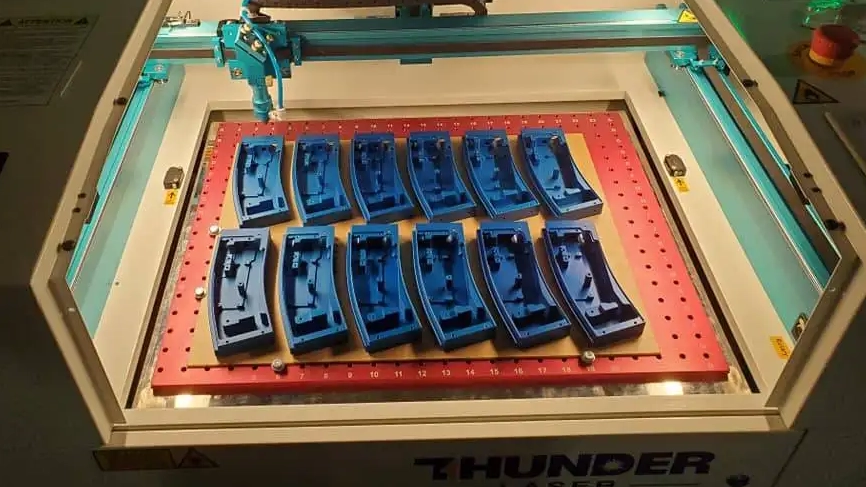
Flat, cylindrical, irregular, and small firearm-related parts require different fixtures and material checks.
| Comparison | Laser Engraving | Hand Engraving |
|---|---|---|
| Repeatability | Well suited to repeated logos, text, and production layouts | Each piece reflects the engraver’s individual technique |
| Design detail | Can reproduce fine digital artwork when the material and process are suitable | Can create highly artistic carved details and traditional finishes |
| Production speed | Efficient after artwork, fixture, and process setup are complete | Usually slower and strongly dependent on manual skill |
| Batch consistency | Strong consistency with a validated fixture and repeatable workflow | Natural variation between pieces |
| Best fit | Identification, branding, personalization, and repeat production | One-of-a-kind artistic or heritage-style work |
A practical comparison of laser engraving and traditional hand engraving for firearm-related customization.
Consult a licensed gunsmith, compliance professional, manufacturer, or other qualified specialist when the work involves a regulated frame or receiver, a required identification mark, a National Firearms Act item, an uncertain material, a pressure-bearing or safety-critical part, or any area where material removal could affect function.
An engraving business should also establish documented procedures for licensing, customer identification, intake, storage, records, inspection, shipping, and return. The laser machine is only one part of the service. Compliance and controlled handling are equally important.
Compliance information was reviewed against public ATF resources available in July 2026. This article provides general laser-processing information and is not legal advice.
Laser engraving can provide precise, durable, and repeatable customization on compatible firearm components, but the process must begin with legal review, safe handling, material verification, and protection of structural and required markings. The correct decision depends on the part, base material, finish, engraving objective, jurisdiction, and operator qualifications.
For machine, material, fixture, and workflow selection, continue with the Laser Engraving Gun Guide: Machines, Materials & Setup. For project-specific material validation, Thunder Laser also offers a material testing service.
Talk To Our Experts Now!
Please leave your contact information so that we can serve you better.
LASER ENGRAVING A GUN FAQS
TAKE THE NEXT STEP WITH THUNDER LASER


 Stable & Consistent MachinesUnlimited ApplicationRobust After-sales SupportFactory Direct Supply


