What Makes RF Laser Sources Unique? Key Technologies Behind
 2025-09-16
WHAT ARE YOU LOOKING FOR?
Search Across Products, Blog Posts, Support Content, And Resources.

What Makes RF Laser Sources Unique? Key Technologies Behind
2025-09-16

The laser source is the heart of any laser machine. It directly affects precision, stability, beam quality, maintenance needs, and long-term processing performance. RF laser sources represent a major advancement in CO2 laser technology, using innovative engineering to improve how energy is delivered, plasma is stabilized, heat is managed, and beams are controlled.
This article explains the core technologies behind RF laser sources, including transverse RF discharge, dielectric barrier discharge, positive V-I characteristics, high-frequency power modulation, slab waveguide design, thermal management, and robust cavity construction. Together, these technologies help make RF lasers a strong choice for demanding industrial applications.
Reference video on RF laser source technology.
The performance of any laser depends on how effectively its gain medium is excited to achieve population inversion. Among various excitation methods, including optical, electrical, and chemical excitation, radio frequency excitation has become an important choice for modern industrial CO2 lasers.
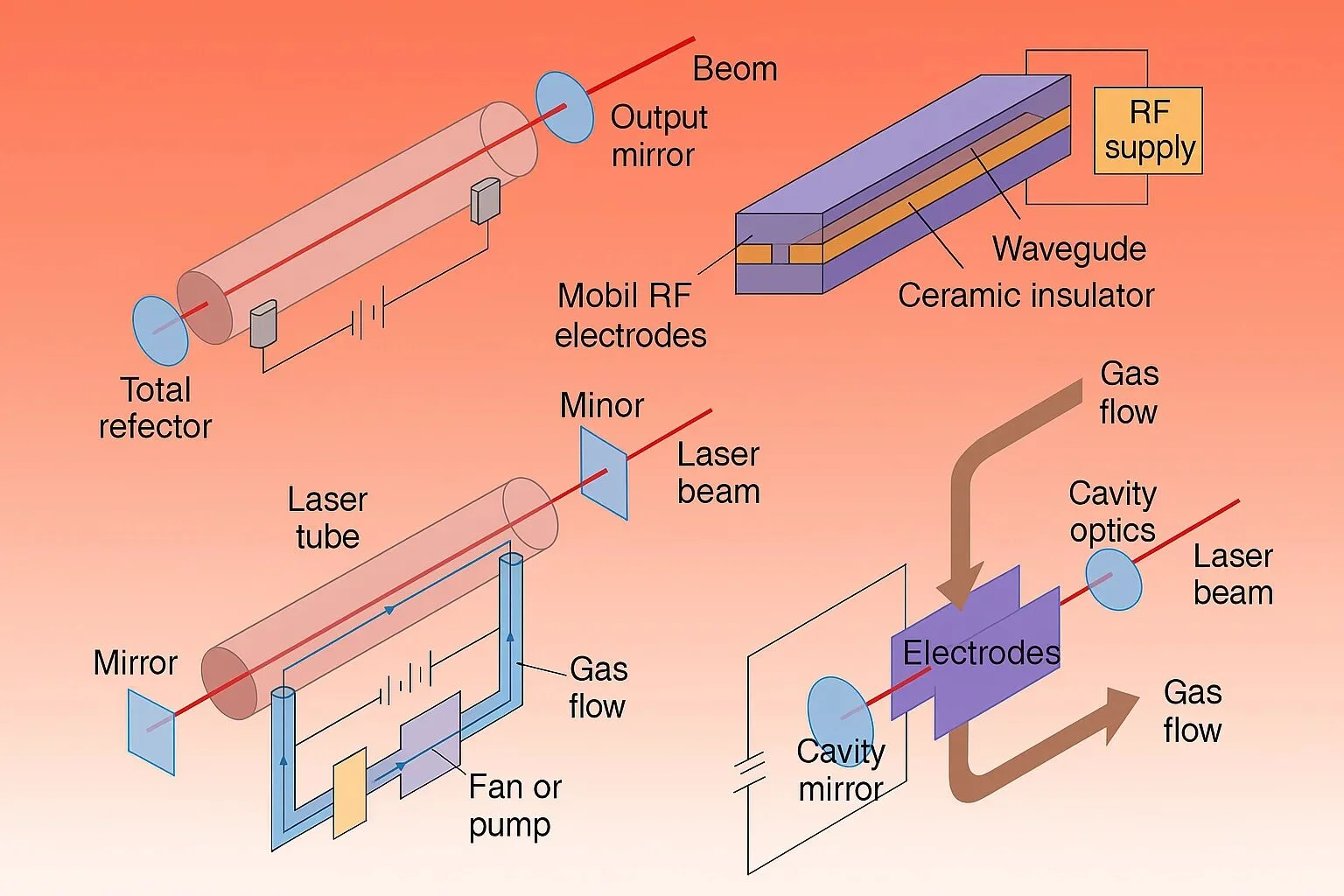
RF laser sources use transverse RF discharge to redesign how energy is delivered to the gain medium. Traditional glass tube lasers usually rely on longitudinal DC discharge, where high-voltage electrodes directly contact the gas. This can cause electrode erosion, gas contamination, and unstable discharge. By contrast, RF laser sources place electrodes along the top and bottom of the laser cavity, perpendicular to the optical axis. When a high-frequency alternating electric field is applied, it excites the gas without direct electrode contact.
This controlled excitation forms a stable plasma, laying the foundation for consistent and precise laser output. Because the gas is not contaminated by electrode material, RF laser sources can support longer operational lifetimes, reduced maintenance, and more consistent beam performance.
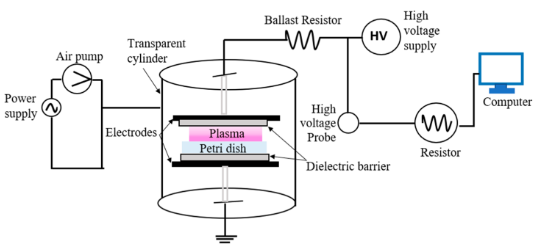
A key innovation in RF laser technology is dielectric barrier discharge, often called DBD. This structure separates the electrodes from direct contact with the laser gas by using a thin insulating layer.
In conventional DC glass tube lasers, metal electrodes directly contact the laser gas. During operation, this direct interaction causes the electrodes to erode gradually under high-voltage discharge, producing tiny metal particles. These particles can contaminate the gas, reduce purity, create uneven plasma, destabilize output, and degrade beam quality. As a result, DC lasers often require more frequent maintenance, including electrode cleaning or replacement and gas replenishment.
RF laser sources solve this problem by applying a high-frequency electric field across the dielectric barrier, separating the electrodes from the gas. This non-contact excitation works much like wireless energy transfer: energy passes through the barrier to excite the gas without direct contact. The gas remains cleaner, plasma stays more uniform, and the risk of electrode material contaminating optical components is reduced.
Learn more: Dielectric barrier discharge (DBD)
In conventional DC glass tube lasers, the plasma exhibits a negative voltage-current characteristic. This means that as discharge current increases, the voltage required to sustain the discharge may actually decrease. This behavior can create instability: a small rise in current can lower the sustaining voltage, which further accelerates the current and may cause the discharge to spike. A slight current drop can have the opposite effect, suppressing the discharge and risking collapse.
To prevent this runaway behavior, DC lasers often rely on ballast resistors to limit current. Although this method can work, it wastes energy and reduces overall efficiency.
RF laser sources exhibit a positive V-I characteristic, where the sustaining voltage rises along with current. This helps naturally balance fluctuations. If current increases, the higher voltage counteracts it; if current decreases, the voltage drops, helping maintain a stable plasma. By reducing reliance on energy-wasting ballast resistors, RF laser sources can improve efficiency while supporting stable plasma, precise power control, high beam quality, and reliable operation.
In laser processing, precise power control is critical for fine detail, consistent quality, and efficient throughput. Traditional glass tube lasers rely on low-frequency switching, which can respond slowly and deliver less consistent output. These limitations can make fine engraving or high-speed cutting more difficult.
RF laser sources use high-frequency RF power modulation. Instead of continuously varying voltage, the system delivers a train of ultra-short pulses at a fixed peak power. By adjusting the duty cycle, or the proportion of time the pulses remain on, the laser precisely controls the average output power.
Because this modulation works at radio frequencies, response is nearly instantaneous. At low average powers, engraving and marking can achieve fine detail and consistency. At higher duty cycles, cutting becomes faster and more efficient while maintaining clean edge quality. This high-speed modulation also enables advanced techniques such as grayscale engraving, expanding the versatility of RF laser sources across different applications.
A waveguide is a structure that channels light along a specific path, helping keep energy concentrated and consistent. In RF CO2 lasers, this is achieved through a slab waveguide, where the laser beam travels between two closely spaced, parallel electrodes inside the cavity.
In traditional glass tube lasers, the beam spreads more freely through the gas. This can cause higher-order modes, which are irregular light patterns that distribute energy unevenly across the beam. The result can be a larger and less uniform spot, reducing precision and making fine engraving or cutting more difficult.
RF laser sources address this by confining the beam within the waveguide. The structured path suppresses higher-order modes and helps maintain the beam in its fundamental Gaussian mode. This produces a smaller, more focused spot with higher energy density, improving cutting, engraving, and marking precision over long production runs.
The slab waveguide also supports heat management. Its geometry spreads thermal energy more evenly across the cavity, reducing distortions caused by hot spots and thermal lensing. Combined with transverse RF discharge and dielectric barrier discharge, this waveguide design helps produce a beam that is stable, consistent, and reliable.
Learn more: planar waveguides - slab waveguides
All laser discharges generate heat. If heat is not managed properly, it can distort the optical path and degrade beam quality, a phenomenon often called thermal lensing. Glass tubes, with relatively poor thermal conductivity, can struggle to dissipate heat evenly, leading to hot spots and unstable output.
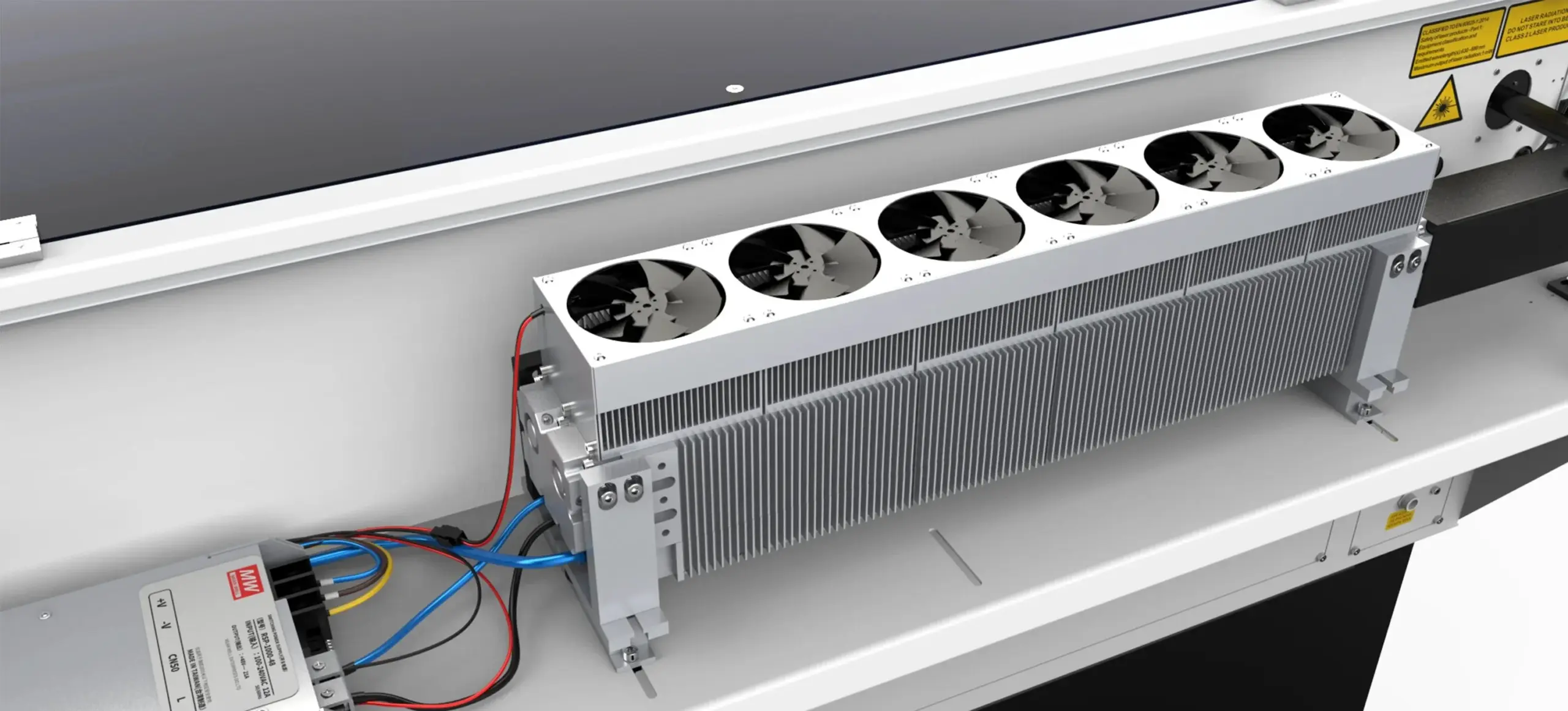
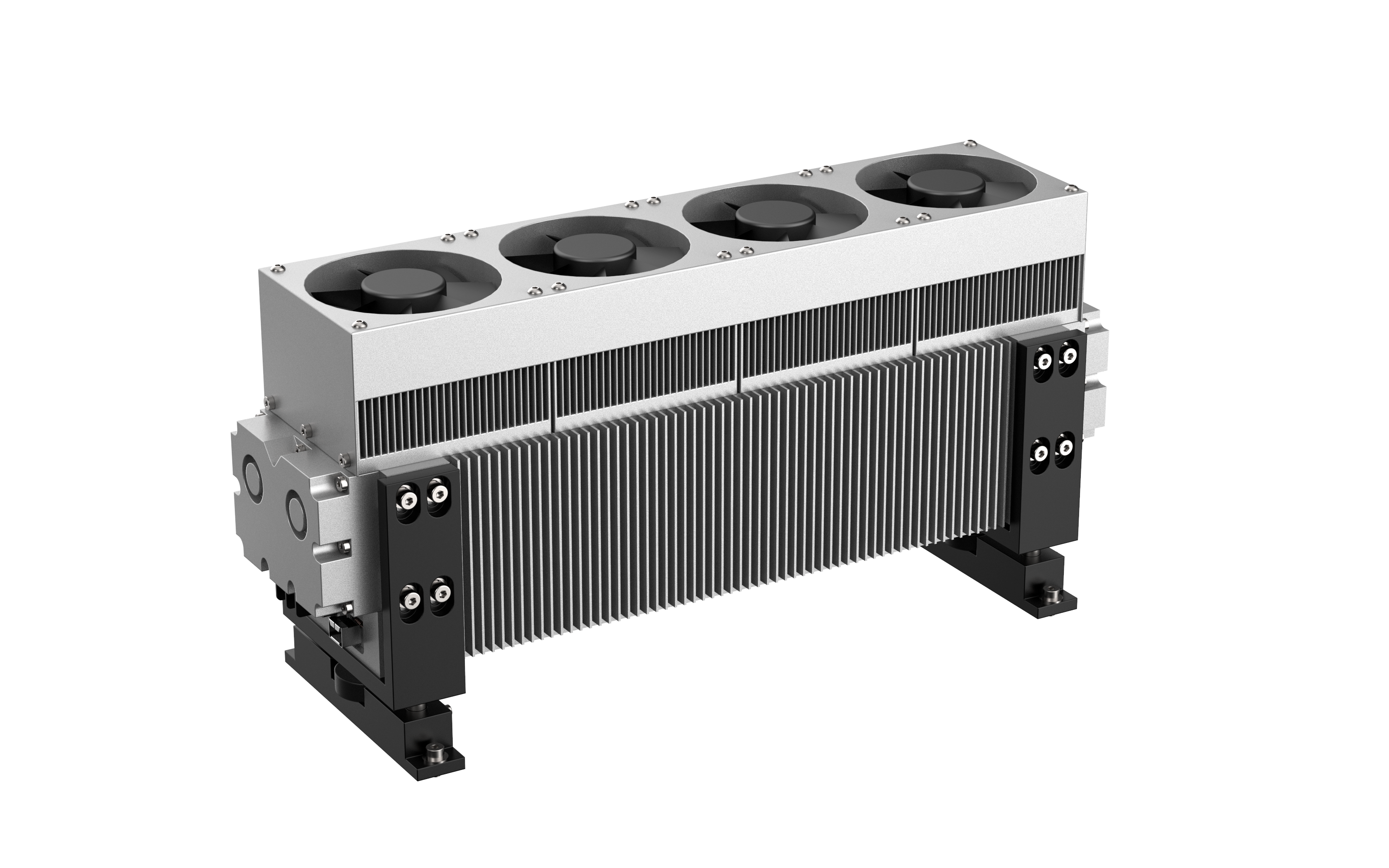
RF laser sources use metal or ceramic cavities with high thermal conductivity to spread heat quickly and uniformly. Many systems also incorporate water or air cooling channels, helping keep cavity temperature stable during continuous, high-power operation.
Effective thermal management helps maintain beam focus and M² stability, supporting longer uninterrupted operation with lower maintenance demands. This is especially important for industrial tasks involving materials such as acrylics, composites, and other production materials.
Unlike fragile glass tubes, which are more prone to breakage and sensitive to vibration or thermal shock, RF CO2 laser sources use robust metal or ceramic cavity structures. These cavities are designed to withstand mechanical stress and demanding operating conditions.
This structural strength works together with the inherent advantages of RF excitation. Because electrodes do not directly contact the gas, electrode erosion and gas contamination are reduced. Combined with effective thermal management and self-stabilizing plasma, RF laser sources can operate continuously for thousands of hours with minimal maintenance.
For industrial users, this means more predictable output, fewer interruptions, and less time spent on recalibration and maintenance. Over time, these advantages can help reduce the total cost of ownership.
RF laser sources are not simply "upgraded glass tubes." They represent a more advanced industrial laser source design built around stable excitation, precise power control, efficient thermal management, and durable cavity construction.
By understanding transverse RF discharge, dielectric barrier discharge, positive V-I behavior, high-frequency modulation, slab waveguide design, heat management, and robust cavity structure, users can better evaluate modern CO2 laser systems and select the right machine for precision, reliability, and long-term productivity.
Explore RF CO2 Laser Machines
Discover Thunder Laser machines built for stable performance, high-quality engraving, precise cutting, and reliable production workflows.
Contact UsTalk To Our Experts Now!
Please leave your contact information so that we can serve you better.
FAQS
FIND THE RIGHT LASER FOR YOUR NEXT PROJECT
Explore Thunder Laser solutions designed for different materials, workflows, and production needs.


 Stable & Consistent MachinesUnlimited ApplicationsRobust After-sales SupportFactory Direct Supply