RF CO2 vs. Glass CO2 Laser: Which Laser Source Should You Choose?
 2024-05-29
WHAT ARE YOU LOOKING FOR?
Search Across Products, Blog Posts, Support Content, And Resources.

RF CO2 vs. Glass CO2 Laser: Which Laser Source Should You Choose?
2024-05-29

RF CO2 laser cutting machines and glass CO2 laser cutting machines are both based on CO2 laser technology. However, they differ in laser source design, beam characteristics, power and efficiency, maintenance needs, operating lifetime, and overall performance.
Understanding these differences can help users choose a laser source that better fits their cutting performance requirements, material needs, budget, and long-term application goals.
Simple rule: RF CO2 laser sources are often chosen for higher beam quality, longer lifetime, and lower maintenance needs, while glass CO2 laser sources are often selected when cost performance and moderate power are more important.
Both RF CO2 and glass CO2 laser sources use a gas mixture that typically includes CO2, N2, and He. The main difference is how the gas mixture is excited and how the laser source is built.
RF CO2 laser sources use radio-frequency excitation, while glass CO2 laser tubes generate the laser beam inside a sealed glass tube. This difference affects beam quality, efficiency, maintenance, lifetime, machine cost, and the final processing experience.
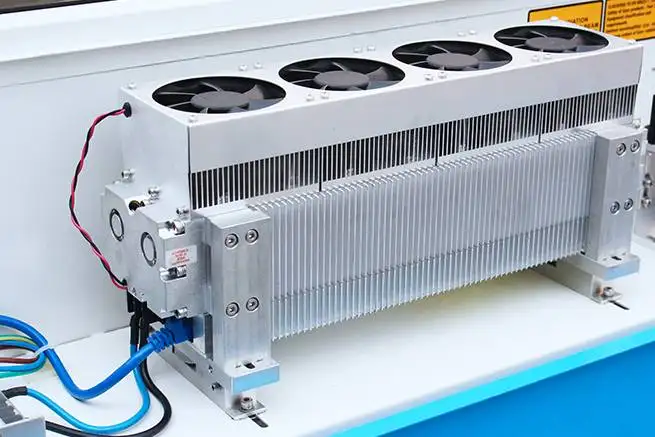
An RF CO2 laser source is powered by an RF generator. The generator excites the gas mixture inside the laser source to produce laser radiation.
The laser beam produced by an RF laser source has a high-quality Gaussian beam profile. This helps support precise and consistent cutting quality, especially when clean edges and narrow kerfs are important.
RF laser sources can achieve high output power depending on the system design, typically ranging from hundreds of watts to several kilowatts in industrial applications. They also offer relatively high electrical-to-optical conversion efficiency, which can help reduce operating costs.
RF laser cutting machines can process a wide range of materials, including metals, plastics, wood, ceramics, and composites. This makes them versatile tools for various industrial applications.
RF laser sources are known for long operational lifetime, low maintenance requirements, and high beam quality. They can achieve precise cuts with narrow kerfs and offer excellent cutting speeds, especially for non-metallic materials.
RF laser cutting machines can be more expensive than conventional CO2 laser systems because they use an RF generator and related components. For users with limited budgets, the initial purchase cost may be an important consideration.
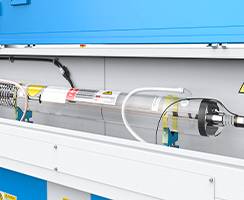
A glass CO2 laser generates the laser beam inside a sealed glass tube filled with a gas mixture. This structure is relatively simple and commonly used in many CO2 laser cutting and engraving machines.
The beam produced by a glass CO2 laser source can have relatively good beam quality, but it may not match the Gaussian beam profile of an RF laser source. This can affect fine cutting consistency and overall processing precision in some applications.
Glass CO2 laser sources can achieve moderate output power, typically ranging from several tens of watts to a few hundred watts. Their electrical-to-optical conversion efficiency is generally lower than that of RF laser sources.
Glass CO2 laser cutting machines can process many materials, including metals, plastics, wood, and ceramics. However, they may not be as efficient as RF laser sources in certain applications.
Glass laser sources are relatively simple in design and can be more cost-effective than RF laser sources for lower-power applications. They offer a practical balance between performance and cost, making them suitable for many industrial cutting applications where moderate power is sufficient.
Compared with RF laser sources, glass CO2 laser sources usually have a shorter operational lifetime and may require more frequent maintenance or replacement. Their beam quality and efficiency may also be lower than RF laser sources.
| Comparison Item | RF CO2 Laser Source | Glass CO2 Laser Source |
|---|---|---|
| Source Design | Uses an RF generator to excite the CO2 gas mixture. | Generates the laser beam inside a sealed glass tube. |
| Beam Quality | High-quality Gaussian beam profile for precise and consistent cutting. | Good beam quality, but may not match RF Gaussian beam performance. |
| Power and Efficiency | Can support high output power and higher conversion efficiency. | Usually moderate output power and lower conversion efficiency. |
| Maintenance | Known for low maintenance requirements. | May require more frequent maintenance or replacement. |
| Lifetime | Long operational lifetime. | Shorter operational lifetime compared with RF sources. |
| Cost | Higher initial cost because of RF generator and related components. | More cost-effective for many lower-power applications. |
The best choice depends on your cutting performance requirements, material compatibility needs, budget, and specific application requirements. Both source types can be useful, but they are better suited to different priorities.
RF laser sources offer higher output power potential, better beam quality, higher efficiency, and longer operational lifetime, but they can be more expensive. They are a strong choice when users need higher precision, lower maintenance, and better long-term performance.
Glass CO2 laser sources provide a balance between performance and cost. They are suitable for many cutting applications where moderate power levels are sufficient and budget control is an important factor.
In short, choose RF CO2 for higher performance and longer-term stability. Choose glass CO2 when cost performance and moderate processing requirements are the main priorities.
Talk To Our Experts Now!
Please leave your contact information so that we can serve you better.
RF CO2 VS GLASS CO2 LASER FAQS
FIND THE RIGHT LASER FOR YOUR NEXT PROJECT
Explore Thunder Laser solutions designed for different materials, workflows, and production needs.


 Stable & Consistent MachinesUnlimited ApplicationsRobust After-sales SupportFactory Direct Supply