Laser Marking Machine vs CO2 Laser Machine: Types, Materials, and Buying Guide
 2023-09-22
WHAT ARE YOU LOOKING FOR?
Search Across Products, Blog Posts, Support Content, And Resources.

Laser Marking Machine vs CO2 Laser Machine: Types, Materials, and Buying Guide
2023-09-22

Product branding, identification, and traceability often depend on permanent marks. A clear logo, serial number, QR code, batch number, or product label helps customers recognize the brand and helps manufacturers improve product authentication and reliability.
A laser marking machine plays an important role in this process. It creates durable, precise, and high-contrast marks on many materials without relying on inks, labels, or direct mechanical contact. Depending on the laser source, a marking machine can process metals, plastics, ceramics, glass, wood, paper, packaging materials, electronic components, medical devices, jewelry, and more.
However, there are many laser marking and engraving solutions on the market. Fiber lasers, CO2 lasers, UV lasers, YAG lasers, and green lasers all have different strengths. This guide explains the major types of laser marking machines and compares them with CO2 laser machines to help you choose the right solution for your project.
A laser marking machine uses a focused laser beam to engrave, mark, etch, discolor, or modify the surface of a material. The process begins with a high-energy laser source that generates intense light. This light is focused onto the material surface to create a permanent mark with high precision.
Laser marking is widely used in automotive, aerospace, electronics, medical, jewelry, packaging, manufacturing, and consumer product industries. Common marking content includes logos, serial numbers, product codes, barcodes, QR codes, safety information, decorative patterns, and traceability marks.
Although these terms are sometimes used together, they are not exactly the same. Laser marking usually focuses on creating a readable or decorative surface mark. Laser engraving removes more material to create depth. Laser cutting separates the material into shapes or parts.
| Process | Main Purpose | Typical Result | Common Use |
|---|---|---|---|
| Laser Marking | Add permanent information or branding | Surface color change, etching, or shallow mark | Serial numbers, logos, barcodes, QR codes |
| Laser Engraving | Remove material for visible depth or texture | Deeper engraved pattern or recessed mark | Gifts, signs, plaques, wood and acrylic products |
| Laser Cutting | Separate material into finished shapes | Cut edge or complete part | Acrylic signs, wood parts, packaging, models |
In simple terms, choose laser marking when the goal is product identification or surface branding. Choose laser engraving when the goal is deeper decoration or texture. Choose laser cutting when the goal is to cut through the material.
Laser marking machine types are usually defined by their laser source and wavelength. Different laser sources interact with materials in different ways, so no single machine is best for every application.
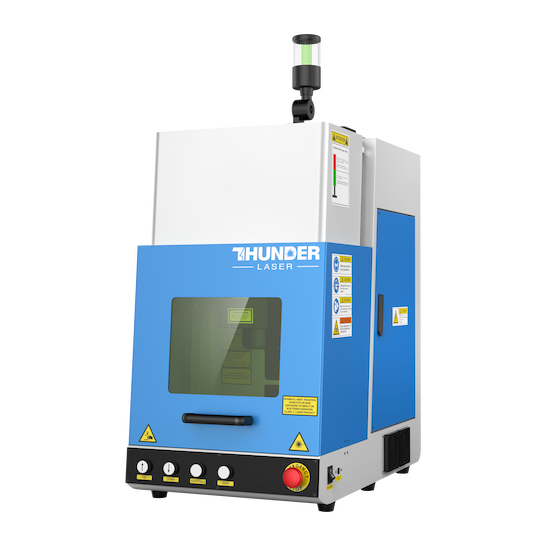
A fiber laser marking machine uses fiber optic technology and is known for high precision, fast marking speed, and strong performance on many industrial materials. It is often considered one of the best options for metal marking.
Fiber lasers are commonly used for metals, coated metals, plastics, ceramics, electronic parts, tools, machinery components, automotive parts, nameplates, and product traceability codes.
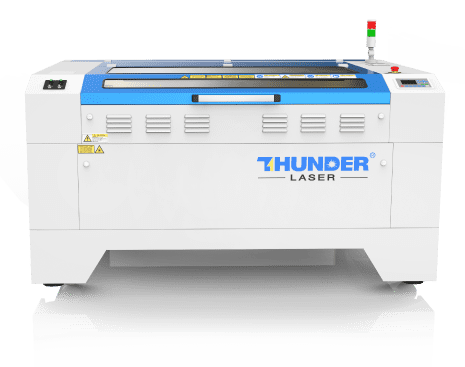
A CO2 laser machine uses a gas laser source to generate a high-energy beam. CO2 lasers are highly practical for organic and non-metallic materials such as wood, paper, cardboard, leather, acrylic, rubber, fabric, and many plastics.
CO2 lasers are widely used for engraving, cutting, signage, packaging, craft production, and wood processing. When the application is mainly cutting or engraving non-metal materials, a CO2 laser machine is often the better choice.
A UV laser marking machine uses a shorter wavelength and is suitable for delicate or heat-sensitive materials. It can create precise marks with less thermal impact on the surrounding marking area.
UV lasers are commonly used for plastics, glass, ceramics, electronics, thin films, PCBs, and sensitive product marking applications where clean, high-contrast marking is important.
YAG laser marking machines are suitable for metals, ceramics, and plastics. They are often used in industrial and medical-related applications where permanent identification is required.
Green laser marking machines use a visible green wavelength and are often used for sensitive materials. They can be suitable for precision marking on plastics, glass, ceramics, jewelry, medical devices, and other applications where controlled marking is needed.
| Laser Type | Best Materials | Main Strength | Typical Applications | Buying Note |
|---|---|---|---|---|
| Fiber Laser | Metals, plastics, ceramics, coated surfaces | High-speed, high-precision metal marking | Industrial parts, tools, electronics, nameplates | Strong choice for metal and industrial marking |
| CO2 Laser | Wood, paper, acrylic, leather, fabric, rubber, many plastics | Versatile non-metal cutting and engraving | Signs, packaging, crafts, wood engraving, acrylic cutting | Better for cutting and engraving non-metal materials |
| UV Laser | Plastics, glass, ceramics, electronics, thin films, PCBs | Fine marking with lower thermal impact | Sensitive product marking, electronics, glass and plastic marking | Useful when heat control and detail matter |
| YAG Laser | Metals, ceramics, plastics | Durable marking on industrial materials | Medical, industrial marking, identification | May overlap with fiber laser applications |
| Green Laser | Plastics, glass, ceramics, jewelry, sensitive materials | Precision marking on sensitive substrates | Jewelry, medical devices, delicate plastic and glass marking | Consider when special material response is required |
Many buyers compare laser marking machines with CO2 laser machines because both can create permanent results. The key difference is application focus. Laser marking machines, especially fiber and UV systems, are commonly selected for product identification and high-precision marking. CO2 laser machines are commonly selected for cutting and engraving non-metal materials.
Fiber and UV laser marking machines usually offer excellent precision for product marking. They are suitable for small characters, fine codes, detailed logos, and industrial traceability marks. CO2 lasers are also precise, but they are usually more suitable for engraving and cutting larger non-metal workpieces rather than ultra-fine product marking.
Material compatibility is one of the most important selection factors. CO2 lasers perform well on many non-metal and organic materials such as wood, acrylic, leather, paper, fabric, and rubber. Fiber lasers are usually stronger for metals and some plastics. UV lasers are useful for plastics, glass, ceramics, electronics, and other sensitive substrates.
For high-volume product marking, fiber and UV laser marking systems are often more suitable because they are designed for fast, repeatable marking. CO2 machines can be efficient for cutting and engraving, but they are not always the best choice for small, high-speed identification marks on industrial parts.
CO2 laser systems may have a lower initial cost in some cases, which can make them attractive for budget-conscious buyers. However, the total cost also depends on maintenance, cooling, energy consumption, production speed, consumables, and downtime.
Fiber and UV laser marking machines often require less routine maintenance because of their solid-state design. CO2 laser machines may require more maintenance, including mirror cleaning, cooling system checks, and optical path care.
Choose the machine based on your real application. For metal identification, industrial codes, and high-speed product marking, fiber or UV laser marking may be more suitable. For wood, acrylic, leather, paper, and non-metal cutting or engraving, a CO2 laser machine is often a better fit.
Fiber and CO2 laser systems are both valuable, but they are usually selected for different tasks. Fiber lasers are commonly used for industrial product marking, especially on metals. CO2 lasers are commonly used for non-metal cutting and engraving.
| Factor | Fiber Laser Marking Machine | CO2 Laser Machine |
|---|---|---|
| Laser Source | Solid-state laser with a shorter wavelength, commonly around 1070 nm | Gas laser with a longer wavelength, commonly around 10,604 nm |
| Marking Speed | Generally faster for many industrial marking tasks | Generally slower for fine product marking, but useful for cutting and engraving |
| Accuracy and Precision | High precision for small marks, codes, and metal identification | Precise for engraving and cutting, but usually not the first choice for fine metal marking |
| Warm-Up Time | Usually no long warm-up process | May require startup preparation depending on the system |
| Cost Structure | Higher initial cost in many cases, but lower operating cost for suitable applications | Often lower initial cost, but operating and maintenance costs must be considered |
| Cooling | Often air-cooled depending on configuration | Often water-cooled depending on model and laser tube |
| Size and Portability | Can be compact and suitable for marking workstations | Usually larger because it often includes a worktable and cutting/engraving area |
| Best Applications | Metal engraving, plastic marking, electronics, tools, industrial parts | Wood, acrylic, leather, paper, fabric, rubber, signage, packaging, crafts |
UV laser marking and CO2 laser processing serve different needs. UV lasers are often used for fine product marking on sensitive materials, while CO2 lasers are widely used for engraving and cutting non-metal materials.
| Factor | UV Laser Marking Machine | CO2 Laser Machine |
|---|---|---|
| Laser Source | UV laser with a shorter wavelength, commonly around 355 nm | Gas laser with a longer wavelength, commonly around 10,604 nm |
| Marking Style | High-precision marking with less effect on the surrounding area | Good for engraving and cutting, but may create more heat effect in some marking tasks |
| Maintenance | Often lower routine maintenance for suitable marking applications | Requires regular optical path, cooling, and cleaning maintenance |
| Material Compatibility | Plastics, glass, ceramics, electronics, thin films, some metals | Wood, acrylic, leather, paper, fabric, rubber, many plastics, packaging materials |
| Cost | Higher initial cost in many cases, but efficient for precise marking | Often lower initial cost, but operating cost depends on usage and maintenance |
| Best Applications | Sensitive product marking, electronics, glass, plastics, PCBs, thin films | Engraving and cutting for signage, packaging, crafts, wood, acrylic, and leather |
YAG and green lasers are also used for marking applications. YAG lasers can overlap with some fiber laser applications, while green lasers are often selected for sensitive materials that respond better to green wavelength marking.
| Factor | YAG and Green Laser Machines | CO2 Laser Machine |
|---|---|---|
| Laser Source | YAG laser around 1064 nm or green laser around 532 nm | Gas laser with a longer wavelength, commonly around 10,604 nm |
| Cost | Initial cost can be higher, while operating cost may be lower for suitable applications | Initial cost may be lower, but operating and maintenance costs should be considered |
| Material Compatibility | YAG: metals, ceramics, plastics, wood, semiconductors. Green: plastics, glass, ceramics, jewelry, medical-related sensitive materials | Wide range of non-metal materials, but not always recommended for sensitive marking applications |
| Applications | YAG: marking, engraving, and some cutting on suitable materials. Green: precision product marking | Engraving and cutting for non-metal materials, signs, packaging, crafts, and production parts |
The right laser machine depends on your material, required mark quality, production speed, budget, maintenance expectations, and whether you need marking, engraving, cutting, or a combination of these processes.
Material should be the first decision point. If you mainly mark metals, fiber laser marking is often a strong choice. If you mainly cut or engrave wood, acrylic, leather, paper, or fabric, CO2 laser machines are usually more suitable. If you mark sensitive plastics, glass, or electronics, UV or green laser marking may be worth considering.
A product code, QR code, or logo mark has different requirements from a deep engraved gift or a cut acrylic sign. Marking applications need readability, contrast, and consistency. Engraving applications need texture, depth, and surface finish. Cutting applications need edge quality and complete separation.
For high-volume industrial marking, speed and repeatability are critical. Fiber and UV systems can be more suitable for fast marking workflows. For flexible workshop production that includes cutting and engraving, a CO2 machine may provide broader material versatility.
Initial price is only one part of the decision. Also compare operating cost, maintenance needs, downtime, cooling requirements, consumables, productivity, and whether the machine can handle future projects.
Practical recommendation: If your work is mostly product marking on metal or plastic parts, start by evaluating fiber, UV, or green marking systems. If your work is mostly cutting and engraving non-metal materials, start by evaluating a CO2 laser machine.
Laser machines are among the most popular solutions for product marking, engraving, and cutting because they create permanent, clean, and repeatable results. For product identification and traceability, laser marking is especially useful because it can add durable information without labels or inks.
Fiber, CO2, UV, YAG, and green lasers each serve different material and application needs. Fiber lasers are strong for metal and industrial marking. CO2 lasers are practical for non-metal cutting and engraving. UV and green lasers are useful for sensitive materials and fine marking. YAG lasers can also support marking on metals, ceramics, and plastics.
The best choice depends on what you make, what material you process, and what result you need. Understanding these differences will help you select a laser machine that improves product quality, production efficiency, and long-term value.
Need Help Choosing a Laser Marking or CO2 Laser Machine?
Contact Thunder Laser for guidance on fiber, UV, CO2, and laser marking solutions for your materials, production needs, and application goals.
Contact UsTalk To Our Experts Now!
Please leave your contact information so that we can serve you better.
LASER MARKING MACHINE FAQS
FIND THE RIGHT LASER FOR YOUR NEXT PROJECT
Explore Thunder Laser solutions designed for different materials, workflows, and production needs.


 Stable & Consistent MachinesUnlimited ApplicationsRobust After-sales SupportFactory Direct Supply