


Laser Engraved Bricks: Benefits, Applications, and Machine Guide
 2025-12-18
WHAT ARE YOU LOOKING FOR?
Search Across Products, Blog Posts, Support Content, And Resources.

Laser Engraved Bricks: Benefits, Applications, and Machine Guide
2025-12-18

Laser engraved bricks have become a practical and meaningful option for schools, memorials, churches, parks, museums, universities, sports facilities, and community fundraising projects. With permanent names, messages, logos, dates, or decorative artwork, engraved bricks can raise funds while creating a lasting physical connection between donors and the cause they support.
Fundraising bricks can be produced through several engraving methods, but laser engraving offers strong advantages for detail, consistency, efficiency, and design flexibility. Compared with traditional methods such as sandblasting, laser engraving can reproduce intricate designs more accurately and support more personalized brick and paver projects.
This guide explains what laser engraved bricks are, how brick laser engraving works, where custom engraved bricks and engraved pavers are commonly used, and how brick engraving companies can choose suitable laser equipment for personalized fundraising, memorial, and commercial production.
Quick Answer: Laser engraved bricks and engraved pavers can be customized with names, donor messages, dates, logos, and artwork. For brick engraving companies, the best laser engraving machines for bricks are enclosed CO₂ laser systems with sufficient work area and Z clearance, stable focus, precise motion control, repeatable positioning, variable-data support, and effective dust or fume management. Always test the exact clay, concrete, stone, or coated paver before production.
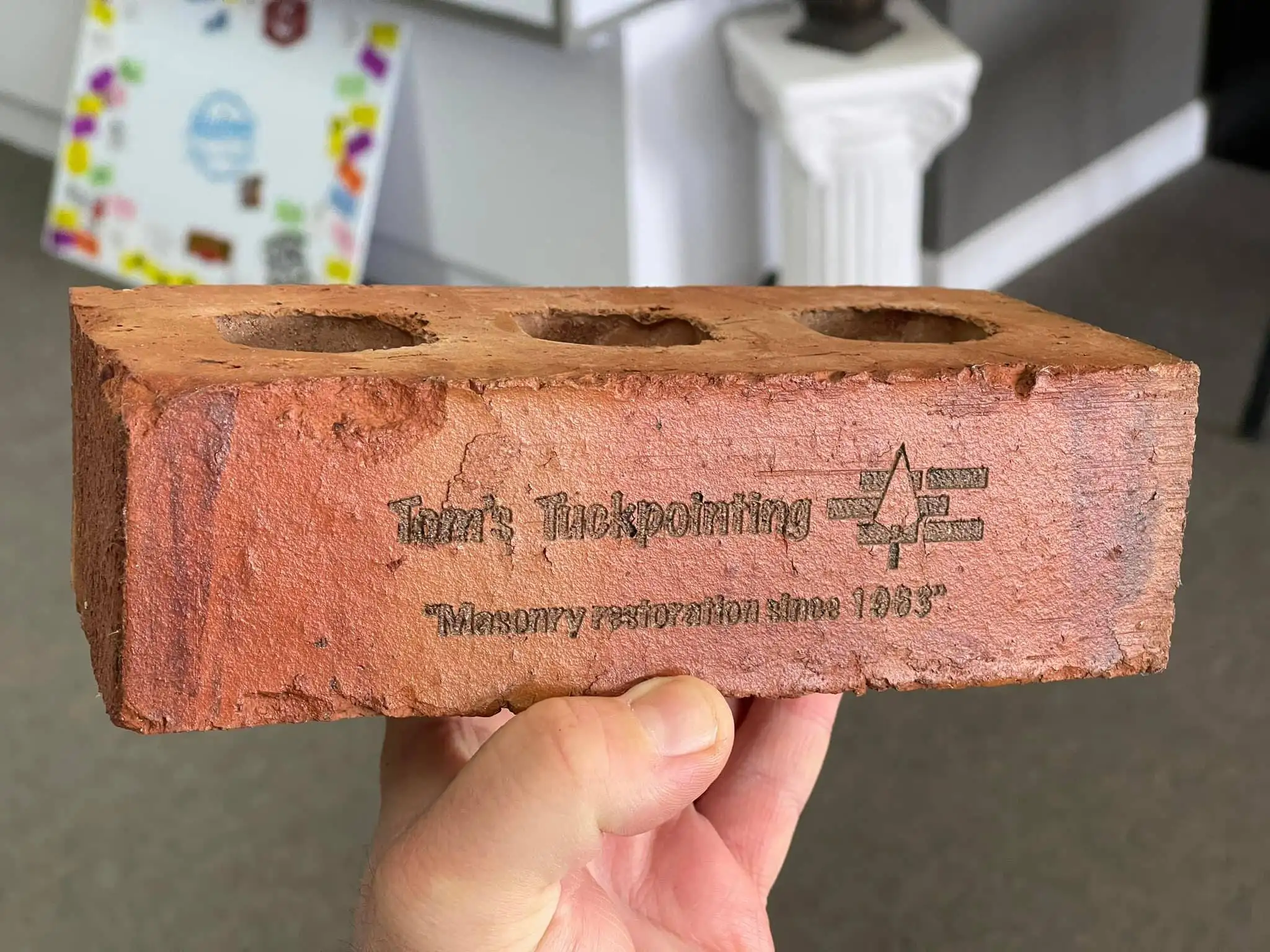
Laser engraved bricks can carry names, dates, logos, donor messages, and memorial text for long-lasting public display.
Laser engraved bricks are standard brick, paver, clay, concrete, or stone materials customized with engraved letters, logos, messages, artwork, or symbolic designs. They are often called fundraising bricks because many organizations use them as donor recognition products for fundraising campaigns.
You can find laser engraved bricks in public walkways, memorial walls, school campuses, museums, gardens, religious spaces, community centers, parks, and stadium areas. Each brick becomes both a functional building material and a personal storytelling element.
For fundraising campaigns, engraved bricks help donors feel emotionally connected to the project. Instead of giving a one-time donation with no visible reminder, donors can leave a permanent mark that remains part of the place they helped support.
Brick laser engraving uses a focused laser beam to remove or alter the surface of the brick according to a digital design. The operator prepares the text, logo, pattern, or image in software, positions the brick under the laser head, focuses the beam, checks the engraving area, and starts the job with suitable parameters.
The laser follows the digital file with high precision. This makes it possible to engrave names, donor messages, symbols, dates, logos, and even more complex artwork. For brick and paver applications, the best results usually depend on the material type, surface texture, laser power, engraving speed, focus, and test results.
Before engraving a full batch of fundraising bricks, always test the design on the same or similar brick material. Test engraving helps confirm contrast, depth, readability, and edge quality before production begins. You can also compare broader material behavior through the Thunder Laser material compatibility guide.
Example of laser engraving on red clay bricks.
Laser technology provides multiple advantages for engraving bricks and pavers. It improves the quality, repeatability, efficiency, and creative range of the engraving process, making it especially useful for donor bricks and personalized public installations.
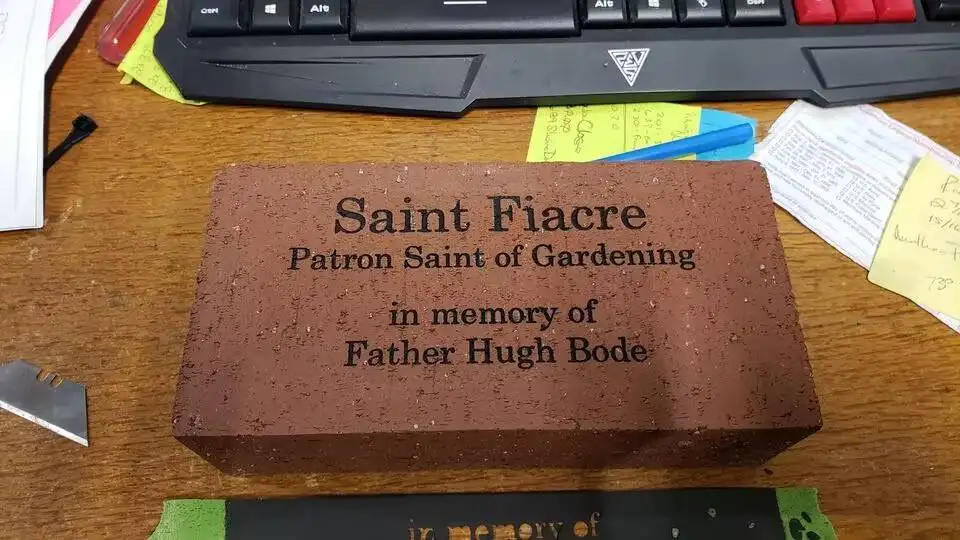
Laser engraved bricks are used in fundraising, memorial, community, education, and public recognition projects.
Because of their durability and personalization value, laser engraved bricks are used across many sectors. They can turn a walkway, wall, garden, or entrance area into a meaningful display of names, memories, achievements, and shared community identity.
Laser engraving and sandblasting can both be used for brick personalization, but they differ in process, detail, repeatability, waste, and workflow. For fundraising bricks that require names, dates, logos, and consistent batch results, laser engraving is often the more flexible option.
Sandblasting can still be useful for certain projects, especially when a traditional etched appearance is desired. However, it may be less convenient for intricate designs, complex graphics, and highly variable donor personalization. The comparison below summarizes the main differences.
| Aspect | Laser Engraving | Sandblasting |
|---|---|---|
| Process | Uses a focused laser beam to etch the design onto the brick surface. | Uses abrasive particles to physically create the engraving. |
| Precision and Detail | Supports detailed text, graphics, and accurate design reproduction. | Detail may be limited by the abrasive process and manual control. |
| Speed and Efficiency | Efficient for batch production after the digital workflow is set up. | Can be slower because it may require more manual preparation and handling. |
| Versatility | Works well for text, logos, donor names, dates, symbols, and complex graphics. | May be more limited for complex or highly detailed designs. |
| Personalization | Digital files make it easier to customize each brick with unique donor information. | Personalization is possible but may be less efficient for complex batches. |
| Environmental Impact | Generates minimal material waste during the engraving process. | Creates dust and debris that need proper control and disposal. |
| Setup and Maintenance | Digital setup can be streamlined, and routine laser maintenance supports repeatability. | Requires equipment setup, abrasive handling, and periodic maintenance. |
| Cost | The initial equipment cost may be higher, but efficiency can help in repeat production. | Initial equipment cost may be lower, but manual handling and materials should be considered. |
A comparison table that summarizes the differences between laser engraving and sandblasting for brick personalization.

The best laser engraving machines for bricks should provide sufficient work area and Z clearance, stable focusing, repeatable positioning, and reliable dust or fume handling.
For brick engraving companies, the best laser engraving machine should match the exact brick or paver material, piece dimensions, required engraving contrast, production volume, and batch workflow. Enclosed CO₂ laser machines are commonly considered for suitable clay bricks, concrete pavers, stone pavers, and other non-metal construction materials, but the final machine configuration should always be confirmed through material testing.
The best brick engraving equipment is not simply the machine with the highest laser power. A commercial brick engraving machine should provide a stable working platform, accurate motion control, reliable focusing, enough work area and Z clearance for the largest brick or paver, compatible engraving software, and an efficient workflow for custom engraved bricks with different donor names, dates, messages, or logos.
For compact sample development, small donor-brick batches, and smaller personalization workflows, the Bolt Series can be reviewed as a compact RF CO₂ engraving option. For higher-volume or more industrial brick engraving production, the Titan Series may be more suitable for users who need a larger enclosed production workflow.
For fundraising brick suppliers, memorial businesses, personalization studios, and established brick engraving companies, repeatable positioning and variable-data handling are especially important. These features help improve consistency when processing large batches of fundraising bricks, memorial bricks, donor bricks, and engraved pavers.
Brick engraving companies often process custom engraved bricks in batches containing different donor names, dates, memorial messages, logos, or order numbers. A structured production workflow helps reduce spelling errors, positioning mistakes, mismatched orders, and inconsistent engraving results.
Clay bricks, concrete pavers, stone pavers, and glazed materials can respond differently to the same laser settings. The following troubleshooting guide helps identify common problems when producing laser engraved bricks, custom fundraising bricks, and engraved pavers.
| Problem | Possible Cause | Adjustment Direction |
|---|---|---|
| Low engraving contrast | The material does not create strong natural contrast, or the energy input is too low. | Test power, speed, focus, and line spacing on the same material. Consider a tested color-fill process when appropriate. |
| Fine text is difficult to read | The brick surface is too coarse, the font is too small, or the strokes are too thin. | Increase the font size and stroke width, simplify the design, and review a physical sample from normal viewing distance. |
| Engraving depth or color is uneven | The surface height, texture, density, or focus varies across the brick or paver. | Improve material positioning, confirm the surface is stable, refocus, and test a smaller engraving area. |
| Brick edges chip or crack | The material is fragile, already damaged, or receiving too much concentrated heat. | Inspect the brick before engraving, reduce heat input, avoid weak edges, and test another area or material batch. |
| Heavy debris remains on the surface | Material removal creates loose particles that hide the final contrast. | Allow the brick to cool, clean the surface before evaluating the result, and maintain the machine and extraction system. |
| Results vary between bricks | Firing, color, aggregate, coating, density, or supplier batches are inconsistent. | Test each new material batch, group similar bricks together, and document settings by supplier and material type. |
| The design is off-center | The brick position, file origin, fixture, or framing step is inconsistent. | Use a reusable jig or stop, verify the origin, and frame every design before engraving. |
| Outdoor color fill fails | The fill material is not compatible with the brick surface or outdoor exposure. | Test adhesion, weather resistance, cleaning, sealing, and curing requirements before using the finish on a full order. |
Common brick and paver engraving problems should be tested and corrected on the exact material before full production.
Selecting the right laser device is easier when you understand the practical requirements of engraving bricks and pavers. Good results come from the right machine, the right settings, and careful material testing before full production.
Laser engraved bricks are valuable for fundraising, memorials, donor recognition, historical spaces, schools, religious communities, and public installations. They combine practical building materials with personalized storytelling, helping organizations raise funds while creating a visible and lasting tribute.
Compared with sandblasting, laser engraving offers strong advantages in precision, detail, repeatability, design flexibility, and digital customization. To achieve the best results, choose a suitable laser engraver, test your brick material carefully, document successful settings, and use a reliable exhaust or filtration workflow.
Need Help Choosing the Best Laser Engraving Machine for Bricks?
Contact Thunder Laser to discuss your brick or paver material, engraving size, production volume, batch workflow, dust control needs, and suitable commercial brick engraving equipment.
Contact UsTalk To Our Experts Now!
Please leave your contact information so that we can serve you better.
LASER ENGRAVED BRICKS FAQS
FIND THE RIGHT LASER FOR YOUR NEXT PROJECT
Explore Thunder Laser solutions designed for different materials, workflows, and production needs.


 Stable & Consistent MachinesUnlimited ApplicationsRobust After-sales SupportFactory Direct Supply


