


How to Choose and Use Different Laser Heads
 2024-07-02
WHAT ARE YOU LOOKING FOR?
Search Across Products, Blog Posts, Support Content, And Resources.

How to Choose and Use Different Laser Heads
2024-07-02

Choosing the right laser head can make a major difference in laser engraving and cutting results. Different laser heads have different focal distances and laser dot sizes, which affect detail, cutting depth, working distance, and overall processing quality.
In this guide, we’ll explain how Thunder Laser heads are used, what shorter and longer focal lengths are best for, and how to match the laser head to your material and processing goal.
Learn how to choose and use different laser heads for Thunder Laser machines.
Thunder Laser offers different laser head options for different applications. The standard laser head is suitable for general engraving and cutting, the high-resolution head is designed for fine detail engraving, and the 4-inch laser head is mainly used for thicker materials.
| Type | Laser Dot Size | Focal Distance | Main Function |
|---|---|---|---|
| Standard Laser Head | 0.0039″ / 0.099 mm | 5.0 mm–6.5 mm | Cutting material less than 10 mm and engraving photos within 500 DPI |
| High Resolution Head | 0.0020″ / 0.050 mm | 3.0 mm–4.0 mm | Engraving photos up to 1000 DPI and cutting material less than 1 mm |
| 4″ Laser Head | 0.0078″ / 0.198 mm | 9.0 mm–11 mm | Cutting material more than 10 mm |
A comparison of Thunder Laser head types, laser dot sizes, focal distances, and recommended applications.
The commonly used laser heads for Thunder Laser equipment range from 1.5 inches to 4 inches. These inch values refer to the focal length, which is the distance between the lens and the laser beam’s focal point.
For Thunder Laser Nova series laser cutting machines, the standard lens is 2.0 inches. It provides balanced performance for both engraving and cutting, making it the most commonly used laser head for everyday work.
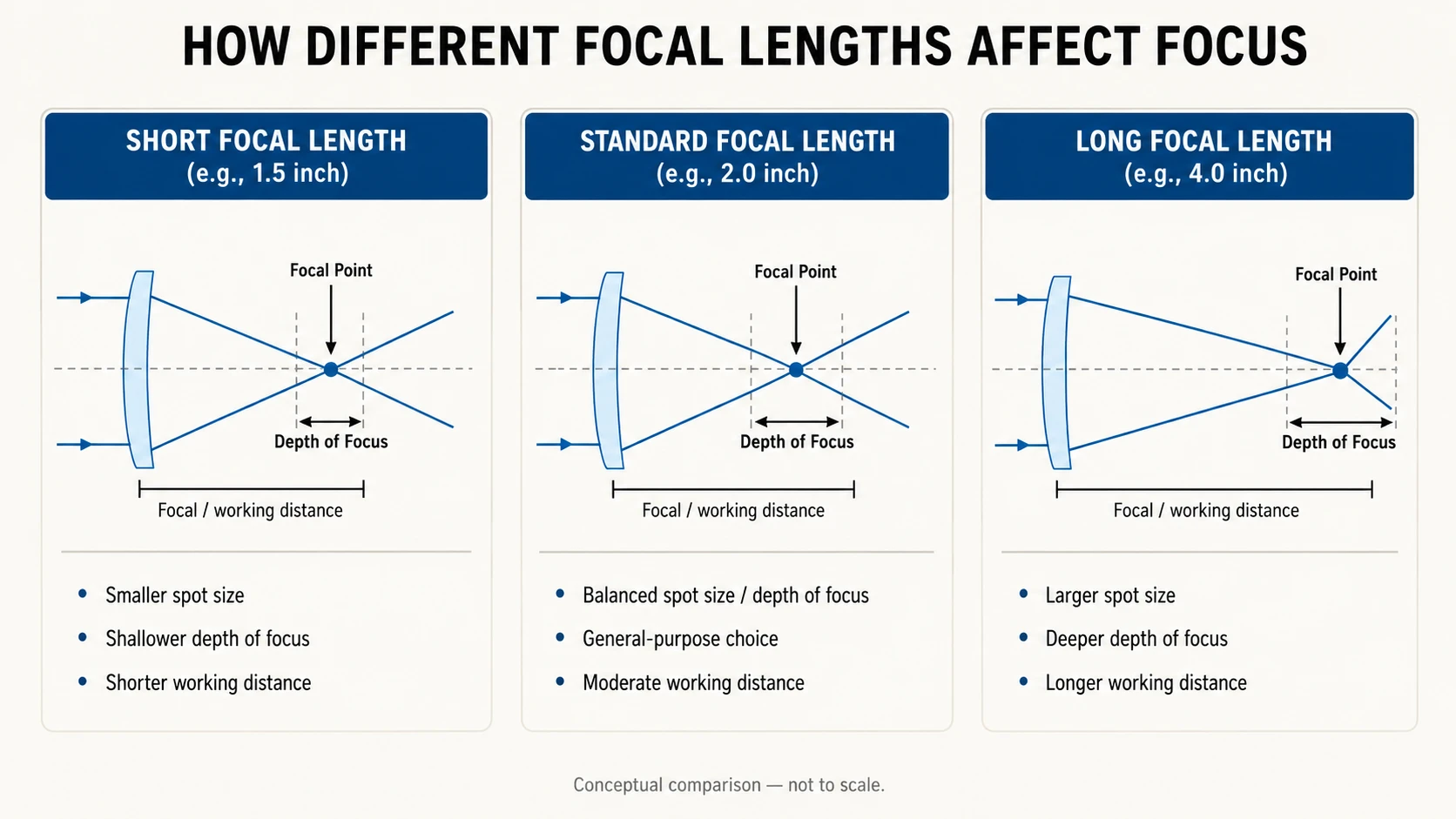
Focal length affects laser spot size, engraving detail, and cutting depth.
Shorter focal length lenses, such as 1.5-inch or high-resolution lenses, create a smaller laser spot. This smaller spot provides higher power density and is better suited for fine details, photo engraving, and high-resolution work.
Longer focal length lenses, such as 2.5-inch and 4.0-inch lenses, provide a deeper focus and more working distance. They are mainly used for cutting thicker materials or processing surfaces that need more depth of field.
In general, smaller focal length lenses are better for extremely fine details, while larger focal length lenses are better for cutting thicker materials.
Shorter focal length lenses, including the 1.5-inch lens and high-resolution head, are useful when engraving requires very fine detail. Because the laser spot is smaller, the engraved image can appear sharper and more detailed.
However, a smaller spot can also make engraving lines more visible when working on larger areas. This may create a slightly rougher surface or less transparent color on some engraved materials.
Tip: If engraving lines are too pronounced, increasing the Z-axis offset can move the focus point away slightly and expand the laser spot for a smoother effect.
A 2.5-inch lens has a longer focal length than the standard lens. It offers deeper focus and a larger beam spot, making it useful for cutting thicker materials while still maintaining reasonable engraving performance.
The 4.0-inch lens has the longest focal length in this lineup. It provides the deepest focus and widest beam diameter. It is not typically used for standard engraving, but it is useful for specific jobs that need more working distance or a larger depth of field.
The best laser head depends on the result you want to achieve. For general engraving and cutting, the standard laser head is a practical everyday choice. For high-resolution photo engraving and fine details, a shorter focal length or high-resolution head is more suitable. For thicker materials, longer focal length lenses provide better cutting depth and working distance.
By matching the laser head to your material, focal distance, laser dot size, and desired effect, you can improve consistency, quality, and efficiency in your laser projects.
Need Help Choosing the Right Laser Head?
Contact Thunder Laser to find the right laser machine, laser head, and processing setup for your engraving and cutting applications.
Contact UsTalk To Our Experts Now!
Please leave your contact information so that we can serve you better.
LASER HEADS FAQS
FIND THE RIGHT LASER FOR YOUR NEXT PROJECT
Explore Thunder Laser solutions designed for different materials, workflows, and production needs.


 Stable & Consistent MachinesUnlimited ApplicationsRobust After-sales SupportFactory Direct Supply


