How to Choose Lenses for Laser Processing?
 2024-05-24
WHAT ARE YOU LOOKING FOR?
Search Across Products, Blog Posts, Support Content, And Resources.

How to Choose Lenses for Laser Processing?
2024-05-24

Choosing the right lens is an important part of laser processing. Different lens focal lengths can affect engraving detail, spot size, focus depth, cutting ability, and the final processing effect.
This guide explains common laser processing lens models, how to distinguish them, how focal length affects engraving and cutting, and what precautions to follow when changing lenses.
The distance between the center of the focus lens and the laser beam focal point is called the focal length. According to the different focal lengths of built-in focus lenses, laser processing lenses are commonly divided into four models: 1.5", 2.0", 2.5", and 4.0".
In general, 1.5", 2.0", and 2.5" lenses are mainly used for engraving and cutting applications, while 4.0" lenses are mainly used for cutting thicker materials.
| Lens Model | Main Use | Typical Advantage |
|---|---|---|
| 1.5" Lens | Detailed engraving and high-resolution photo engraving | Smaller spot size for finer engraving details |
| 2.0" Lens | General engraving and cutting | Balanced detail, uniformity, and versatility |
| 2.5" Lens | Large-area engraving and heat-sensitive materials | Larger spot size helps reduce heat concentration and material warping |
| 4.0" Lens | Cutting thicker materials | Deeper focus depth and stronger penetration ability |
For the Nova 2.0 series, the longer the focal length, the longer the lens barrel. This means the lens barrel length can help users distinguish different lens models.
For the Nova 2.5 series, different lens focal lengths can be identified by different colors when color identification is available.
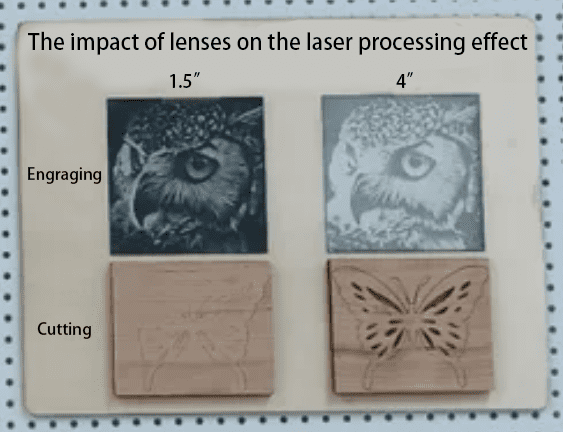
Correctly selecting the appropriate lens model is key to achieving the desired laser processing effect. A shorter focal length usually creates a smaller spot size, while a longer focal length usually creates a larger spot size, deeper focus depth, and stronger cutting ability.
The smaller the lens focal length, the smaller the spot size at the focal point. A smaller spot can produce finer engraving details under the same parameters, making photo engraving clearer.
For this reason, the 1.5" lens is more suitable for highly detailed, high-resolution photo engraving.
The 2.0" lens balances engraving detail and uniformity, making it one of the most versatile choices for engraving most materials. It is suitable for users who need a general-purpose lens for common engraving and cutting tasks.
When engraving larger areas, a very small spot may create obvious lines because the lens output may not overlap evenly. This can cause rougher image engraving effects or uneven whitening when engraving acrylic.
The 2.5" lens is suitable for reducing uneven large-area engraving issues on heat-sensitive materials such as plastics. Because it has a larger spot size, it can help prevent too much heat concentration at the focal point, reducing material warping during processing while still maintaining useful engraving precision.
Defocusing can also increase the laser spot size on the material surface without changing the lens, helping achieve more uniform engraving in some situations.
The larger the lens focal length, the larger the spot size at the focal point, the deeper the depth of focus, and the stronger the penetration ability. Therefore, using a lens with a longer focal length can help cut through thicker materials.
For materials thicker than 10 mm, a 4.0" lens is recommended for cutting.
Lens selection should be based on the processing goal. Cutting, detailed engraving, large-area engraving, and heat-sensitive material processing may require different focal lengths.
Simple rule: shorter focal length is better for fine details, while longer focal length is better for deeper focus and thicker cutting.
When changing lenses, safety and machine protection are important. Follow the precautions below before and during lens replacement.
Laser lens selection directly affects engraving detail, engraving uniformity, cutting thickness, focus depth, and processing stability. The 1.5" lens is suitable for fine photo engraving, the 2.0" lens is a versatile choice for common engraving work, the 2.5" lens is useful for larger engraving areas and heat-sensitive materials, and the 4.0" lens is recommended for cutting thicker materials.
Before changing lenses, stop laser operation, protect the platform area, and make sure the lens replacement process is safe. By matching the correct focal length to the application, users can achieve cleaner, more stable, and more predictable laser processing results.
Choose the lens based on your goal: fine engraving, general use, large-area engraving, or thick-material cutting. The right focal length can make a clear difference in the final result.
Talk To Our Experts Now!
Please leave your contact information so that we can serve you better.
LASER PROCESSING LENS FAQS
FIND THE RIGHT LASER FOR YOUR NEXT PROJECT
Explore Thunder Laser solutions designed for different materials, workflows, and production needs.


 Stable & Consistent MachinesUnlimited ApplicationsRobust After-sales SupportFactory Direct Supply