How to Choose Lasers for Laser Marking Machines?
 2024-05-16
WHAT ARE YOU LOOKING FOR?
Search Across Products, Blog Posts, Support Content, And Resources.

How to Choose Lasers for Laser Marking Machines?
2024-05-16

Laser marking offers fast marking speed, precise control, high yield, durable marks, minimal surface damage, low noise, and easy maintenance. It is gradually replacing traditional marking methods such as steel stamping, electrochemical marking, dot peen marking, mechanical engraving, electro-erosion, and inkjet printing.
Inside every laser marking machine, the laser source is one of the most important components. It generates and emits the laser beam, and its quality directly affects marking performance, processing stability, material compatibility, and final marking results. This guide compares three common laser types: fiber lasers, UV lasers, and diode lasers.
Fiber lasers, UV lasers, and diode lasers are commonly discussed in laser marking and engraving applications. Each laser type has a different working medium, wavelength range, beam quality, operating mode, and suitable application field.
| Laser Type | Basic Description | Typical Application Direction |
|---|---|---|
| Fiber Laser | Uses fiber as the working medium. Q-switched and MOPA lasers are both based on fiber laser technology. | Metal marking, industrial marking, commercial marking, and precision marking. |
| UV Laser | An ultraviolet laser named after its generated wavelength. It uses a solid-state laser. | Cold light marking, heat-sensitive materials, fine marking, packaging, glass, and plastics. |
| Diode Laser | Also called a semiconductor laser. Blue diode lasers are commonly discussed in small laser equipment. | DIY marking and engraving, portable applications, occasional use, and small-scale projects. |
A fiber laser usually uses diode excitation to stimulate rare-earth-doped fiber, generating the laser beam. Fiber laser sources are widely used because they can provide stable output and high beam quality.
A UV laser uses a solid working medium and generates laser light by optically exciting dopant laser-active ions within the solid medium. Its short wavelength makes it suitable for fine marking and applications that require limited thermal influence.
A diode laser uses a p-n junction structure. When the junction receives a suitable DC electrical signal, electrons and holes recombine and release photons. After enhancement by the resonator cavity, a laser beam is produced. In simple terms, a diode laser can directly convert electrical energy into light energy.
Fiber lasers, including Q-switched and MOPA types, usually output laser wavelengths around 1064 nm. This wavelength is in the near-infrared range and is well absorbed by many common metals, such as stainless steel, aluminum, and copper, making fiber lasers suitable for metal marking and engraving.
Fiber laser light is invisible to the human eye. Some laser systems combine visible red-light indication with the invisible laser path, allowing users to preview the processing area before marking. During actual laser processing, the machine cover should be closed to help ensure safety and avoid direct eye exposure.
UV lasers typically emit ultraviolet light at around 350 ± 5 nm. Their shorter wavelength can affect materials at the molecular level, producing minimal thermal effects. This makes UV laser marking suitable for many materials, especially heat-sensitive materials such as glass and thermoplastic plastics.
Diode lasers have a broader wavelength range, often between 400 and 2000 nm. Common laser processing wavelengths include 532 nm green light, 450 ± 5 nm blue light, and 405 nm violet light. These wavelengths are visible, but direct viewing is still dangerous because direct exposure to any laser can damage the eyes.
Laser beam quality is often measured by M². This value represents the ratio between the actual beam and an ideal Gaussian beam. The closer the M² value is to 1, the better the beam quality. Better beam quality means a smaller spot size, higher power density, and better processing quality.
Fiber lasers usually have high beam quality, with an M² value below 1.2. Their beam is close to an ideal Gaussian distribution, making them suitable for high-precision and high-resolution marking applications.
UV lasers also have high beam quality, often with an M² value below 1.2. Their short wavelength allows a very small focused spot on materials, which is useful for precise marking. However, UV laser beam quality may be affected by environmental factors such as temperature fluctuations and mechanical vibration.
Diode lasers typically have an M² value ranging from about 1.1 to 1.7. Their beam quality depends strongly on the laser structure and operating conditions. Low-power diode lasers often have better beam quality, while high-power diode lasers may have more variable and irregular beam shapes.
Based on emission mode, lasers can be divided into continuous-wave lasers and pulsed lasers. In the source comparison, fiber lasers and UV lasers are discussed as pulsed lasers, while diode lasers are discussed as continuous-wave lasers.
Continuous-wave lasers emit light continuously during operation, similar to water flowing from a pipe. Pulsed lasers emit light intermittently, releasing a certain number of laser pulses per unit of time, with no light between two pulses. Continuous-wave lasers usually have more obvious thermal effects, while some pulsed lasers have much lower thermal effects.
The emission mode of a laser is independent of its working medium and excitation method. For a specific laser device, users should confirm with the supplier whether it is continuous-wave, pulsed, or supports multiple output modes.
Pulsed lasers can emit a large number of laser pulses within one second. They have two important power-related parameters: average power and peak power. Average power measures output over one second, including both emitted pulses and intervals with no light. Peak power measures the instantaneous power during one pulse.
Peak power can be hundreds of times higher than average power. It is different from maximum power, which is commonly discussed for continuous-wave lasers. In MOPA marking machines, peak power can be indirectly controlled by adjusting parameters such as pulse width. Q-switched marking machines have non-adjustable pulse width, while MOPA marking machines allow adjustable pulse width.
Continuous-wave lasers emit light continuously. In some practical applications, continuous-wave lasers can modulate the laser output into pulsed light by adjusting the PWM signal, but the pulse energy is much lower than that of true pulsed lasers.
Laser power is usually measured in watts, while software settings may show power as a percentage. For example, a 30 W laser set to 20% power outputs about 6 W. The higher the output power, the greater the laser beam energy.
The processing time of diode laser cutting and engraving machines is usually much longer than that of laser marking machines. This is related to the motion system and maximum processing speed of the machine.
Small and medium-sized diode laser cutting and engraving machines usually cannot exceed 1000 mm/s. In comparison, laser marking machines can often reach maximum processing speeds above 2000 mm/s. This is because marking machines use a galvanometer system to move the laser beam quickly, while laser cutting and engraving machines use motors, rails, and transmission belts.
Q-switched and MOPA fiber laser marking machines can mark many metals, including brass, white copper, bronze, phosphor bronze, 304 stainless steel, mirror stainless steel, carbon steel, pure iron, galvanized iron sheet, zinc alloy, gold-plated zinc alloy, zinc, magnesium, nickel, aluminum, anodized aluminum, and titanium. They can also mark some non-metal materials such as PBT, PET, epoxy resin, PU leather, and slate, and can remove coatings from coated metals and painted ABS.
UV laser marking uses cold light marking technology and directly affects the molecular structure of materials with limited thermal impact. It is suitable for most materials except a few highly reflective metals, including metals, wood, plastics, and heat-sensitive materials such as glass and thermoplastics. It is also suitable for ultra-fine marking, such as marking food and medical packaging materials and micro-hole processing of silicon wafers.
Blue diode lasers can process wood, leather, paper, cardboard, opaque acrylic, stone, coated glass, coated ceramics, stainless steel, titanium, iron, and aluminum oxide. However, processing effects can vary significantly, especially when compared with dedicated marking machines.
Different laser wavelengths produce different effects on materials. UV lasers can provide high processing accuracy and are suitable for fine processing at the micron or even nanometer level. On some plastics, such as white beverage bottles, UV marking can create clear and vivid marks comparable to printing without causing pollution or material damage.
When engraving plastic products with fiber lasers, there is often little residue and the effect can be very good. In contrast, blue laser engraving may leave residue around pattern edges, creating a less clean effect. Blue laser engraving on acrylic may also be less obvious, while fiber lasers can create clearer and brighter patterns on acrylic.
For metal marking, fiber lasers usually create clear, precise, and high-quality marks on most metal surfaces. Blue laser engraving machines can engrave metals, but the engraving depth may be uneven, color marking quality may be unstable, and thermal effects may cause metal deformation. For this reason, blue laser metal engraving is more suitable for DIY than commercial applications.
Q-switched and MOPA fiber lasers both commonly use a 1064 nm wavelength, but their marking performance differs. Q-switched machines can achieve black and white marking on some metals and stable color marking on titanium plates. MOPA machines can achieve all marking functions of Q-switched machines and can also provide richer marking colors, including black marking on anodized aluminum and stable color marking on stainless steel.
Laser marking machine processing effects reference video
Fiber lasers generally have a long service life, usually exceeding 20,000 to 30,000 hours. Some suppliers of Q-switched fiber lasers claim that their lasers can last up to 100,000 hours. UV laser lifespan can exceed 20,000 hours. Actual lifespan depends on operating conditions, environment, and maintenance.
Diode laser lifespan is about 10,000 hours, but some diode lasers may not reach the expected lifespan. Since diode lasers often need to operate at high power to achieve satisfactory results, long-term high-power operation can accelerate component aging, reduce output power, increase failure risk, and affect stability.
Laser machines generate heat during prolonged operation. Without proper heat dissipation, unstable laser output and reduced beam quality may occur. Laser marking machines generally use air cooling for heat dissipation.
Air cooling is simple to install and maintain, and it is convenient for integrated machine design. However, it may not dissipate heat as efficiently as water cooling and is mainly suitable for small and medium-sized laser equipment. Fan cooling may also produce noise, which should be considered if the working environment needs to stay very quiet.
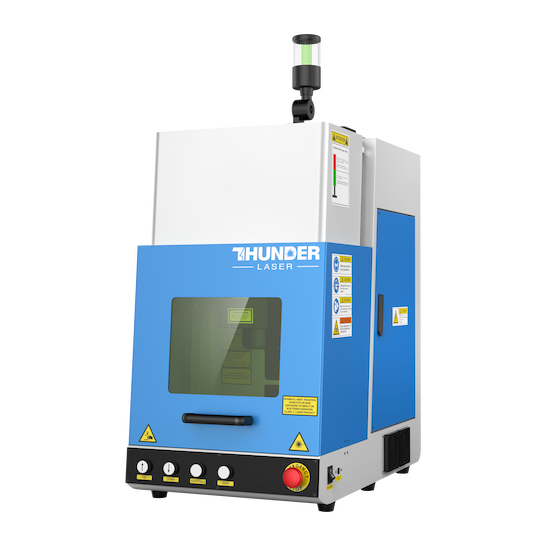
According to the source article, the Aurora series Q-switched laser machine weighs 71 kg, the MOPA laser machine weighs 76 kg, and the UV laser machine weighs 92.5 kg.
Diode lasers have a simpler structure, high efficiency, and compact size, making them lightweight. They are commonly used in handheld machines and other small-scale applications in the non-metal laser marking field.
When choosing a laser, users should consider specific processing needs, budget constraints, material types, required marking effect, production scale, and equipment usage environment. Each laser type has its own suitable application scenarios.
Fiber laser marking machines offer advantages such as long lifespan and low maintenance cost, making them suitable for commercial and industrial applications. Q-switched laser marking machines provide basic marking functions and can mark metals, some non-metals, logos, and crafts.
MOPA laser marking machines can achieve all marking functions of Q-switched laser marking machines. In addition, MOPA machines can create richer colors, black marking on anodized aluminum, and stable color marking on stainless steel. Their marking effect is finer, smoother, and more suitable for precision processing.
UV laser marking machines are suitable for industrial applications where product information such as production dates, batch numbers, and traceability codes must be marked immediately after production. UV cold light marking performs well on plastic packaging for food, daily necessities, and electrical appliances.
UV marking can create good visual effects without ink pollution, packaging puncture risks, excessive heating, or toxic and harmful substances caused by thermal processing. UV laser marking machines are also used in fine processing fields such as flexible circuit boards and translucent button manufacturing.
Diode lasers are suitable for various small-scale applications, but they have limitations in beam quality, short pulse capability, thermal effect control, application range, power, and processing speed. Compared with fiber lasers, diode lasers are less suitable for commercial metal marking.
Their advantages are lower cost, compact size, easier transport, and flexible use. They can appeal to users who only use lasers occasionally, do not require mass production, have limited space, or need to move machines frequently, such as street vendors or DIY users.
| Laser Type | Best For | Main Limitation |
|---|---|---|
| Fiber Laser | Metal marking, commercial use, industrial marking, and precision applications. | Different fiber laser types have different color marking and pulse control capabilities. |
| UV Laser | Heat-sensitive materials, packaging, glass, plastics, and fine marking. | Beam quality and performance may be more affected by environmental factors. |
| Diode Laser | DIY users, occasional projects, portable use, and small-scale applications. | Processing speed, beam quality, and commercial marking performance are more limited. |
Choosing the right laser for a laser marking machine depends on the materials you plan to process, the required marking effect, production requirements, budget, and working environment. Fiber lasers are strong choices for metal marking and commercial use, UV lasers are suitable for cold light marking and heat-sensitive materials, and diode lasers are more suitable for DIY or occasional use.
For users who need durable, precise, and efficient marking, fiber and UV laser marking machines usually provide stronger overall performance than diode laser engraving machines. For users who prioritize portability and low cost, diode lasers may still be a practical entry-level choice.
For laser marking machine selection, start with your material and final marking goal. Metal marking, color marking, heat-sensitive packaging, and DIY projects often require different laser technologies.
Talk To Our Experts Now!
Please leave your contact information so that we can serve you better.
LASER MARKING MACHINE
LASER SELECTION FAQS
Start by confirming the material, required marking effect, production volume, budget, and workspace conditions. Choose fiber lasers for many metal marking tasks, UV lasers for cold light and heat-sensitive applications, and diode lasers for lower-cost or portable DIY use.
FIND THE RIGHT LASER FOR YOUR NEXT PROJECT
Explore Thunder Laser solutions designed for different materials, workflows, and production needs.


 Stable & Consistent MachinesUnlimited ApplicationsRobust After-sales SupportFactory Direct Supply