




How to Choose Lasers for Laser Cutting Machines?
 2024-05-20
WHAT ARE YOU LOOKING FOR?
Search Across Products, Blog Posts, Support Content, And Resources.

How to Choose Lasers for Laser Cutting Machines?
2024-05-20

In today’s non-metal processing field, laser cutting and engraving machines have become a new generation of productivity tools because of their powerful functions and wide application range. Inside every laser machine, the laser source is one of the most important components because it generates and emits the laser beam.
The quality of the laser source directly affects the performance, processing speed, cutting ability, engraving detail, and long-term stability of the laser cutting and engraving machine. This guide compares three common laser sources: CO2 glass tube lasers, RF lasers, and diode lasers.
A CO2 glass tube laser has a tubular appearance. Its main components, including the discharge tube, water cooling tube, gas storage tube, and gas return tube, are made from hard glass materials. For this reason, it is often simply called a glass tube laser.
A CO2 RF tube laser is commonly abbreviated as an RF tube because its excitation method uses radio frequency AC excitation. Compared with glass tube lasers, RF tubes are more compact and are often selected for applications that require finer engraving and long-term stable operation.
A diode laser, also known as a semiconductor laser, uses a semiconductor diode structure as its core working component. In this article, diode laser mainly refers to the blue diode laser commonly used in small desktop or open-frame laser machines.
| Laser Source | Basic Description | Typical Direction |
|---|---|---|
| CO2 Glass Tube Laser | A DC-excited CO2 laser source made with glass tube components. | Cost-effective cutting and engraving for many non-metal materials. |
| CO2 RF Laser | A radio-frequency-excited CO2 laser source with compact metal tube construction. | Fine engraving, stable output, long service life, and higher-end applications. |
| Diode Laser | A semiconductor laser source, often used in compact desktop or DIY laser machines. | Occasional use, small projects, mobile operation, and entry-level applications. |
The working medium of a glass tube laser is a mixed gas of carbon dioxide, nitrogen, and helium. Laser generation usually uses DC excitation. Direct current excites carbon dioxide molecules from a low energy level to a high energy level, and when the molecules return to a lower energy level, they emit photons. This process repeats continuously and outputs a laser beam.
The auxiliary gases improve laser efficiency. Nitrogen helps transfer energy and supports the transition of carbon dioxide molecules to higher energy levels, while helium accelerates thermal relaxation and helps carbon dioxide molecules return to lower energy levels more quickly.
The working principle of an RF laser is similar to that of a glass tube laser because both use carbon dioxide gas as the working medium. The difference is the excitation method. An RF laser uses a high-frequency electric field generated by an RF power source to excite carbon dioxide gas molecules and produce laser output.
A diode laser uses a p-n junction structure formed by semiconductor materials. When an external DC signal reaches a certain intensity, electrons recombine with holes and release photons. These photons are amplified by the resonant cavity to produce a laser beam. In simple terms, a diode laser can convert electrical energy directly into light energy.
Different laser sources output different wavelengths depending on their working medium and structural design. CO2 lasers, including glass tube and RF tube lasers, typically output wavelengths around 9–10 μm. This range is useful for processing many non-metallic materials because wood, plastics, fabrics, and similar materials can effectively absorb mid-infrared light.
Common CO2 laser wavelengths include 9.3 μm, 10.2 μm, and 10.6 μm. A 9.3 μm laser can be suitable for materials such as polyimide film, polycarbonate, and PET. A 10.2 μm laser can be suitable for polypropylene. A 10.6 μm laser is suitable for many common non-metallic materials.
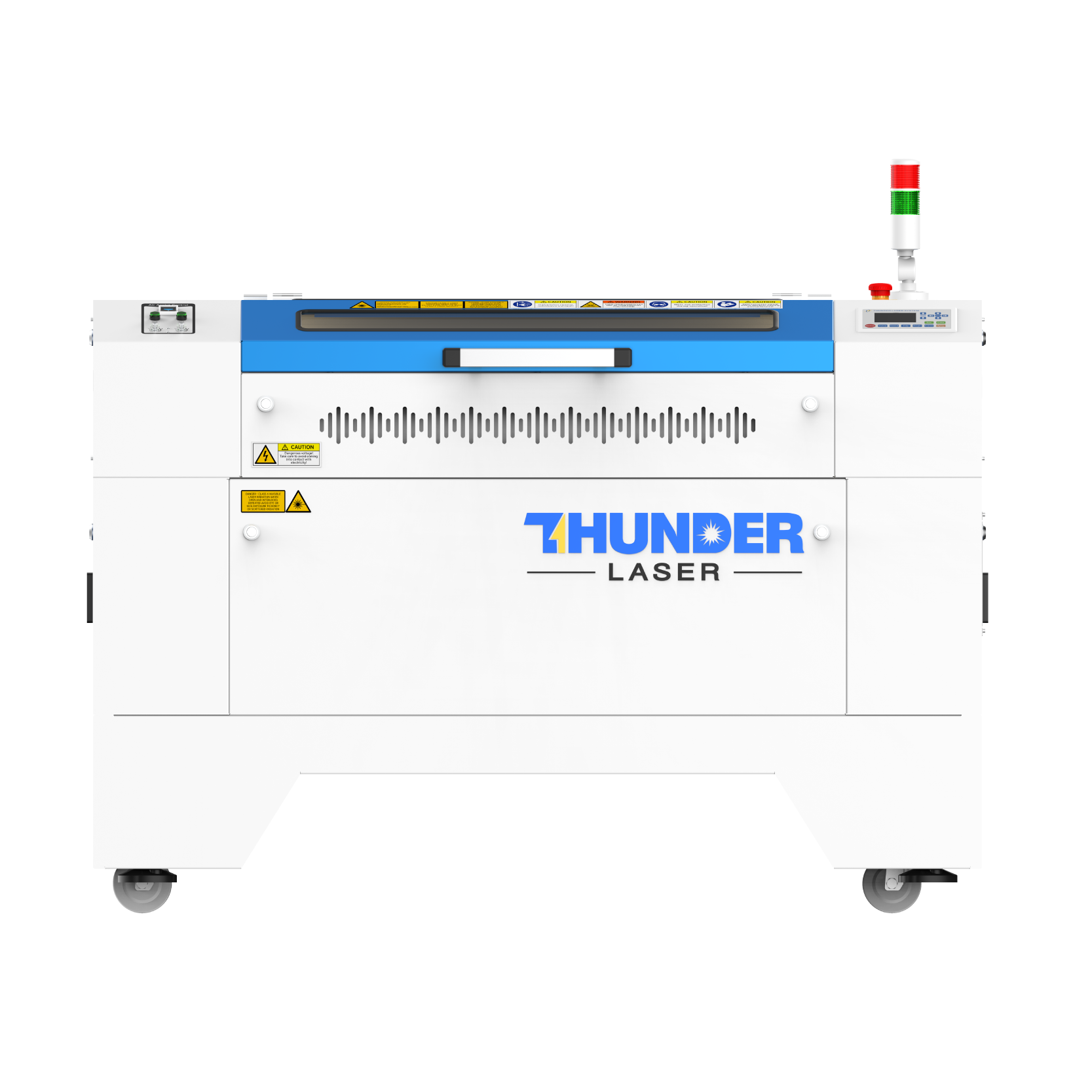
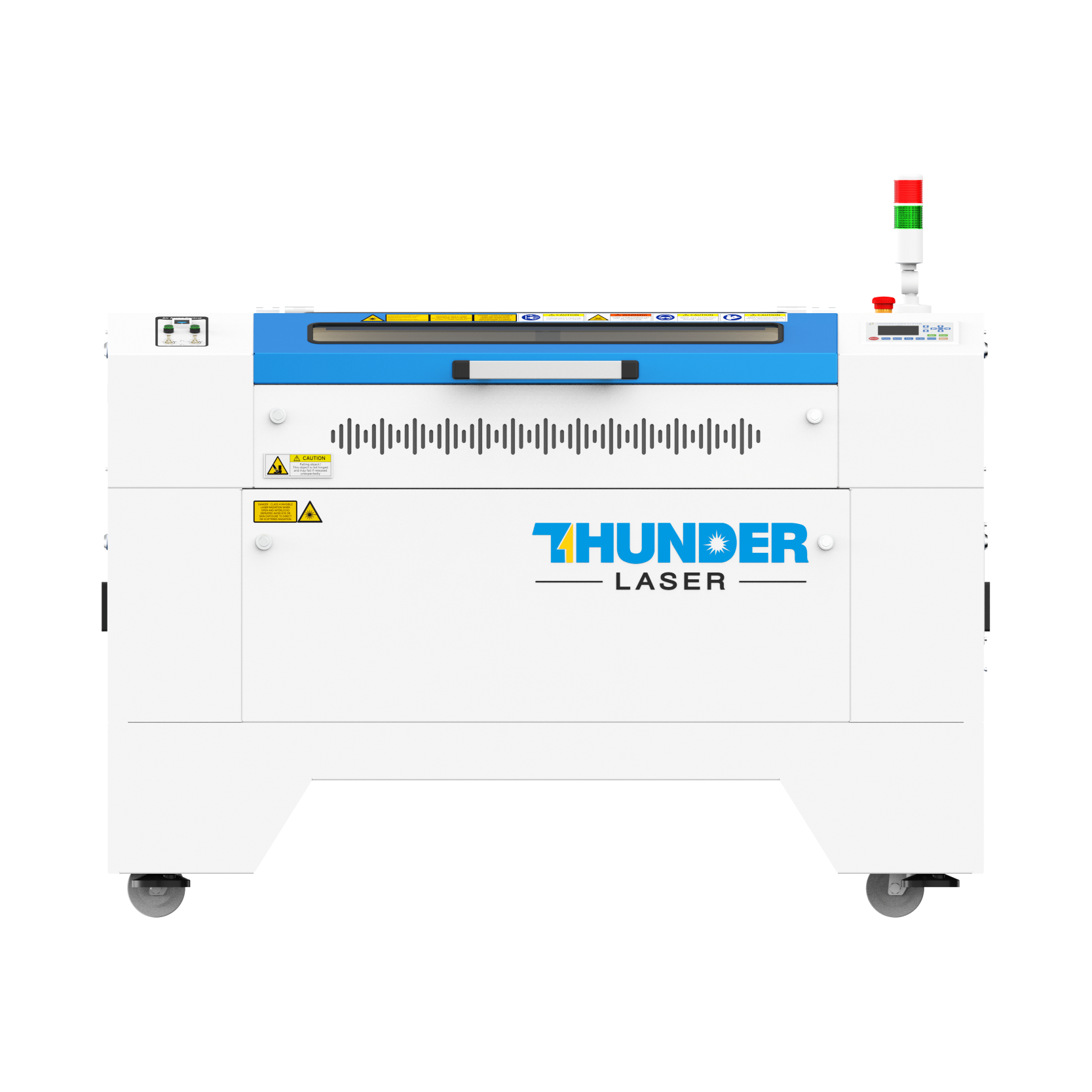
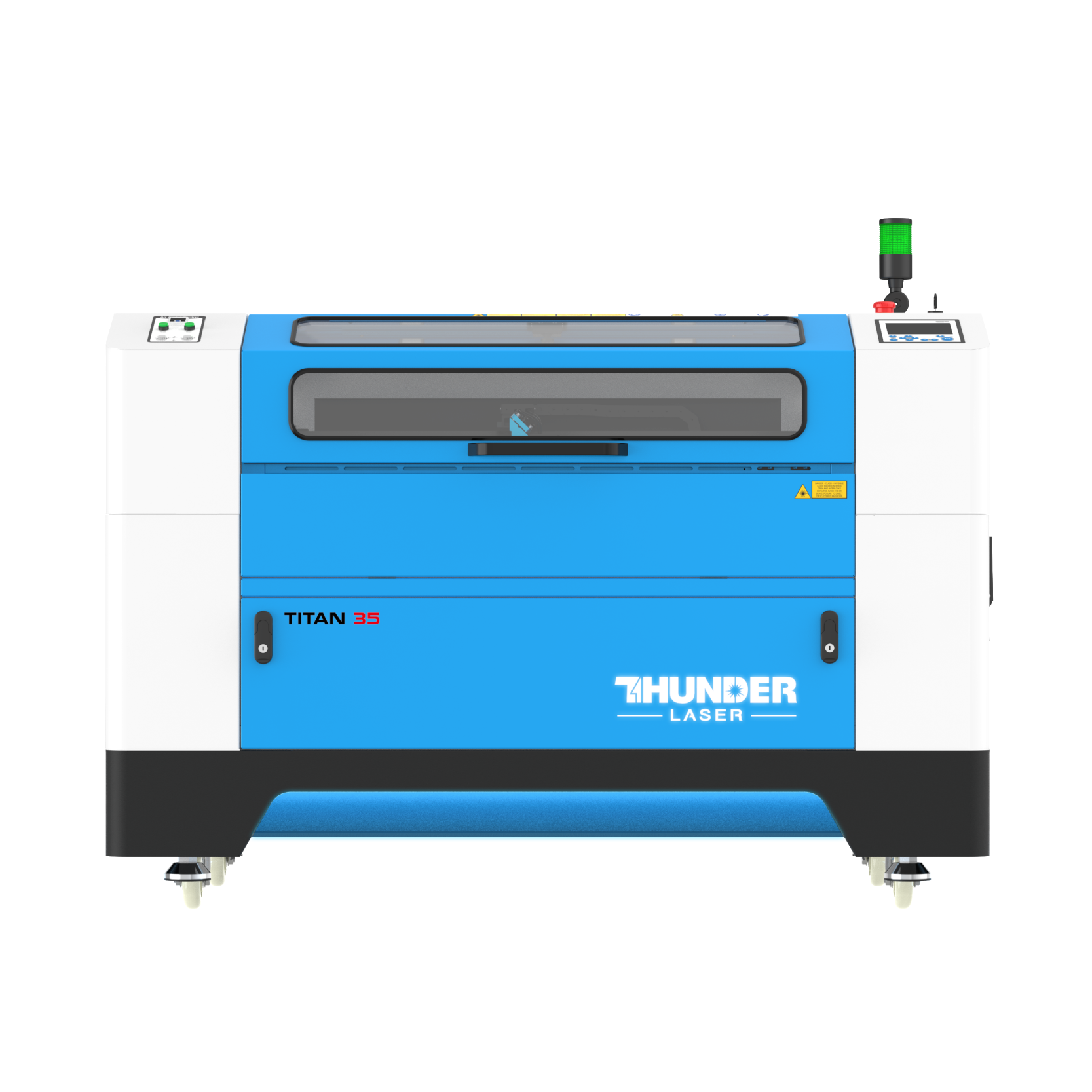
Thunder Laser cutting and engraving machines use a 10.6 μm CO2 laser source, which supports a wide range of applications, including wood, acrylic, ABS, paper, fabric, leather, bricks, and more. By changing the modulation frequency, it can also process special materials such as polyimide film.
Because CO2 laser light is invisible to the human eye, Thunder Laser combines visible red indicator light with the invisible laser path through a focusing lens. Users can click the frame button before processing to observe the moving red light and confirm the processing area. During actual laser processing, the cover must be closed for safety, and users should never look directly at the laser.
Diode lasers have a wider wavelength range, typically between 400 and 2000 nm. Common processing wavelengths include 532 nm green light, 450 ± 5 nm blue light, and 405 nm violet light. Although these wavelengths are visible, direct viewing is still unsafe and can damage the eyes.
In general, the longer the laser path and the more reflecting mirrors used, the greater the laser loss. In small and medium-sized laser equipment, CO2 glass tube and RF tube lasers usually use three reflecting mirrors to change the light path and output a laser beam perpendicular to the processing platform.
This design is needed because CO2 laser sources are relatively large and cannot be placed directly inside the laser head. By contrast, diode lasers are small and can often be placed directly inside the laser head. A single diode laser beam usually needs zero or one reflecting mirror for transmission.
Laser beam quality directly affects cutting and engraving quality. It is commonly measured by M², which compares the actual beam with an ideal Gaussian beam. The closer the M² value is to 1, the better the beam quality. Better beam quality means a smaller focused spot, higher power density, better processing efficiency, and better detail.
In commercial small and medium-sized laser cutting and engraving machines, CO2 lasers generally have better beam quality than diode lasers. CO2 lasers typically have an M² value between 1.1 and 1.3, while diode lasers typically range from 1.1 to 1.7.
CO2 lasers use a gas mixture as the gain medium, which is more uniform and stable than the semiconductor materials used in diode lasers. CO2 laser structures also support a better transverse mode that is closer to an ideal Gaussian profile.
RF tube lasers usually provide better beam quality and smaller spot sizes than glass tube lasers. This makes RF tubes especially useful for very fine engraving and applications where stable, delicate processing is required.
Cathode sputtering refers to a phenomenon where positive ions in plasma collide with the cathode under high voltage, causing cathode material to be sputtered out. The sputtered material can deposit on other surfaces, causing contamination of the laser cavity, electrode gap changes, and other problems that affect lifespan, output stability, and laser quality.
Cathode sputtering is more noticeable in glass tube lasers due to factors such as cathode material, design structure, and overheating when cooling is insufficient during continuous operation. RF tube lasers reduce this issue through their cathode material and packaging structure, resulting in more stable performance and longer service life.
Diode lasers typically do not involve traditional cathode sputtering because their operation is based on solid-state semiconductor materials rather than gas discharge.
The processing time of diode lasers is usually much longer than that of CO2 laser tubes. When processing the same product, the processing time of a diode laser is generally about three times that of a CO2 laser tube, especially during cutting.
This difference is related to maximum output power and maximum processing speed. Small and medium-sized diode laser machines often use 10–20 W laser sources, with a few models reaching above 40 W, while their maximum processing speed usually does not exceed 1000 mm/s.
In comparison, CO2 laser tubes in small and medium-sized laser machines usually start above 30 W and can reach hundreds of watts, while maximum processing speed can reach 1000 mm/s or even 2000 mm/s. Higher power allows the machine to achieve the same result at a faster speed and with fewer processing cycles.
CO2 lasers can process wood, leather, paper, cardboard, fabric, transparent and opaque acrylic, stone, glass, ceramics, anodized aluminum, and coated metals. Diode lasers can process wood, leather, paper, cardboard, opaque acrylic, stone, coated glass, coated ceramics, stainless steel, titanium, iron, and aluminum oxide.
Glass tube lasers are effective for cutting many non-metallic materials, including paper, wood, bamboo products, acrylic, rubber, and other materials. They are often selected when users need stronger cutting ability at a relatively lower cost.
RF lasers perform especially well in non-metal engraving. Their beam shaping and polarization characteristics support more delicate and uniform processing effects. Beam shaping can adjust the spot size and shape, improving energy distribution during processing, while linear polarization can help reduce energy loss when processing certain reflective materials.
Diode lasers can also engrave and cut non-metal materials, but because their power is generally lower, they are more suitable for cutting thin materials and shallow engraving. For thicker materials, multiple passes are often required, which may increase processing errors.
If you need to cut thick materials, perform deep engraving, or complete processing in the shortest possible time, a CO2 laser is usually the more suitable choice because it can provide higher power and stronger single-pass processing ability.
CO2 glass tubes cannot be refilled and reused, so their service life is shorter than RF laser tubes, generally ranging from 2,000 to 4,000 hours. With a good working environment and proper maintenance, glass tubes may last longer. Thunder Laser provides a 1-year warranty for glass tube lasers.
CO2 RF tubes have stable performance and do not require special maintenance. They can be refilled and reused, and their service life can exceed 10,000 hours. Thunder Laser provides a 2-year warranty for RF tubes.
Diode lasers have a service life of approximately 10,000 hours, but some diode lasers may not reach their rated lifespan. Because diode lasers often need to run at high power or even 100% power for long periods, component aging, output power reduction, failure risk, and stability issues may increase over time.
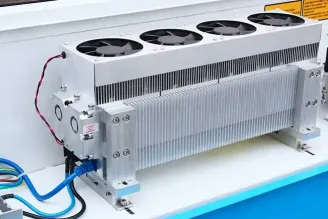
Prolonged laser operation generates heat, which can cause unstable laser output and reduced beam quality. For this reason, laser equipment requires a cooling system. Glass tube lasers generally use water cooling, while RF tube lasers and diode lasers commonly use air cooling.
Water cooling is quiet and effective, making it suitable for high-power laser equipment. However, installation and maintenance are more complex because an additional cooling system is required. Water cooling can also be affected by freezing in low-temperature environments, and overheated cooling water may reduce cooling performance.
Air cooling is easier to install and maintain, and it supports more integrated machine designs. However, it is mainly suitable for small and medium-sized equipment because cooling efficiency may be lower than water cooling. Cooling fans may also produce noise.
To reduce fan noise for air-cooled RF tubes, Thunder Laser uses an intelligent fan speed control board. The fan automatically adjusts among four speed levels based on processing power, helping reduce unnecessary noise when the machine is idle or running at lower power.
For glass tube lasers, tube length is positively related to maximum output power. Higher output power requires a longer glass tube because a longer discharge tube provides a longer laser medium.
High-power RF tube lasers are larger than low-power RF tubes, but their compact sealed design makes them much smaller than glass tubes. RF tubes are made of metal, so they are heavier than glass tube lasers, but they are also more compact and durable in structure.
Diode lasers have a simple structure, high efficiency, and compact size. They are the lightest among the three laser source types and are commonly used in small desktop machines or simpler open-frame machines.
CO2 laser machines are typically enclosed in a cabinet and pre-assembled at the factory. They are tested before delivery to ensure that the equipment can function properly, making them easier for beginners and users without a technical background.
Diode laser machines are often shipped as components and require customer assembly. This requires more technical knowledge and hands-on ability. For DIY users, self-assembly can be part of the experience, but it also increases setup time and difficulty.
Diode laser users may also need to purchase optional components such as honeycomb platforms and exhaust pumps to achieve better performance. These components are often included by default with CO2 laser machines.
When choosing a laser source, users should consider application needs, budget, material types, precision requirements, processing speed, working environment, and maintenance expectations. Each laser source has its own advantages and limitations.
Glass tube lasers are relatively low-cost compared with other laser types. They are suitable for users with limited budgets, startups, and low-cost projects. They can provide strong cutting performance for many non-metal materials.
However, glass tube beam quality is not as strong as RF tube beam quality. Their output response speed is relatively slower, and they cannot operate well at low power, which limits some high-precision processing applications.
RF lasers offer advantages such as compact size, easy maintenance, low operating cost, high beam quality, and long service life. Their smaller size supports more compact equipment design, and their stable output makes them suitable for high-precision and long-term use.
In non-metal laser engraving, RF lasers are often preferred for fine engraving effects. Whether processing wood, acrylic, leather, fabric, or paper, RF lasers can create precise and clear engraving results, making them suitable for users who require premium engraving quality.
Diode lasers are suitable for various small-scale applications but have limitations in beam quality, short pulse operation, temperature effects, power, processing speed, and material range. Compared with CO2 lasers, they are less suitable for fast or deep processing of many non-metal materials.
Their advantages are low cost, portability, and flexibility. They can be attractive for users who only use lasers occasionally, have limited space, need mobile operation, or work on small low-volume projects.
| Laser Source | Best For | Main Limitation |
|---|---|---|
| CO2 Glass Tube Laser | Budget-friendly cutting and engraving for many non-metal materials. | Shorter service life and less fine engraving performance than RF tubes. |
| CO2 RF Laser | Fine engraving, stable output, long-term use, and high-end non-metal processing. | Higher initial cost than glass tube lasers. |
| Diode Laser | DIY projects, occasional use, portable work, and entry-level laser applications. | Lower power, slower processing speed, and more limited material performance. |
Choosing the right laser source for a laser cutting machine depends on the materials you process, the thickness you need to cut, the engraving quality you expect, your budget, and how often the machine will be used. CO2 glass tube lasers are suitable for cost-effective cutting and general non-metal processing, while RF lasers are better for fine engraving, long service life, and stable high-quality results.
Diode lasers can be useful for small, portable, and occasional projects, but they are usually slower and less powerful than CO2 laser sources. For users who need efficient cutting, deep engraving, or consistent production, CO2 laser sources are generally the stronger choice.
For laser cutting machine selection, start with the material and final effect. Choose glass tube lasers for budget-friendly cutting, RF lasers for premium engraving and long-term stability, and diode lasers for lightweight DIY or occasional work.
Talk To Our Experts Now!
Please leave your contact information so that we can serve you better.
LASER CUTTING MACHINE LASER SOURCE FAQS
FIND THE RIGHT LASER FOR YOUR NEXT PROJECT
Explore Thunder Laser solutions designed for different materials, workflows, and production needs.


 Stable & Consistent MachinesUnlimited ApplicationsRobust After-sales SupportFactory Direct Supply