


Aluminum Laser Engraving Materials, Settings, Tips, and Machine Guide
 2026-09-16

Bolt-Serie
Professionelle Lasergraviermaschine für hochpräzise Ergebnisse

Nova-Serie
Großformat-CO₂-Laserschneider mit Glasröhre

Nova Plus-Serie
Professionelle RF-CO₂-Laserschneidmaschine

Titan-Serie
Industrielles RF-CO₂-Lasersystem

Titan Pro-Serie
Industrielles Lasersystem mit RF-CO₂- und MOPA-Faserlaser


WAS SUCHEN SIE FÜR?
Suche über Produkte, Blog-Beiträge, Support-Inhalte und Ressourcen.

Aluminum Laser Engraving Materials, Settings, Tips, and Machine Guide
2026-09-16

Aluminum is widely used in industrial parts, electronics, signage, tools, promotional products, nameplates, gifts, and personalized accessories. Its light weight, durability, corrosion resistance, and clean metallic finish also make it one of the most common metals used for laser marking and engraving.
However, not all aluminum surfaces behave the same under a laser. Bare aluminum, anodized aluminum, painted aluminum, and powder-coated aluminum require different laser sources and parameter strategies. A fiber laser can mark or engrave bare aluminum directly, while CO₂ lasers are generally better suited to anodized or coated aluminum surfaces.
Quick Answer: Yes, aluminum can be laser engraved and marked. For bare aluminum, a fiber or MOPA fiber laser is generally the preferred choice. Anodized aluminum can be processed with fiber, MOPA, or compatible CO₂ laser systems depending on the desired result. CO₂ lasers are particularly useful when the goal is to remove or modify an anodized, painted, or coated surface rather than directly engrave bare aluminum.
This guide explains how different aluminum surfaces respond to laser energy, which laser machines are suitable, what settings to use as starting references, and how to improve contrast, detail, consistency, and engraving depth. For a broader overview of metal processing, see the Metal Laser Engraving and Cutting Guide and the Metal Laser Engraving & Marking Application Guide.
Yes. Aluminum can be laser marked, etched, or engraved, but the result depends heavily on the surface finish and laser source. Before selecting settings or a machine, first determine whether the material is bare aluminum, anodized aluminum, painted aluminum, or another coated aluminum product.
Bare aluminum is best processed with a fiber laser because its wavelength is well suited to direct interaction with metal surfaces. Depending on power, frequency, scan speed, line spacing, focus, and number of passes, a fiber laser can create white or light marks, identification codes, logos, fine graphics, and material-removal engraving.
For applications such as serial numbers, barcodes, QR codes, product identification, tools, industrial components, and custom metal products, a fiber laser is generally the most practical starting point.
When more control over pulse behavior, contrast, surface appearance, or material removal is required, a MOPA fiber laser offers a wider processing window. To understand the difference, see Fiber vs. MOPA Laser Marking.
Anodized aluminum has a controlled oxide layer on its surface. Depending on the anodizing process, dye, color, thickness, and laser source, laser energy can alter or remove part of this surface layer to create visible contrast.
This is why anodized aluminum is widely used for laser engraved tags, equipment labels, control panels, business cards, product plates, personalized accessories, and photo panels. Dark anodized colors often produce especially clear contrast when the laser reveals or modifies the lighter surface beneath.
Fiber and MOPA fiber lasers work well for anodized aluminum, while compatible CO₂ systems can also produce clean surface engraving by interacting with the anodized layer. This makes anodized aluminum one of the most versatile aluminum materials for laser personalization.
Painted and powder-coated aluminum are typically processed by removing or modifying the coating rather than deeply engraving the aluminum substrate itself. This can reveal the metal beneath and create strong visual contrast.
CO₂ lasers can be effective for this type of coating-removal workflow, while fiber lasers may also be used depending on the coating composition, thickness, required contrast, and desired surface effect.
Because commercial coatings vary significantly, always identify the coating and verify that it is safe for laser processing before production.
| Aluminum Surface | Recommended Laser | Typical Process | Common Results |
|---|---|---|---|
| Bare Aluminum | Fiber / MOPA Fiber | Direct marking or engraving | White marks, identification, logos, fine engraving, deeper material removal |
| Anodized Aluminum | Fiber / MOPA / CO₂ | Surface modification or anodized-layer removal | High-contrast text, logos, photos, serial numbers, decorative designs |
| Painted Aluminum | CO₂ / Fiber depending on coating | Coating removal or surface marking | High-contrast graphics, labels, signs, identification |
| Powder-Coated Aluminum | CO₂ / Fiber depending on coating | Coating removal | Logos, text, control panels, branded products |
Different aluminum finishes require different laser sources and processing strategies.
Aluminum laser engraving and marking demonstration.
Aluminum is already widely used in commercial and industrial products, so laser processing can add identification, branding, personalization, or decorative value without requiring mechanical tooling.
Fiber laser marking is well suited to fine graphics, small text, serial numbers, barcodes, QR codes, and other detailed identification elements. Because the process is digitally controlled, artwork can be changed quickly without manufacturing new physical dies or cutting tools.
This is particularly useful for industrial traceability, electronics, customized tools, personalized products, and variable-data marking.
When the laser modifies the metal surface or removes part of an anodized or coated layer, the design becomes part of the processed surface rather than an applied sticker or printed layer.
This makes laser-marked aluminum useful for parts and products that require long-lasting identification. Actual durability still depends on the engraving method, coating, outdoor exposure, abrasion, chemicals, and service environment.
Laser engraving is a non-contact process. The laser beam processes the surface without a cutting tool physically pressing against the aluminum.
This reduces mechanical force on thin components and eliminates cutting-tool wear during engraving. Proper fixturing is still important to keep the part stable and maintain consistent focus.
The same workflow can be used for a single customized nameplate or a batch of serialized production parts. Names, numbers, QR codes, logos, graphics, and identification information can be changed digitally between jobs.
For a practical example, see the Laser Marking Aluminum Pen tutorial.
The best machine depends first on the aluminum surface and desired result. Bare-metal marking and engraving require a different laser source from many coating-removal applications, so machine selection should start with the process rather than simply comparing wattage.
For a broader product-selection framework, see How to Choose the Best Thunder Laser Machine.
The Thunder Laser Aurora Series is the primary choice for direct aluminum marking and engraving. Fiber and MOPA fiber laser sources can interact directly with metal, making the series suitable for aluminum tags, components, logos, serial numbers, barcodes, QR codes, branded products, tools, accessories, and industrial identification.
Within the Aurora Series, the right option depends on the result and workflow:
Rather than assuming MOPA is automatically better for every aluminum job, choose it when its additional pulse control or processing capability is actually needed. Standard fiber remains a practical solution for a large range of routine aluminum marking tasks.
| Application Need | Recommended Direction | Why |
|---|---|---|
| Logos, text, serial numbers, QR codes | Aurora Lite / Fiber | Suitable for straightforward direct metal marking |
| Frequent positioning and repeated production | Aurora Fiber | More complete camera, autofocus, and positioning workflow |
| Advanced black marking on anodized aluminum | Aurora MOPA | More flexible pulse-width and frequency control |
| Deeper aluminum engraving | Aurora MOPA | Better suited to demanding material-removal workflows |
Aurora selection should be based on marking effect, workflow, and processing depth.
If your workshop mainly processes non-metal materials but also needs to engrave anodized or compatible coated aluminum, the Bolt Series provides an RF CO₂ workflow that can process these treated aluminum surfaces.
The important distinction is that a standard CO₂ laser is not the primary tool for direct engraving of bare aluminum. Its aluminum role is mainly tied to anodized, painted, coated, or otherwise treated surfaces where the laser modifies or removes the surface layer.
This makes Bolt relevant for personalized plates, coated tags, anodized signs, control panels, photo plates, and mixed-material workshops that also work with wood, acrylic, leather, paper, and other CO₂-compatible materials.
For current anodized aluminum CO₂ starting parameters, use the Thunder Laser CO₂ Laser Settings Library.
The best aluminum depends on whether the priority is direct metal marking, visual contrast, decorative personalization, or deeper engraving. Surface treatment can have as much influence on the final appearance as the base aluminum alloy.
Bare aluminum is the logical choice when you want to mark the actual metal rather than remove a coating. It is commonly used in components, machined parts, product identification, industrial tags, tools, hardware, electronics, and engineering applications.
Use a fiber or MOPA fiber laser for direct processing. Since aluminum alloys and finishes vary, polished, brushed, cast, machined, and textured aluminum may all require different settings.
Anodized aluminum is one of the easiest aluminum products to use when strong visual contrast is the main goal. The anodized surface is available in many colors and can be processed into logos, photographs, names, patterns, serial information, and graphics.
It is especially popular for:
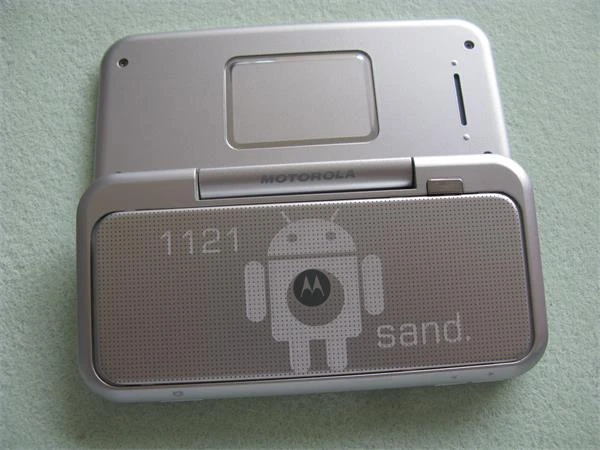
Laser engraved anodized aluminum products with high-contrast surface marking.
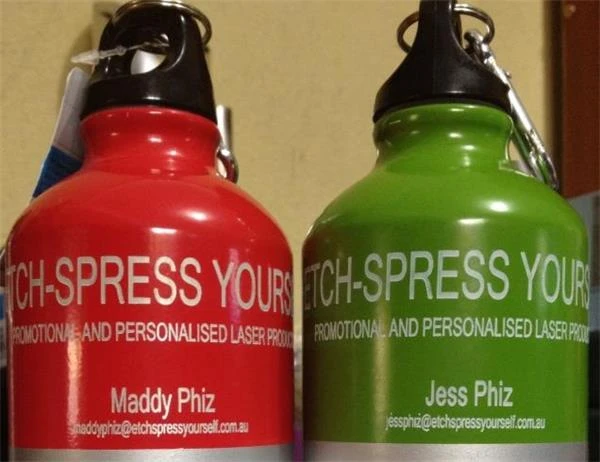
Laser engraved anodized aluminum bottle with personalized surface graphics.
Both fiber and suitable CO₂ lasers can process anodized aluminum, but they interact with the surface differently. Always test the exact anodizing color and finish rather than assuming one parameter will work across all anodized products.
Painted and powder-coated aluminum is useful when the goal is to reveal the underlying metal and create high contrast. Applications include equipment panels, labels, signage, cases, branded products, control panels, and promotional items.
Coating composition matters. Unknown coatings should be identified before laser processing, and adequate exhaust should be used whenever the process produces fumes or particulate residue.
Many commercial aluminum products arrive with a finish already applied, including pens, bottles, cards, electronic housings, flashlights, tools, tags, and promotional products.
Do not assume every black, colored, or metallic-looking surface is anodized. Some products are painted, powder-coated, plated, lacquered, or covered with another decorative finish. Identifying the surface first can save considerable testing time.
Because aluminum combines low weight, durability, and a professional metallic appearance, it is suitable for both industrial identification and premium personalization.
Fiber lasers can produce serial numbers, part numbers, QR codes, barcodes, Data Matrix codes, equipment information, and traceability marks on aluminum components.
These applications are common in manufacturing, electronics, tools, machinery, automotive components, fixtures, and product identification workflows.
Anodized or coated aluminum is widely used for control panels, machine labels, warning plates, electrical labels, room signs, equipment tags, and branded nameplates.
Laser processing provides a flexible way to produce both fixed graphics and variable information without changing physical tooling between designs.
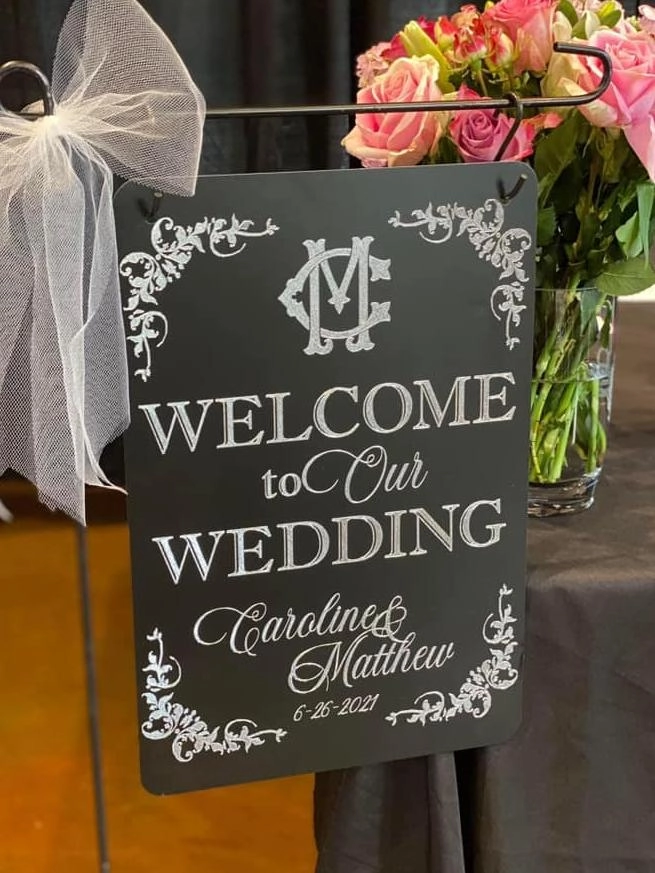
Laser engraved aluminum advertising board for signage and branded display applications.
Aluminum pens, keychains, bottle openers, business cards, tags, wallets, flashlights, drinkware, accessories, and promotional products can be customized with names, dates, messages, logos, and graphics.
This is useful for personalization businesses because individual designs can be changed quickly while maintaining the same basic marking workflow.
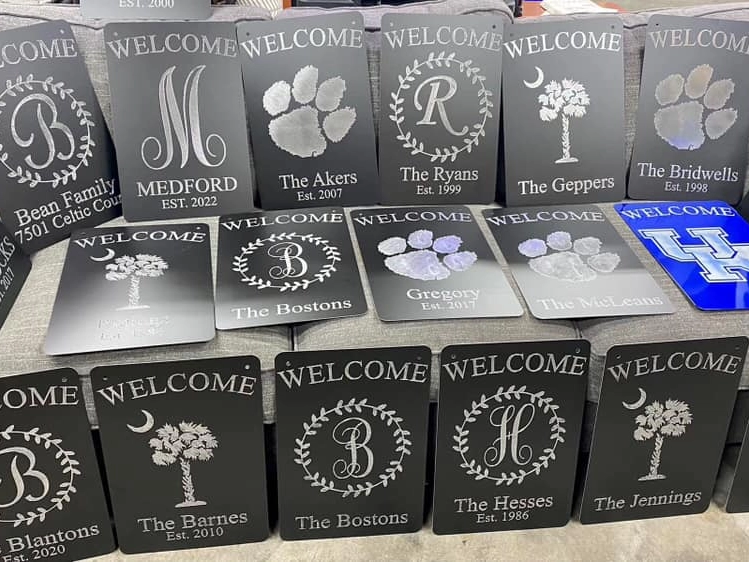
Laser engraved aluminum invitations for personalized events and premium stationery.
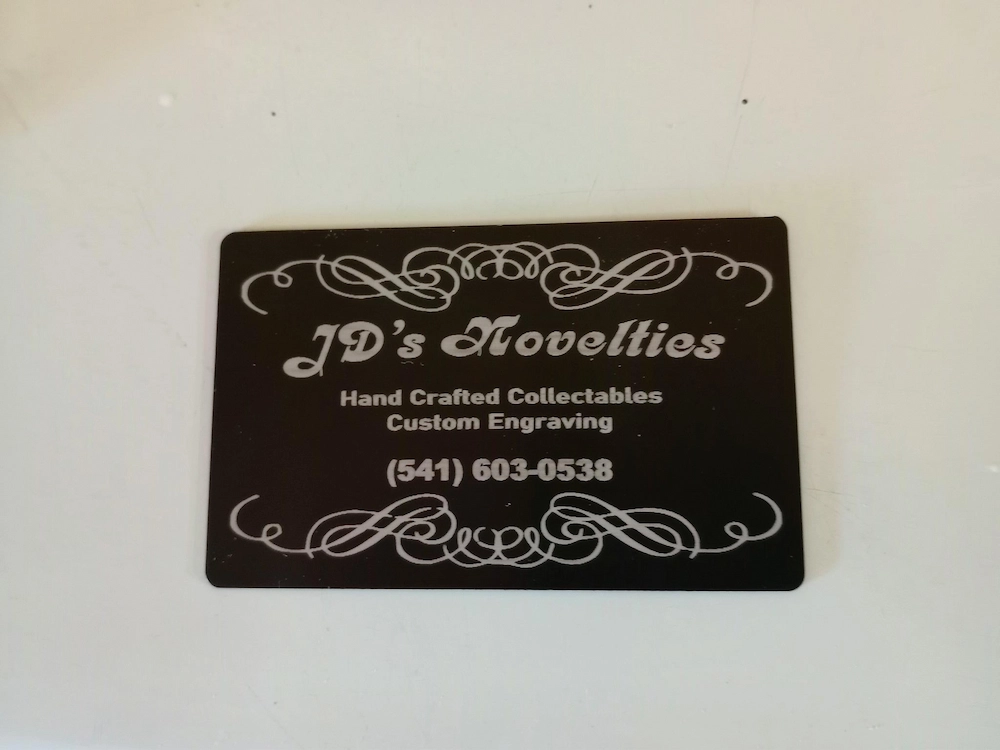
Laser engraved aluminum business card with high-contrast personalized graphics.
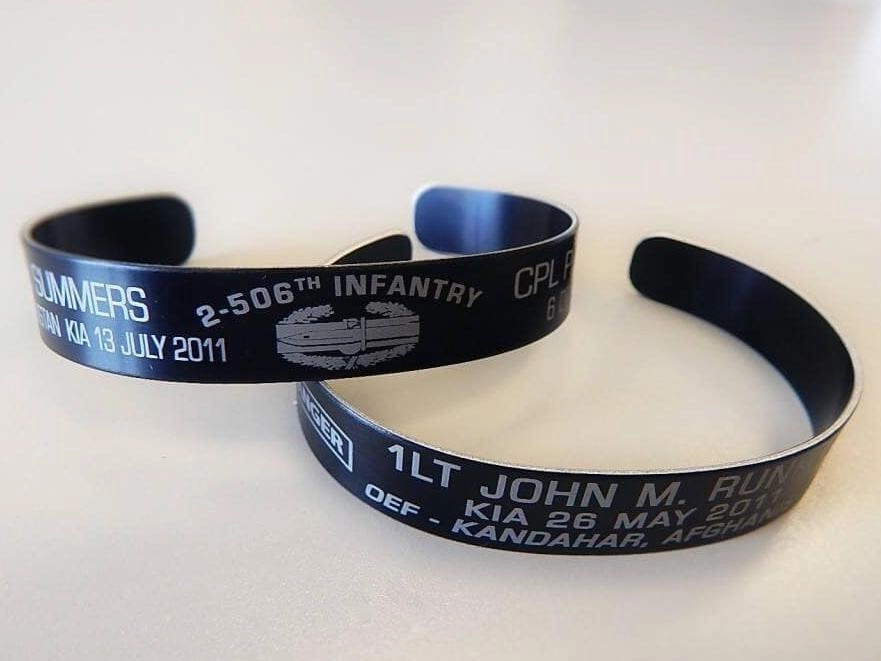
Laser engraved aluminum bracelet for customized gifts and accessories.
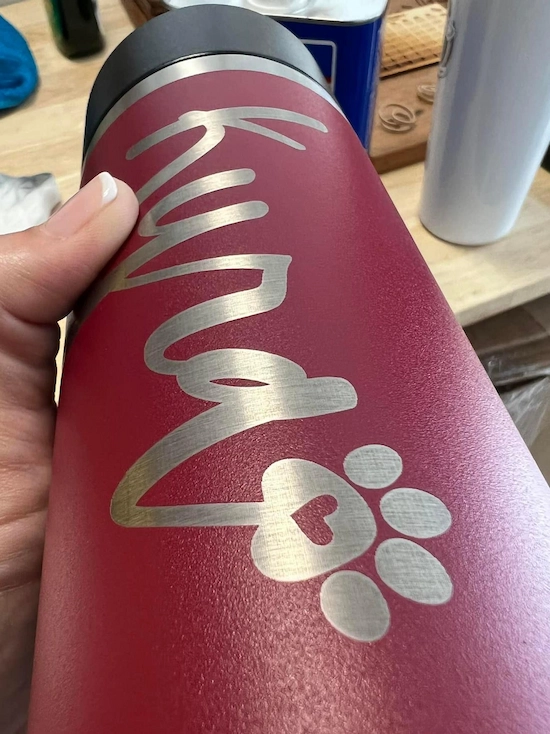
Laser engraved aluminum tumbler for personalized drinkware and promotional products.
Anodized aluminum can produce detailed photographic and graphic effects when the image is prepared correctly and the contrast between processed and unprocessed areas is strong enough.
Photo engraving usually requires more parameter and image-preparation testing than simple text or logos. Resolution, dithering, line spacing, surface color, focus, and engraving strategy all influence the final image.
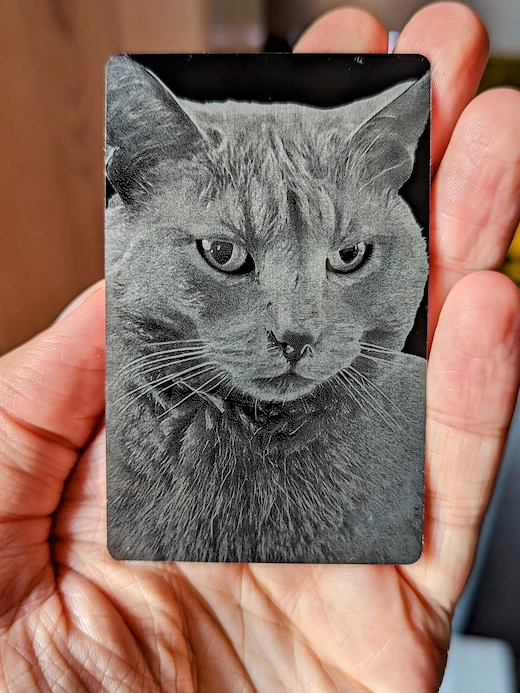
Laser engraved aluminum photo showing detailed grayscale and decorative image reproduction.
Aluminum is widely used for electronic enclosures, control boxes, laptop and device housings, instrument panels, switch plates, and industrial cases. Laser marking can add logos, model information, connection labels, serial numbers, compliance information, and operating instructions.
There is no universal aluminum laser setting. Alloy composition, anodizing, coating, surface finish, color, laser source, lens, focal position, desired contrast, engraving depth, fill strategy, and machine configuration can all change the required parameters.
The following settings are current Thunder Laser starting references. They should be used as baselines for testing rather than guaranteed final production settings.
| Material | Result | Speed | Power | Frequency | Fill Mode | Line Interval | Passes |
|---|---|---|---|---|---|---|---|
| Aluminum | White Mark | 3500 mm/s | 80% | 50 kHz | Bi-directional | 0.02 mm | 1 |
Aurora Lite 50W fiber starting reference for a white mark on aluminum.
| Material | Process | Speed | Power | Air Assist | DPI | Lens |
|---|---|---|---|---|---|---|
| Anodized Aluminum | Engraving | 1000 mm/s | 50% | Low | 350 | 2" |
Bolt 30W RF CO₂ starting reference for anodized aluminum engraving.
MOPA fiber lasers provide additional pulse-width and frequency control, so a single generic parameter set would not represent the full range of possible results. Black marking, surface contrast, shallow engraving, deeper material removal, and different anodized finishes may require substantially different combinations.
Start with a controlled material test and change parameters systematically. For a foundation in parameter relationships, see the Laser Parameters Setting Guide, Laser Power Guide, and Laser Processing Speed Guide.
Do not start by asking only what wattage the aluminum needs. First determine whether you have bare aluminum, anodized aluminum, painted aluminum, or another coated product.
This decision determines the correct laser source and makes parameter testing far more efficient.
Fingerprints, cutting oil, dust, polish, adhesive residue, and other surface contamination can cause inconsistent marks.
Clean the engraving area with a material-compatible method and allow it to dry completely before processing. Avoid cleaners that leave an oily or protective film.
Correct focus is especially important for fine text, QR codes, photos, and detailed graphics. If the workpiece is tilted, curved, or positioned at inconsistent heights, line quality and contrast can change across the design.
Use a fixture when processing repeated parts. Stable positioning improves repeatability and reduces setup time for batch production.
Two pieces that both look like “black anodized aluminum” may use different alloys, anodizing thicknesses, dyes, or coatings. A setting that works perfectly on one supplier's material may produce a weaker result on another.
Run a test grid on the actual production material before a large batch. Start with a verified baseline and vary speed, power, frequency, line interval, pulse width, or passes according to the laser source.
Increasing power is not always the best solution for a weak aluminum mark. Speed determines dwell time, frequency affects pulse behavior, line interval changes energy overlap, and multiple passes can increase material removal without relying on one aggressive pass.
With MOPA systems, pulse width introduces another important variable. For advanced aluminum effects, parameter balance matters more than simply maximizing power.
If deeper engraving is required, multiple controlled passes may provide better results than forcing maximum material removal in a single pass.
Monitor heat buildup, debris, focus, and surface quality between passes. Deep engraving requirements should be tested on the exact aluminum alloy before committing to production.
Paint, powder coating, anodizing dyes, marking compounds, and other surface treatments can generate fumes or residue during processing.
Confirm the coating composition and use appropriate exhaust. Avoid processing materials with unknown or unsafe surface treatments until their composition has been verified.
Once you find a reliable setting, document more than just “aluminum.” Record the alloy or product, supplier, finish, anodizing color, laser source, lens, focus, speed, power, frequency, pulse width where applicable, line interval, passes, and final result.
Building a material-specific parameter library improves repeatability and reduces unnecessary testing when repeat orders arrive.
If you are unsure how your aluminum product will respond, Thunder Laser also offers a Material Testing Service for evaluating compatibility, processing results, machine selection, and recommended starting settings.
Aluminum is highly suitable for laser marking and engraving, but successful processing starts with understanding the surface. Bare aluminum is best approached with fiber or MOPA fiber technology, while anodized, painted, and coated aluminum can provide additional options, including compatible CO₂ laser workflows.
For routine aluminum logos, serial numbers, QR codes, and industrial identification, the Aurora Series provides a direct fiber-laser solution. When advanced pulse control, black anodized-aluminum marking, or deeper engraving is required, Aurora MOPA provides a broader processing window. For workshops already using CO₂ technology, Bolt can process compatible anodized and coated aluminum surfaces without positioning CO₂ as a direct bare-aluminum engraving solution.
Whatever machine you use, begin with verified reference settings, test the actual aluminum surface, and adjust parameters according to the desired contrast, depth, and production requirement. This approach produces more reliable results than relying on one universal “aluminum setting.”
Sprechen Sie jetzt mit unseren Experten!
Bitte hinterlassen Sie Ihre Kontakt informationen, damit wir Ihnen besser dienen können.
WOOD LASER ENGRAVING
& CUTTING FAQS
The new Bolt Series has been upgraded with faster engraving speeds (up to 2000 mm/s), higher RF power options (up to 80W), larger working areas, improved Z-axis height, and Standard dual-air assist. We also added a recessed tray design for larger rotary objects and included new accessories such as a conical nozzle.
The new Bolt Series has been upgraded with faster engraving speeds (up to 2000 mm/s), higher RF power options (up to 80W), larger working areas, improved Z-axis height, and Standard dual-air assist. We also added a recessed tray design for larger rotary objects and included new accessories such as a conical nozzle.
The new Bolt Series has been upgraded with faster engraving speeds (up to 2000 mm/s), higher RF power options (up to 80W), larger working areas, improved Z-axis height, and Standard dual-air assist. We also added a recessed tray design for larger rotary objects and included new accessories such as a conical nozzle.
The new Bolt Series has been upgraded with faster engraving speeds (up to 2000 mm/s), higher RF power options (up to 80W), larger working areas, improved Z-axis height, and Standard dual-air assist. We also added a recessed tray design for larger rotary objects and included new accessories such as a conical nozzle.
The new Bolt Series has been upgraded with faster engraving speeds (up to 2000 mm/s), higher RF power options (up to 80W), larger working areas, improved Z-axis height, and Standard dual-air assist. We also added a recessed tray design for larger rotary objects and included new accessories such as a conical nozzle.
BRAUCHEN SIE HILFE BEI DER WAHL DER RICHTIGEN LÖSUNG?
Unser Team berät Sie bei der Auswahl der passenden Maschine, zu Ihren Anwendungen und mit Support, der auf Ihre Anforderungen abgestimmt ist.

 Stable & Consistent MachinesUnlimited ApplicationRobust After-sales SupportFactory Direct Supply


